Don’t Lose Sight of Your Water Level with Cloudy Gage Glass
Enabling a gage glass on vital applications to become cloudy or neglected to the point that an operator is unable to determine the water level is unacceptable.
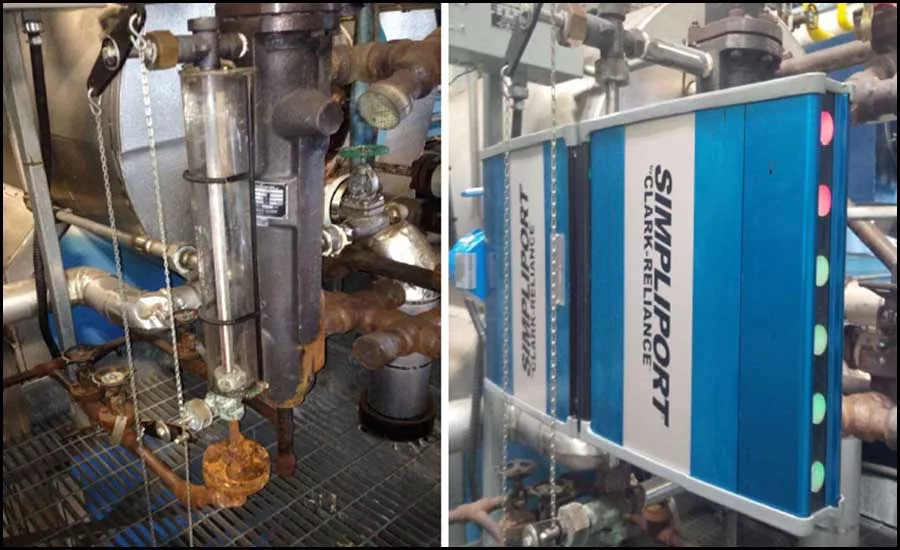
Figure 1. An example of clouded tubular glass replaced with a ported-type glass assembly. Images courtesy of Clark-Reliance
Operators know the importance of monitoring the water level information on boilers, deaerators, feedwater tanks, blowdown tanks, and condensate tanks in their plants. We observe many level gages on boiler installations that are meticulously and properly maintained with excellent service life.
However, enabling a gage glass on these vital applications to become cloudy or neglected to the point that an operator is unable to determine the water level is unacceptable. A gage glass is required on every power boiler that is constructed to meet the American Society of Mechanical Engineers (ASME) Boiler and Pressure Vessel Code. The purpose of the gage glass is to provide a ready, visual determination of the water level at the boiler. The gage glass may also serve as a referee to resolve a dispute between multiple level transmitters they are not displaying similar level indications.
If you experience service life issues with the gage glasses on your boiler applications, there may be an underlying cause. The following concerns and suggestions may be beneficial.
1. Conducting excessively long blowdowns on a gage glass or related water column may have a negative effect on the life of this instrumentation. We suggest the maximum duration for gage blowdowns should be 20 seconds. This is sufficient time to observe the water level drop out of the gage and blow through the drain. When we learn about applications subjected to excessive blowdowns on these instruments, it has often led to more maintenance. This includes shortened glass life and increased maintenance on the isolation and drain valves. If steam and water valves are “gate” type, be sure to operate with them fully open. This reduces wear on the valve internals.
2. A lack of insulation on the interconnecting piping between the drum and level instrument can result in an excessive amount of condensate formation. The continuous flow of excess condensate may cause premature wear inside the gage. The addition of insulation on this piping reduces the adverse effects of excess condensation and loss of heat.
3. Waiting too long to service a gage glass in a neglected condition may result in an inability to read the level (see Figures 1 and 2). If prompt attention to make repairs is ignored, there is a risk for steam cuts or damage to occur on the gage chamber.
4. The use of incorrect or obsolete maintenance procedures may be an issue. Over time, manufacturers may update their gasketing and sealing materials. This can result in revised torque specifications. It’s always advisable to review the instructions with the replacement parts or check the OEM’s website for accuracy. Also, as a standard practice, glass should never be reused after it has been removed from a previously assembled gage. Used glass may have flaws that are not obvious with a casual inspection. The glass used in these instruments has been ground, polished, and must be handled with care.
Many low-pressure boilers operating under 250 psi (16 Bar) utilize tubular glass and boilers under 350 psi (24 Bar) and commonly use a reflex (prismatic) type glass, which is constructed from tempered borosilicate glass. The steam and water are in direct contact with the inner side of these type of glasses without any protection. While most applications serve operators very well, some installations may be problematic. Premature wear may also be attributed to excessive particulate in the water from a lack of boiler blow downs or incorrect water treatment.


It may be helpful to consult with boiler manufacturers when it comes to their water quality recommendations. Personnel and process changes should also be evaluated if they correlate to shorter than historical gage life.
There are options for higher-pressure-rated gage glasses that can significantly reduce or eliminate these issues. Some users opt to install a mica-protected flat glass or ported type of gage. While these gages have higher installation costs, the benefit of reduced maintenance can be substantial. The example in Figure 1 illustrates an installation where the user was replacing the tubular glass every few months until the ported gage was installed.
Now, they have operated maintenance-free for more than two years. It’s important to know that illumination is required for ported-type gages to create distinguished colors for water and steam.
On applications operating above 350 psi (30 Bar), transparent flat glass or ported-type gages are used. In Figure 2, you see an example of a severely neglected gage. This gage should have been repaired long before it ever got to this condition. Figure 3 illustrates a well-maintained gage that is properly illuminated, and the water level is very easy to read. Section VII of the ASME Boiler Code recommends illumination on any gage that is more than 7 feet (2-plus meters) above the grade or platform. This aids the operator and improves installation safety by preventing the use of a ladder or stool to read the water level.
In addition to boiler applications, examine the feedwater, condensate tanks, blowdown tanks, and deaerators for level gage readability and safety. Installing an alternative armored gage or other instrument may be safer than relying on a caution sign behind a tubular glass in a walkway (see Figure 4).
In summary, prompt attention must be given to remedy any concerns with boiler level-indicating instruments, the related piping, isolation and drain valves, insulation, and illumination. For assistance with any installation requirements, consult with a local jurisdiction inspector, insurance carrier, the instrument OEM, and/or plant personnel.
Looking for a reprint of this article?
From high-res PDFs to custom plaques, order your copy today!