Can Integrated Cooling Panels Cover All Specs, and Will They Work for Your Next Project?
Integrated cooling towers deliver benefits throughout the design and installation process — benefits that extend across the life cycle of the unit.
In the world of HVAC installs in commercial buildings, multi-device control configurations are often the norm when it comes to cooling and airflow. While they provide the comfort and functionality a building’s occupants need, they are often far from ideal when it comes to installation, maintenance, and overall finished aesthetic. Multiple loads must feed into multiple boxes, and all of these materials must be mounted to a wall, in a utility area, or on a roof. A licensed electrician must assemble the components, ensuring all parts are installed correctly and are compatible — a process that can take time and add to the system’s cost. While the result might meet spec, it can result in a cluttered and disorganized system that’s difficult to maintain. Since multiple manufacturers often supply materials, those materials might appear compatible on paper but not align as expected. Then, one must consider repairs. Troubleshooting problem areas can lead to additional wasted time: Which control device is causing the issue? Which manufacturer will supply the parts? Calling for support also means multiple points of contact: Manufacturer A directs you to manufacturer B, which directs you back to manufacturer A or manufacturer C, D, or E.
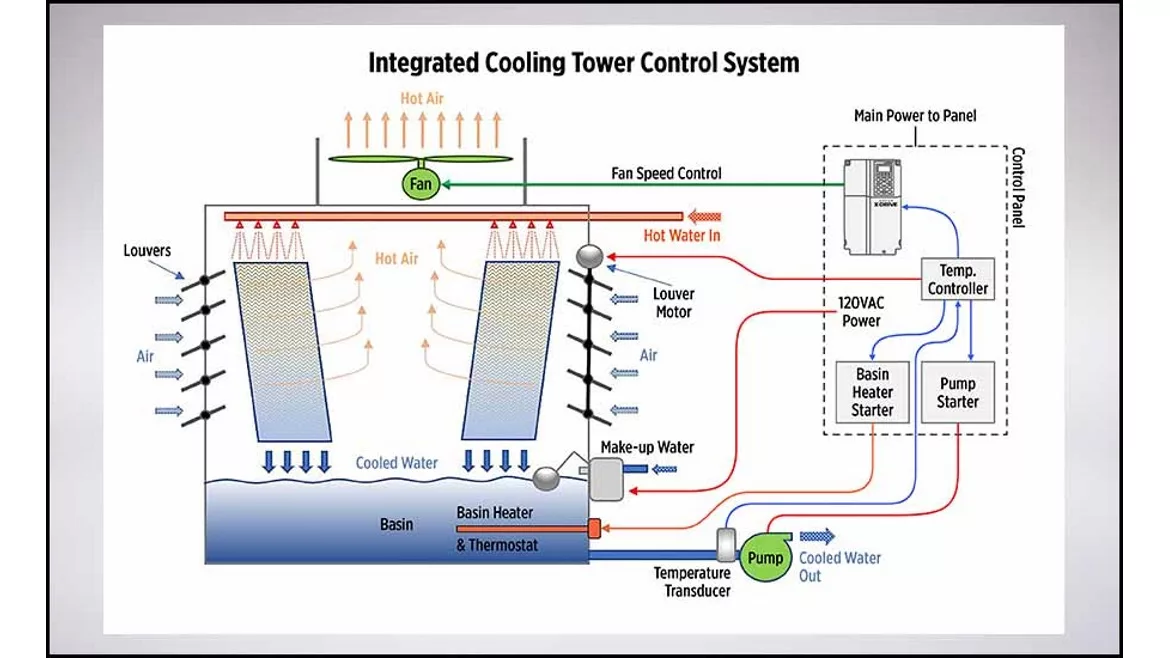
If any of these situations sound familiar, an integrated cooling tower panel could provide a smarter solution. These units, which consist of a drive, pump starter, basin heater starter, and a temperature controller in built-to-spec configurations, can accommodate high-horsepower systems. They serve as a single-point power control panel that drives the entire tower regardless of the complexity and combine what is typically handled by multiple control devices all within a single, standard panel. These units are not only more compact and streamlined, they are also delivered from a single manufacturer and engineered and preassembled to spec. They offer a host of additional benefits that electrical engineers, building owners, electricians, and maintenance personnel can appreciate — from initial spec throughout the life cycle of the product.

Optimized System Design and Engineering
Imagine driving a car where the engine is built by three different car manufacturers and assembled at your local mechanic’s shop. How confident would someone feel behind the wheel? In many ways, multi-device HVAC control systems are built in this way: Many parts from different suppliers are all assembled on-site. In contrast, when an integrated cooling tower is used, it is configured with one supplier and all engineering and part building is done by that supplier. It is one set of engineers who only work on those components, so they know the parts that work together and how they work together best. The unit is custom-assembled to each project’s unique needs with a different combination of components and accessory configurations depending on the end use.
This raises another question: Can a single cooling tower control panel and its supplier cover all the various requirements that are written into project specifications? The answer is yes — with some slight modifications. Engineering experts at the manufacturer will work with a configurator to select the appropriate parts and generate a bill of materials. The control panel is built directly from this. It not only creates the engineered-to-order panel solution but also shifts the complexity of the build to the factory floor and out of the building’s utility room. Having complex connections and components built by the manufacturer that knows the product best reduces troubleshooting in the field.
All parts are also still UL and safety certified — as is the integrated unit. Opting for UL-listed industrial control panels helps ensure compliance against electrical codes. Ultimately, providing solutions that meet the minimum standards right from the start is key to successfully passing inspections and avoiding bleeding resources to rework installations to meet code, not to mention preventing downtime while you do so. The hard part is done, streamlining the installation.

Streamlined Installation and Footprint
With the entire panel built and assembled at the manufacturer, electrical installers can work with one panel and not have to worry about stringing conduits together. This leads to fewer connectivity and supply line issues. Instead of having multiple points of installation, where an electrician must thread power feeds coming from a utility into four or five boxes, there is only one. When using the panel's temperature controller, the number of control lines and conduits that are needed are further reduced.
This reduction in complexity cuts down on installation time and costs while also minimizing the chance for error. One installation variable to note: Because the distribution of the electrical load is taking place inside the panel, and only a single wire feeding into the panel, that wire must often be larger to accommodate the increased load. For this reason, integrated control systems should be taken into account during the planning phase of a building’s electrical system.
Consider also the physical and spatial differences between multiple wires leading to multiple boxes and one wire leading to one box. For anyone who has tried to wire a TV at home to speakers, plus an old-school DVD player — cord control has some aesthetic and spatial challenges. With an integrated cooling tower unit, all wires and connections are inside for a cleaner, easier-to-intuit appearance.
Continuing with the TV analogy, imagine an entertainment console packed with a TV and other devices taking up floor space versus a TV mounted on the wall. Integrated cooling towers also provide a visually cleaner appearance in less space and a smaller footprint on the wall or roof. When wall space is at a premium — as it always is in construction — integrated cooling towers can be housed in less space with fewer holes to drill for mounting hardware. Reducing the overall footprint gives systems engineers back space that they can allocate to other mission critical systems. It also reduces the complexity of the installation and eases access issues. The benefits add up to additional savings in terms of time and labor.

Simplified Operation and Tech Support
HVAC systems, whether they’re a multi-control device or integrated system, are often complex units. Questions will come up initially during install and throughout the life cycle of the product. What sets integrated systems apart is the speed and simplicity of getting questions answered either with one manual or a phone call to tech support. With an integrated system from a single manufacturer, there is one point of contact to resolve issues or answer questions and no bouncing around to multiple suppliers. For maintenance and troubleshooting, replacement parts are also easier to locate, order, or keep on hand. With everything in one place, it’s easier to pinpoint what needs to be serviced. With multi-control device systems, the main fan control box may not even be on the same floor as the spray pump starter or temperature controller.
Of course, all this simplicity is great, but performance and operation are still critical. This is another area where integrated cooling tower control panels deliver clear benefits. As there is a single point of connection to a power source, the number of conductors is reduced. This greatly minimizes the voltage drop as seen with multi-control device systems due to the increase in conductors used. Less voltage drop in the power cabling will typically increase overall system efficiency.

More Efficient Operation
An integrated unit will also be easier to run and monitor. An integrated temperature controller can, for the most part, take over the role of the building automation system (BAS) or prevent the need to purchase an additional controller in running the cooling tower. The controller will start and stop the fan and spray pump as well as optimize the fan speed when running.
A unit that includes an integrated variable frequency drive (VFD) will also cool water in a more efficient way to optimize energy savings. Think of it this way: When you drive a car, you don't drive with the throttle at only zero and 100%. The most efficient way of maintaining a pace is to continuously adjust the throttle somewhere between the two extremes. Cars are most fuel-efficient if you try to maintain a pace with the smallest amount of input change. That means working the engine as little as possible to achieve the same result. VFDs behave this way as well. They will be able to do the same amount of cooling to the water but with less energy use when running in a more consistent and stable manner.
Evaluating if a Cooling Tower Is Right for the Application
Integrated cooling towers deliver benefits throughout the design and installation process — benefits that extend across the life cycle of the unit. These units have delivered proven success across a variety of projects and can offer not only simplified installation but also an easier-to-maintain platform, simplified support, and smaller footprint. A streamlined system is one that can be considered for any project.
Looking for a reprint of this article?
From high-res PDFs to custom plaques, order your copy today!