The Need for Waste Heat Recovery to Support the Industry Decarbonation Movement
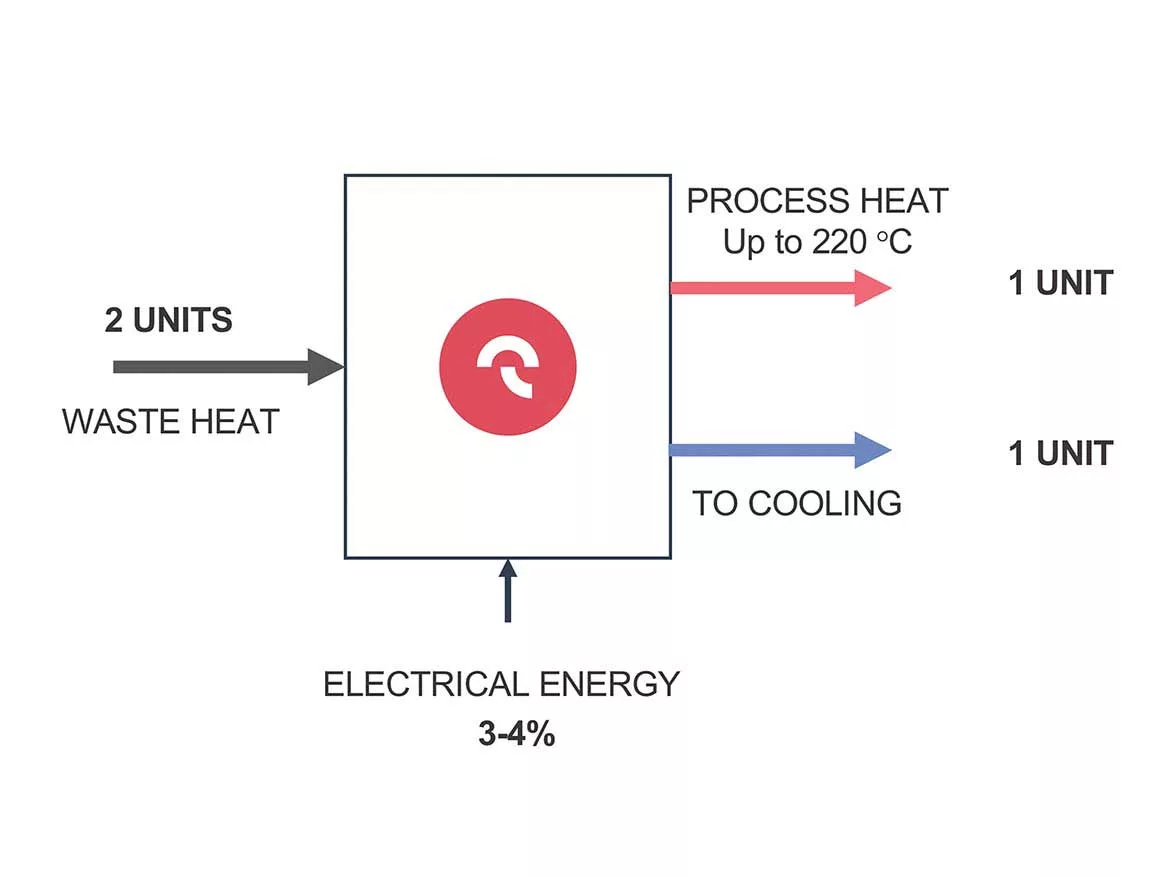
Figure 1. An example of a new approach, mostly for steam applications, to reach medium steam around 200°C – 12 bar, one that uses a phosphate loop where the phosphate goes from oligomer to monomer and back. Image courtesy of QPINCH Company
The energy transition/industry decarbonation movements that have recently accelerated require a tremendous amount of carbon-free electricity. At the same time, there are public oppositions to further installations of wind or PV farms as well as the development of nuclear and hydro, and geothermal can’t be expanded much. Biogas and syngas will continue to be further developed. Waste heat recovery (WHR) is a “low hanging fruit,” which only has one disadvantage: It presents a longer return on investment (ROI) than is usually acceptable to plants.
WHR associated with a steam cycle or an organic Rankine cycle (ORC) presents many benefits in terms of carbon neutrality, including long run times, since it’s not being interrupted, as well as its ability to produce valuable electricity that will be needed for everything from oxygen plants for oxy-combustion to electrolyzers (hydrogen and oxygen production), CO2 capture, purification, compression, and the direct electrification of the processes.
Let’s take CO2 post-combustion capture, be it by absorption (mostly amines), adsorption (mostly with metal-organic framework [MOF]), membrane separation, or cryogenic technologies, each has its own specific energy requirements, and all have to handle the flue gas, cool it, and clean it before it is processed. For instance, a typical cement plant whose electric load is in the 20-25 MW range would need 10 times that much if it were to run on hydrogen and capture the 1 Mon ton/year of CO2 it emits.
This has created a resurgence of interest in WHR. Waste heat is the energy contained in a fluid or a product that is usually left to dissipate in the atmosphere or through cooling fluids, either because the quantity is too small, the temperature too low, or the heat transfer requirement to recover that energy is too complex. That recovered energy can be used for either electricity generation or to improve the process energy efficiency. Numerous examples abound. In reality, even today, a large portion of the industrial energy input is lost as waste heat.
The U.S. Department of Energy webpages offer plenty of resources to review the main applications and technologies. One such study, although a few years old, is very comprehensive and covers many industries and processes.
One focus is how could waste heat temperature be increased in order to be able to produce more useful energy (including electricity). In fact, the biggest drawback for WHR projects is the low temperature of the waste stream for which there is limited natural outlets, such as water or air heating. ORCs have been installed on streams as low as 240°F/120°C, but the lower the temperature, the lower the conversion efficiency.
Heat pumps can facilitate energy savings when passive heat exchange is not possible due to low waste-heat temperature or small temperature differences. The coefficient of performance for a heat pump (COPhp) must then be above 5-6.
Figure 1 provides an example of a new approach, mostly for steam applications, to reach medium steam around 200°C – 12 bar, one that uses a phosphate loop where the phosphate goes from oligomer to monomer and back. It mimics the biological adenosine triphosphate (ADP) cycle as an energy transport molecule. It targets projects in the 2-6 MW range.

Another difficulty is sometimes found in the potentially negative impact on the process that the introduction of a heat exchanger in the flue gas could cause, i.e., by upsetting the pressure in a float glass furnace. In addition, a waste heat boiler is not like a heat recovery steam generator (HRSG). The temperature is different, and the flue gas composition, including the dust load, might call for the use of bare tubes instead of finned ones. It could also mean that a vertical gas flow design is needed so that the cleaning of the tubes can be done online (mechanical hammering for instance).

To alleviate the potential downstream impact, there is the option of thermosyphon heat pipes for heat recovery. Heat pipes are hermetically sealed tubes containing a working fluid in both liquid and vapor phases. When the evaporating end of the heat tube is heated, the internal working fluid turns to vapor, absorbing the latent heat of vaporization. The hot vapor flows to the colder end of the tube, where it condenses and gives up the latent heat to the receiving thermal energy stream. The condensed liquid then flows back down to the hot end of the tube, where it will then repeat the cycle over again. This allows for much less intrusive heat transfer.
Innovative concepts exist that are finding a market when the cost of CO2 emitted is accounted for. The example in Figure 2 combined three features:
• A water/steam loop for the thermodynamic fluid and an oil loop for the heating fluid;
• A double phase injector/accelerator (the oil is accelerated by the steam expansion); and
• A Pelton-type impulse turbine of small diameter operating both on low pressure and low speed.
This application projects below 500 kWe.
For larger projects, one of the largest sources of waste heat is a cement or lime plant with flue gas in the 200,000 normal meter cubed per hour at a temperature around 350°-400°C. It is used, in part, for the drying of the incoming material to be calcined but could also be fitted with a recovery boiler (two, actually, as there are two streams of hot gases).


The benefit of a WHR plant with ORC, shown in Figure 4, is the continuous self-generation of carbon-free electricity but also the water savings from a steam cycle, reducing the water for gas conditioning.
The source of waste heat is not always flue gas or steam, it can be hot solid products that need to be cooled, i.e., clinker in a cement plant. In the steel industry, reheat furnaces are another example, where most are equipped with recuperators of some sort, but the heat content of a hot slab is important enough to justify trying to recover it, as illustrated in Figure 5.
Many projects related to energy saving, CO2 reduction, alternative fuels, etc., can benefit from project financing. The end-user doesn’t have to invest directly; the project could be off-balance-sheets and could take full ownership of the plant after 10 or 15 years. Figure 6 provides an example of a third-party financing arrangement. It calls for proven technology; solid engineering, procurement, and construction (EPC) wrap-up; and solvable client with long-term plant life.

Conclusions
These days, where either by conviction, opportunism (tax credit, utilities grants, new business opportunities), or necessity (pressures from their clients, investors, mandates), all industrial players must consider the energy transition and the industry decarbonation in all their decisions. WHR can make sense within an energy management program and can be translated into CO2 savings with its equivalence on trees planted or cars removed from the road, companies like to present it. Technologies exist for every situation, and financing is also available. The main obstacle often seems to be the willingness by the plant to invest the necessary time outside its daily operations requirement.
Notes:
H = mh where H = total enthalpy rate of waste stream (Btu/hr); m = mass flow rate of waste stream (lb/hr); and h = specific enthalpy of waste stream, (Btu/lb.)
Looking for a reprint of this article?
From high-res PDFs to custom plaques, order your copy today!