Using a Sea Slug to Develop Better Hardware for Artificial Intelligence
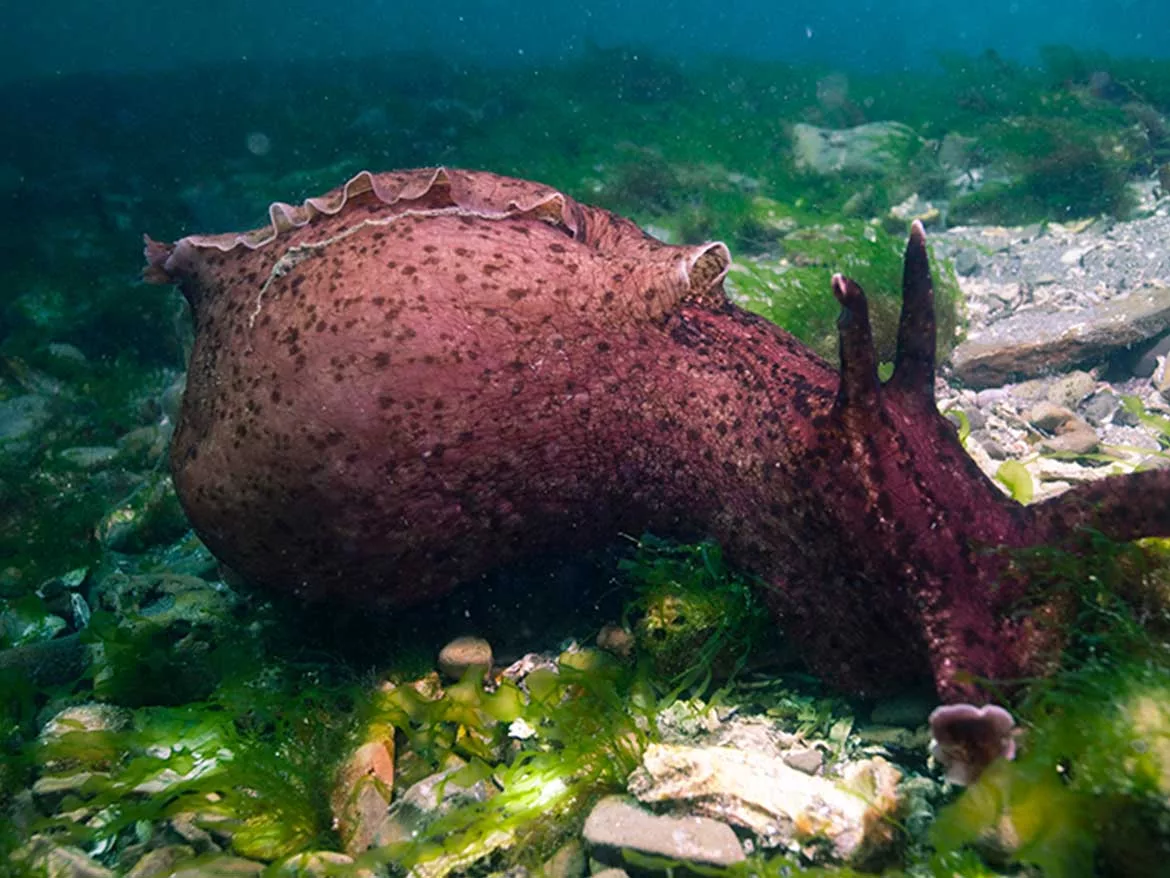
For artificial intelligence to get any smarter, it needs first to be as intelligent as one of the simplest creatures in the animal kingdom: the sea slug.
A new study has found a material can mimic the sea slug’s most essential intelligence features. The discovery is a step toward building hardware that could help make AI more efficient and reliable for technology ranging from self-driving cars and surgical robots to social media algorithms.
The study, publishing this week in the Proceedings of the National Academy of Sciences, was conducted by a team of researchers from Purdue University, Rutgers University, the University of Georgia, and Argonne National Laboratory.
“Through studying sea slugs, neuroscientists discovered the hallmarks of intelligence that are fundamental to any organism’s survival,” said Shriram Ramanathan, a Purdue professor of materials engineering. “We want to take advantage of that mature intelligence in animals to accelerate the development of AI.”
Two main signs of intelligence that neuroscientists have learned from sea slugs are habituation and sensitization. Habituation is getting used to a stimulus over time, such as tuning out noises when driving the same route to work every day. Sensitization is the opposite — it’s reacting strongly to a new stimulus, like avoiding bad food from a restaurant.
AI has a really hard time learning and storing new information without overwriting information it has already learned and stored, a problem that researchers studying brain-inspired computing call the “stability-plasticity dilemma.” Habituation would allow AI to “forget” unneeded information (achieving more stability) while sensitization could help with retaining new and important information (enabling plasticity).
In this study, the researchers found a way to demonstrate both habituation and sensitization in nickel oxide, a quantum material. The material is called “quantum” because its properties can’t be explained by classical physics.

If a quantum material could reliably mimic these forms of learning, then it may be possible to build AI directly into hardware. And if AI could operate both through hardware and software, it might be able to perform more complex tasks using less energy.
“We basically emulated experiments done on sea slugs in quantum materials toward understanding how these materials can be of interest for AI,” Ramanathan said.
Neuroscience studies have shown that the sea slug demonstrates habituation when it stops withdrawing its gill as much in response to being tapped on the siphon. But an electric shock to its tail causes its gill to withdraw much more dramatically, showing sensitization.
For nickel oxide, the equivalent of a “gill withdrawal” is an increased change in electrical resistance. The researchers found that repeatedly exposing the material to hydrogen gas causes nickel oxide’s change in electrical resistance to decrease over time, but introducing a new stimulus like ozone greatly increases the change in electrical resistance.
Inspired by these findings, a research group under Kaushik Roy, Purdue’s Edward G. Tiedemann Jr. distinguished professor of electrical and computer engineering, modeled nickel oxide’s behavior and built an algorithm that successfully used these habituation and sensitization strategies to categorize data points into clusters.
“The stability-plasticity dilemma is not solved at all, but we’ve shown a way to address it based on behavior we’ve observed in a quantum material,” Roy said. “If we could turn a material that learns like this into hardware in the future, then AI could perform tasks much more efficiently.”
For practical use of quantum materials as AI hardware, researchers will need to figure out how to apply habituation and sensitization in large-scale systems. They also would have to determine how a material could respond to stimuli while integrated into a computer chip.
This study is a starting place for guiding those next steps, the researchers said. In addition to the experiments performed at Purdue, a team at Rutgers University performed detailed theory calculations to understand what was happening within nickel oxide at a microscopic level to mimic the sea slug’s intelligence features. Argonne National Laboratory characterized the nickel oxide sample’s properties and the University of Georgia measured conductivity to further analyze the material’s behavior.
The work received funding from multiple entities, including the National Science Foundation; the Air Force Office of Scientific Research; the Army Research Office, the Office of Naval Research; and the Center for Brain-Inspired Computing, a joint university microelectronics program center sponsored by the Semiconductor Research Corporation and the Defense Advanced Research Projects Agency. The research used the resources of the Advanced Photon Source, a U.S. Department of Energy Office of Science User Facility operated for the DOE Office of Science by Argonne National Laboratory.
Looking for a reprint of this article?
From high-res PDFs to custom plaques, order your copy today!