LSU Chemical Engineering Unveils New Distillation Columns
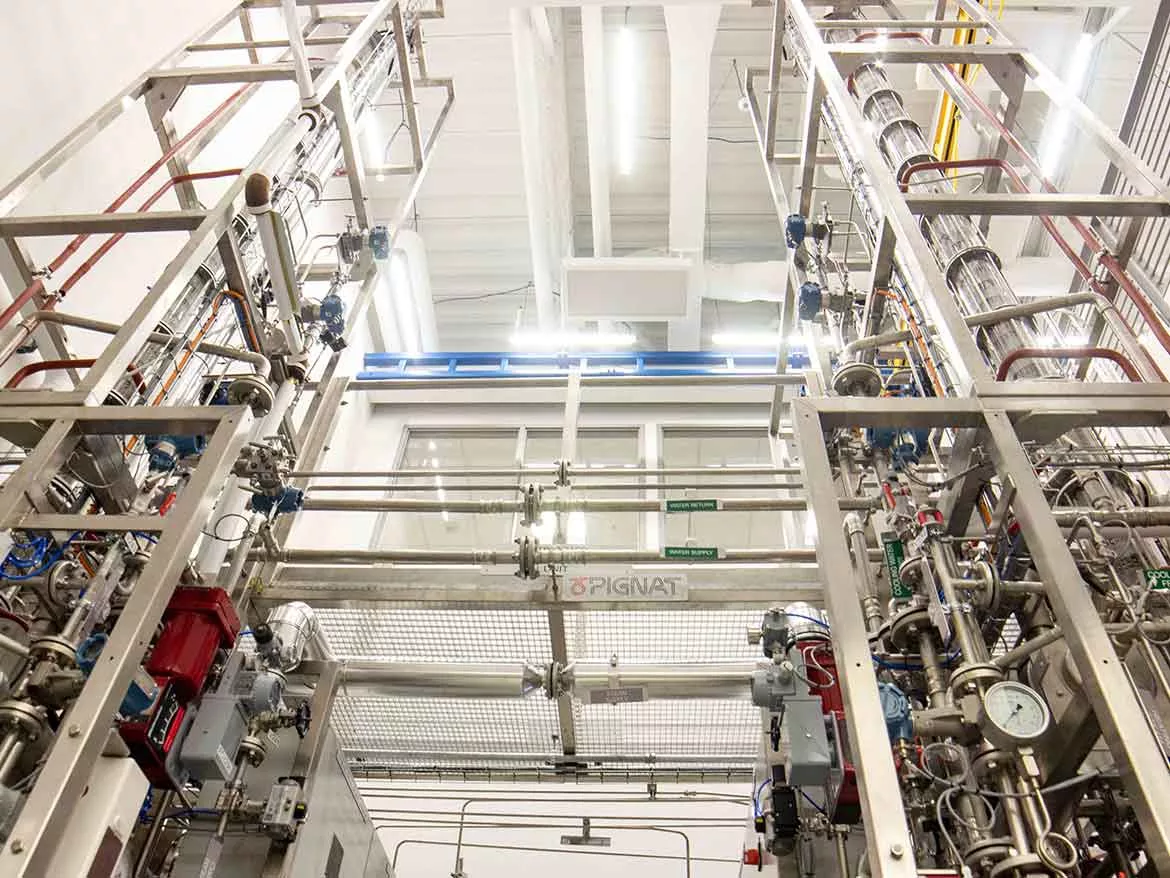
Broadly speaking, the unit—which is located in the Dow Unit Operations Laboratory in Patrick F. Taylor Hall—separates components, water, and a series of glycols, into pure or near-pure components by the differences in their vapor pressure. Image courtesy of LSU College of Engineering
The LSU Cain Department of Chemical Engineering recently completed a journey of several years with the installation of its new distillation columns. The towering structure consumes two floors of Patrick F. Taylor Hall and offers students the opportunity to work on a true commercial analog of the same equipment they will be expected to operate when they enter the workforce as chemical engineers.
“This is the largest and most advanced distillation system that I have ever seen at a university,” said John Flake, chair of the Cain Department of Chemical Engineering. “We have two 6-inch diameter, 20-foot-tall, packed, glass-wall columns that may be arranged in advanced configurations. Students can certainly read about distillation in a textbook and work problems, but the experience of running a steam reboiler and separating products at this scale is a much more meaningful experience. The glass walls are also very important for visualizing what is happening insde the column.”
Many of the precursors for common products come through distillation columns — plastic packaging, backpacks, detergents, refrigerants, even the precursors to make LED lights, to name a few examples. This is because chemical reactions typically produce more than one product, which then needs to be separated or purified, and distillation is the most common separation process.
Broadly speaking, the unit — which is located in the Dow Unit Operations Laboratory in Patrick F. Taylor Hall — separates components, water, and a series of glycols into pure or near pure components by the differences in their vapor pressure. For example, if a mixture of 50% water and 50% glycol are fed into the unit, a stream of “very nearly” pure water is produced from the top of the tower and pure glycol from the bottom. This is accomplished by heating and vaporizing the material in the bottom of the tower and returning a portion of it back down the tower after it is cooled and condensed.
“This unit would not be out of place at a commercial pharmaceutical or specialty chemical facility that operates in the commercial world,” said John Pendergast, professional-in-residence in the Cain Department of Chemical Engineering. “It is built to those specifications and design criteria. Very few students will have the ability to learn on, operate, and study the response of a facility [like the one we have here] that is very close to the unit operation of distillation that dominates the separation landscape of our industry.”
Pendergast, who joined the college in 2018 following a 40-plus-year career at Dow Chemical, was the main designer of the distillation columns and put his years of expertise at Dow into this project. He previously served the company as project manager or lead process engineer on several world-scale processes and plants, and most of his career involved research into separation methods and the implementation of advanced separations that reduce energy consumption or capital consumption or both.
“The primary design criterion for the unit was/is the safety of the students and the inhabitants of PFT,” Pendergast said. “The advanced features of this unit are that it can be used independently by two undergraduate groups at the same time, running realistic distillation experiments that would be seen in industry.
“In addition to that, this unit can be combined to advanced distillation sequences that are more energy-efficient,” he continued. “The units can be used for research to study methods that improve our understanding of these advanced sequences and enable a better understanding and adoption of distillation methods that can reduce energy consumption in our industry.”
The columns were fabricated overseas by the French company Pignat, which builds educational equipment as well as larger-scale equipment for companies like L’Oreal and Michelin. They were originally scheduled to arrive at PFT for assembly in April of this year; however, the COVID-19 pandemic contributed to delays during different stages of the process. In the end, Pignat representatives Regis Rodriguez and Mathias Fragola, along with the company’s U.S. representative Harold Sheppard, were able to make their way to campus and begin final work on the unit.
“Working with an international team has its challenges, especially during COVID,” said Thomas Schroeder, who oversees the operation of the columns as research specialist in the Dow Unit Operations Laboratory. “Shipping equipment to them (i.e, computers, sensors, etc.) was especially difficult, as the lockdowns [began] as we were trying to get them the equipment we purchased for the project. We had to do the [Factory Acceptance Test] over Zoom instead of in person, due to travel restrictions. That said, we maintained communication and made sure the columns were made to our specifications.”
Going forward, Pendergast said the plan for the unit is to utilize the equipment in undergraduate labs this fall; develop projects that can support undergraduate and graduate research work; and seek partners from industry, as well as other sources, to gather funding for graduate research that will support research and publications that advance students at the undergraduate and graduate level.
The distillation columns were made possible, in part, by the Bert S. Turner Endowment for Excellence in Engineering Education, Valero, and other donors and individuals.
Looking for a reprint of this article?
From high-res PDFs to custom plaques, order your copy today!