Designing a Well-Balanced Ventilation System for a Welding Shop
The welding shop is considered as one of the most unfavorable places for human working activities. A huge amount of harmfulness is emitted during the technological process. Welding works provoke saturation of the ambient air with fluoride compounds, ozone oxides, nitrogen, and carbon oxides provoking the development of dangerous diseases and causing harm to the environment. That is why a well-designed and balanced ventilation system for the welding shop is a priority.
A feature in the design of the ventilation system of the welding shop is the need to achieve high results of purification of air masses with relatively low energy costs. In addition, the ventilation process of the production room must be uninterrupted.
The following points become the key tasks of the ventilation system:
- Minimization of the concentration of harmful substances that are emitted during welding through the use of effective local suction;
- Elimination of chemical emissions and emissions that have already spread beyond the premises by means of general ventilation;
- Ensuring a sufficient inflow of fresh air masses into the welding shop in order to reduce the maximum permissible concentration of harmful impurities and hazardous substances.
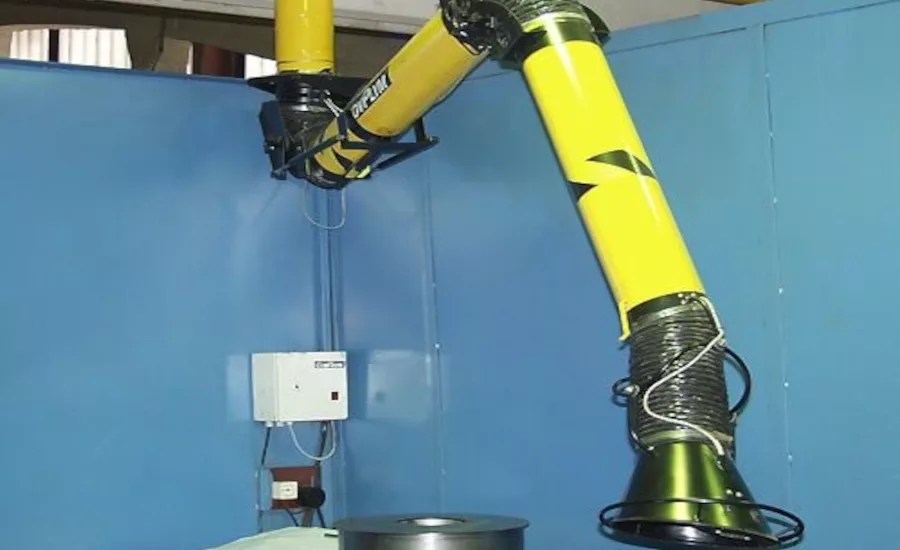
One of the most important points is the construction of high-quality devices for the local removal of all harmful substances released during the welding process. A high-quality hood for a welding station is not only about taking care of the employee's health but also reducing harm to the environment.
The better the ventilation of the welding table is organized and the well-fenced off the welding place, the less harmful substances will enter the atmosphere of the workshop. In addition, the required power of the welding hood is reduced.
In practice, local suction units are capable of capturing and absorbing up to two-thirds of the volume of all emitted toxic substances. The general exchange ventilation system of the workshop is used to remove the remaining third.

Equipping working welding stations with a local retraction system is effective only when it comes to stationary tables. If there are no permanent posts, and shop workers have to constantly perform work on movable welding tables, the local exhaust system becomes simply ineffective. In such situations, the installation of a general ventilation system with an air exchange rate of up to 10 units becomes relevant. When choosing the optimal general exchange scheme, all important points are taken into account, including the exit of convective flows up the production room. Convective currents can be enhanced by directed supply jets or directed by these jets to the air intake panels.

Taking the fact into account these flows are not particularly stable and can be disturbed by the movement of masses of aerated air or chilled inflow. It can be difficult to fight for clean air. The metal welding process is accompanied by a large emission of dust. The only way out lies in the installation of a mechanical general exchange ventilation system of the supply and exhaust type with the option of mandatory heating of the supply air in cold seasons.
When arranging a ventilation system in a welding shop, air supply can be carried out both vertically and horizontally.
The ventilation system is organized by installing powerful fans in the basement so that they provide a powerful flow of air through the ventilation shafts. Outlets are mounted in the floor and covered with special grilles. Exhaust fans in this scheme are usually installed on the roof. Such a system works very effectively in the production premises of welding shops with a large area. The concentration of harmful substances reduces very quickly and effectively.
The blow produced by the welding tool could create a random spark. The hazardous location fans incorporate spark-proof construction in its design to minimize the potential for a random spark being the ignition source of an explosion in a hazardous location. All major components are fabricated from materials that will not produce a spark when struck by a direct impact blow, i.e., aluminum propeller or blade and explosion proof motors.
Minimizing this potential for a spark ignition is also an important reason to use spark-proof industrial ventilation equipment in hazardous locations. The potential for a spark-ignited explosion caused by a direct blow is greatly minimized if a basic spark proof blade is and explosion proof motor is incorporated in the construction.
Only a product utilizing proper design and certification standards can minimize the risk of an explosion in an applicable hazardous atmosphere.
All calculations of appropriate equipment for the welding shop should be carried out exclusively by professionals who make and supply industrial ventilation fans. Any neglect of safety precautions can lead to dangerous situations. High-quality ventilation in the welding shop is the key to the successful operation of any enterprise.
Looking for a reprint of this article?
From high-res PDFs to custom plaques, order your copy today!