Carbon Pricing vs. Carbon Tax: Understanding the Difference

Carbon pricing is exceptionally effective because it eliminates the chance of a market failure — the unknown cost of external carbon emissions — at the source by pricing these costs.
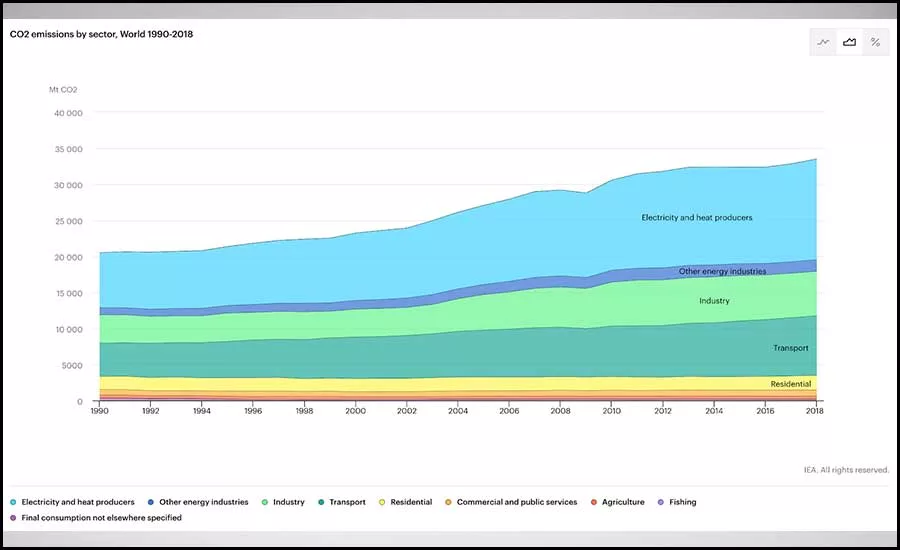
CO2 emissions by sector, 1990-2018. Image courtesy of IEA
Economists worldwide point to carbon pricing as the most effective way to reduce emissions. Why? Because carbon pricing reduces greenhouse gas (GHG) emissions to the lowest cost possible, where that cost includes the monetary amount of efficiency measures a company takes on and the cost of the inconvenience resulting from making do with fewer goods and services that rely on fossil fuels.
Carbon pricing is exceptionally effective because it eliminates the chance of a market failure — the unknown cost of external carbon emissions — at the source by pricing these costs.
So, how does carbon tax fit into the equation? In this article, the GHG emissions management experts at SINAI provide an overview of carbon pricing and carbon tax. Gain an understanding of the difference between the two when it comes to effective emissions management.
What is carbon pricing?
Carbon pricing is a market-based approach to reduce carbon emissions (also referred to as CO2, greenhouse gas, and GHG emissions) that uses market mechanisms to pass the cost of emitting on to the emitters. It aims to discourage the use of carbon dioxide or emitting fossil fuels in order to address the causes of climate change, protect the environment, and meet international and national climate agreements and pledges.
“Polluter pays” is a crucial aspect of the carbon pricing strategy. By putting a monetary amount on carbon, communities can hold emitters responsible for the consequential environmental and social costs of putting GHG emissions into the atmosphere, including increased risk of dangerous weather, warming temperatures, polluted air, and community health threats from the negative impacts on food and water supplies.
Putting a price on carbon also provides financial incentives for polluters to reduce their carbon emissions.
Carbon pricing provides a long list of significant benefits. It is one of the most robust policy tools available for fighting climate change. It offers the opportunity to decarbonize global economic activities by influencing the behavior of businesses, investors, and consumers. It also offers continuous technological innovation and new, clean revenue streams that are more productive and sustainable for corporations. In other words, the best-designed carbon prices provide three key benefits: they preserve the environment, promote funding in clean technologies, and boost revenue.
What is a carbon tax?
A carbon tax is a fee that fossil fuel burning corporations pay as a result of government regulations. By fossil fuels, we mean oil, coal, natural gas, and gasoline. When these carbon-filled fuels are burned, they produce greenhouse gas emissions. These gases, such as methane and carbon dioxide, cause global warming by raising the atmosphere’s temperature. Flooding, heat waves, droughts, and blizzards, along with other extreme weather events, are a result of global warming.
The main objective of a carbon tax is to mirror the actual cost that burning carbon creates. Carbon taxes ensure corporations and consumers pay for the external costs they inflict on the wider society.
How does carbon tax relate to carbon pricing?
A carbon tax is a type of carbon pricing — the other primary type of carbon pricing is emissions trading systems or ETS.
A carbon tax sets an exact price on carbon by specifying a tax rate on GHG emissions or on the carbon amount found in fossil fuels, with the latter becoming more common. Carbon tax differs from an ETS in that the GHG emissions reduction outcome of a carbon tax is not defined in advance, but the carbon price is.
National and economic circumstances largely control the choice between using a carbon tax or an ETS. There are also more indirect ways of pricing carbon, including through fuel taxes, regulations that take into account the social cost of carbon, and the elimination of fossil fuel subsidies. GHG emissions may also be priced through payments for carbon emission reductions.
Setting an internal carbon price for your company
Many companies are setting an ambitious internal carbon price to help consolidate their environmental impact.
Setting an internal carbon price helps your company build resilience and can strengthen communication in capital markets with meticulous datasets that are accessible and easy to understand, and prepare for increasingly demanding regulation.
Looking for a reprint of this article?
From high-res PDFs to custom plaques, order your copy today!