Supply Chain Decarbonization: What Companies Must Consider
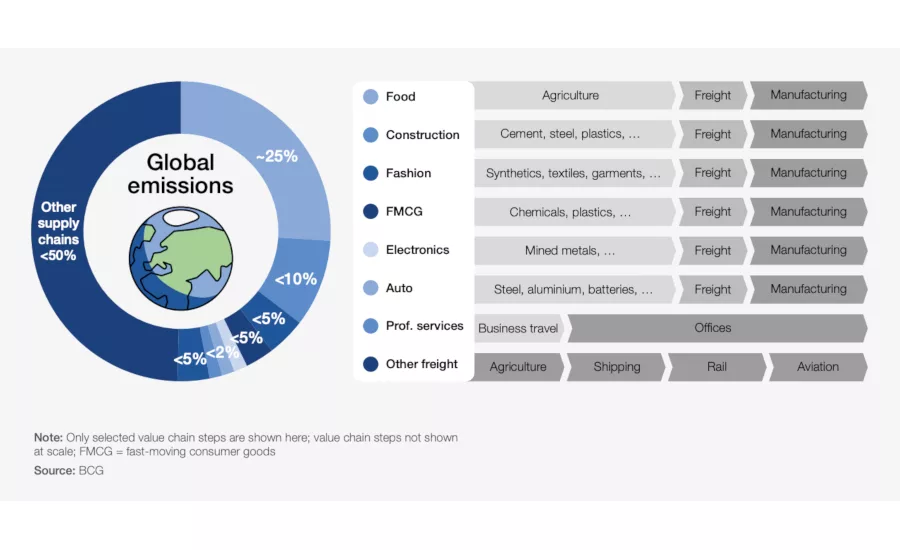
Presenting practical and scalable ways in which corporations can achieve deep decarbonization, from setting a carbon baseline to automating data collection throughout your corporation’s supply chain. Image courtesy of WEF

The term “decarbonization” is used to represent the process of reducing and removing the carbon dioxide, or CO2e (carbon dioxide equivalent, meaning, all seven greenhouse gases included), output from a country’s economy.
New research published earlier this year shows how tackling supply chain emissions can be a game-changer in the worldwide battle against climate change. “Net-Zero Challenge: The Supply Chain Opportunity,” from the World Economic Forum and the Boston Consulting Group, looks at eight worldwide supply chains that produce more than 50% of global greenhouse (GHG) emissions. They find that several corporations can multiply their climate impact by focusing on supply chain decarbonization.
On the other hand, even large corporations struggle to set clear goals and standards for their suppliers and get the data they need.
How best can corporations build a meaningful pathway to deep decarbonization within their supply chains?
In this article, the GHG emissions management representatives at SINAI explain what corporations should consider when getting to grips with supply chain emissions. We present practical and scalable ways in which corporations can achieve deep decarbonization, from setting a carbon baseline to automating data collection throughout your corporation’s supply chain.
Slowing down climate change
The Paris agreement is a legally binding global treaty on climate change aiming to slow down climate change. Unfortunately, current pledges do not go far enough. Many agree that to hit the targets set, deep decarbonization is needed, particularly in global supply chains across a variety of industries.
What is decarbonization?
The term “decarbonization” is used to represent the process of reducing and removing the carbon dioxide, or CO2e (carbon dioxide equivalent, meaning, all seven greenhouse gases included), output from a country’s economy. The most common way this is done is by decreasing the amount of CO2e released from active industries within each economy, including but not limited to utilities, transportation, consumer goods, construction, and materials.
A robust picture of emissions
The first step every corporation should take to get a handle on supply chain emissions is to gain a complete view of what those emissions are. The GHG Protocol’s Scope 3 Standard provides corporations with a methodology that can be used to account for and report carbon emissions from companies of all sectors, worldwide.
Corporations should consider building a detailed view of emissions with supplier-specific data to set ambitious targets for reducing carbon emissions. You can take control of your supply chain’s carbon emissions by performing a carbon inventory.
You should be able to compare emissions sources and resource consumption together with quickly identifying trends and patterns. Ensure you can aggregate, sort, and filter your emissions data to manage risk better and help/support suppliers to find deep decarbonization opportunities.
A detailed carbon baseline
Corporations should consider exploring historical activity data to project emissions as their business grows and changes, creating forecast baselines they can use to monitor progress.
Establishing a comprehensive emissions baseline for your corporation is vital. Baselines are built according to business growth, and you can combine these with supply chain emissions with different levels of detail to generate multiple baselines according to additional premises. Use granular data to analyze suppliers that contribute the most significant emissions.
Emerging software can help corporations easily match procurement data with environmentally extended input/output factors, building a high-level picture of their supply chain’s overall carbon footprint. Corporations can also leverage predictive analytics on resource consumption and emissions trends to gain better insight and business intelligence.
Automated GHG inventories
Corporations should consider engaging diverse partners in their supply chain in a meaningful way, assisting them in a value-based exchange of emissions data.
Work toward a flexible data collection process to move away from generic data sources and create custom emissions factors that you can track with ease.
Collaboration is crucial, and we know supply chain emissions data can be messy. By automating data collection, corporations can consolidate, analyze, and organize data from various sources quickly and easily, leading to more accountable reporting and better decision-making.
Smarter carbon emissions strategies
Corporations should look to optimize their carbon emissions strategy through scenario and sensitivity analysis and enhanced risk management for deep supply chain decarbonization.
Intelligent, data-driven scenario analysis can future-proof a corporation and supply chain with a heightened understanding of projected deep decarbonization pathways.
Accurate and precise data can show which assets of the corporation are most at risk. Explore any reduction opportunities that exist and what cost-positive opportunities may be worth investing in, in the long-term. Suppliers that go over the same type of analysis will ultimately reduce their scope 1 and 2, which will reflect back to their buyers’ scope 3. The overall approach helps everyone in the supply chain to reduce emissions with their own individual definition of success.
Technology to help your organization to remain accountable
Front runners in several global industries are using innovative and cutting-edge technology to better manage their supply chain’s journey to deep decarbonization. They have a complete view of carbon emissions throughout their supply chain and baseline definitions in place, reviewing more granular data of those with the highest emissions. They are working towards deep decarbonization through automated carbon inventories from suppliers and following carbon emissions strategies, backed by data. For more information, visit www.sinaitechnologies.com.
Looking for a reprint of this article?
From high-res PDFs to custom plaques, order your copy today!