Building Organizational Emissions Baselines for GHG Management
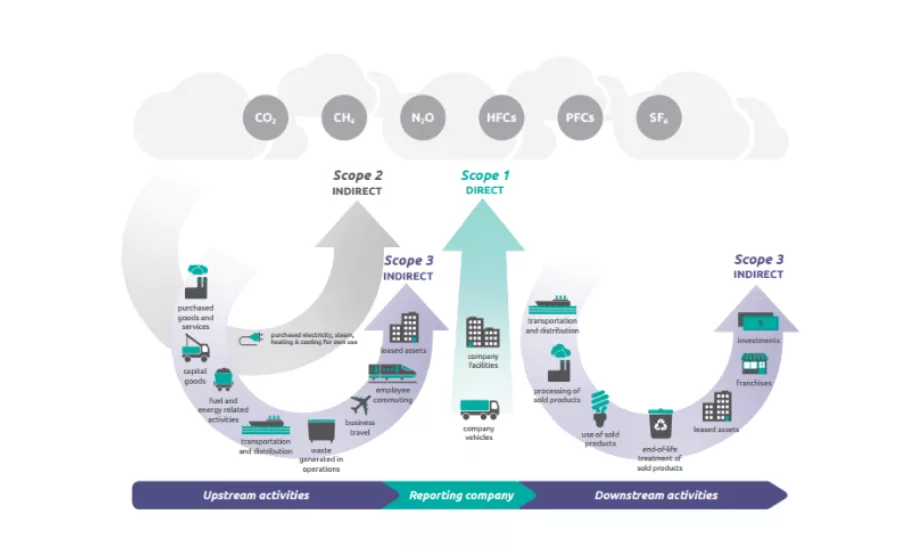
FIGURE 1: A carbon baseline includes both direct and indirect emissions, also known as Scope 1, Scope 2, and Scope 3 emissions. Source: GHG Protocol

FIGURE 2: Examples of how to “future-proof” your organization. Source: SINAI Technologies
Upon surveying the landscape of organizational climate commitments, it is not uncommon to hear about attention-grabbing goals like committing to 100% renewable energy, setting a science-based target, going carbon neutral, or even climate positive. You might be wondering: How do these organizations get started? Looking around your own organization. It may be difficult to imagine how the fragmented efforts that are taking place within different business units and on different timelines can come together to form a coherent story about the opportunity for impact and risk mitigation.
The key to getting started is to establish a carbon baseline
A carbon baseline is an inventory of sources of carbon emissions from business activities. This is typically a one (or more) year(s’) snapshot that serve as a reference point for organizations to understand and track their changing emissions over time. Building a multiyear emissions baseline not only enables an organization to have a better understanding of its recent historical GHG emissions trends, but it also enables an organization to grasp the business trajectory and associated potential future emissions. A carbon baseline includes both direct and indirect emissions, also known as Scope 1, Scope 2, and Scope 3 emissions (see Figure 1 for detailed categories).
Scope 1: Direct carbon emissions from owned or controlled sources (e.g. fuel);
Scope 2: Indirect carbon emissions from consumed purchased electricity, heat, or steam; and
Scope 3: Indirect carbon emissions from all other business activities (e.g., purchased goods and services, capital goods, production of purchase materials, transport-related activities not owned or controlled by the organization, waste disposal, business travel, use of sold products, etc.).
Why establish a carbon baseline?
Just as companies take stock of other types of resources or supplies, it is important for organizations to assess their carbon budgets in order to understand which areas of business activities have the greatest opportunities for impact. We’ve discussed the importance of data quality in a previous blog when establishing carbon inventories. Establishing a detailed carbon baseline provides management with the ability to understand carbon emissions across different business units and make data-informed decisions, for example, by having specific fuel-type information according to projected business growth or understanding how carbon-intensive specific regions’ electric grids are going to behave in the future where the company operates. Given the likely volume of data collection and calculations, the baseline inventory data can be much easier to visualize, analyze, and synthesize if it is established in a centralized software system.

A secondary benefit to establishing a baseline carbon inventory is for tracking change over time. Since a baseline carbon inventory is only a snapshot in time, organizations need to build their processes for ongoing data collection to evaluate the effectiveness of operational changes. Having a baseline carbon inventory also supports companies in conducting peer benchmarking and evaluating their market positions.
So you’ve built your baseline… what's next?
Establishing a carbon inventory baseline is only the first step to managing organizational GHG emissions. Once an organization undertakes the effort to put together this emissions approach to understanding its impact, the organization can extend the same approach to thinking about risks and opportunities in business decision-making processes. For example, when evaluating capital investments into a new facility, a company can inquire and collect data about the historical operational costs — including energy data — for existing facilities it is considering for acquisition, and/or factor in how “dirty” the electric grid is in the potential regions where a new facility may be sited. Because an organization already has a baseline understanding of its existing portfolio of facilities, the organization can evaluate potential facilities against its own portfolio’s average emissions as well compare potential acquisitions against each other from a carbon impact standpoint. Siting new facilities in a region with a cleaner electrical grid, or with easier access to cleaner alternative fuels, can be considered alongside other performance and market factors in the capital investment decision making processes.
Beyond singular business decisions, having an established carbon inventory baseline can facilitate an organization’s goal setting and scenario planning. Companies that have a target year and an established emissions target can draw a line from their established carbon baseline to their designated emissions target to understand the necessary change in their carbon budget over time compared to business as usual (see the purple and green lines in Figure 2).

Forecasting different projections of possible futures based on the current carbon baseline provides a data-driven approach to stacking individual or decentralized business decisions together to get a comprehensive understanding of the planned emissions reductions, which aggregates the approved project pipeline. The planned emissions reductions can then be compared to the planned emissions gap or the targeted emissions reduction that has yet to be accounted for based on existing company mitigation strategies. Finally, for companies thinking about supporting a 1.5°F climate scenario, modeling the path from their carbon baseline to their current goals versus what the target emissions would need to be to achieve the 1.5° scenario can facilitate an internal discussion around the target emissions gap (shown as the steepest emissions pathway in Figure 2).
References:
1. RE100 campaign. The Climate Group & CDP. https://www.there100.org/. Accessed Friday 27 November 2020.
2. Science-based targets. https://sciencebasedtargets.org/. Accessed Friday 27 November 2020.
3. Carbon Neutral Standard. Natural Capital Partners. https://www.carbonneutral.com/. Accessed Friday 27 November 2020.
4. Greenhouse Gas Protocol. World Resource Institute & WBCSD. https://ghgprotocol.org/. Accessed 29 November 2020.
5. https://www.sinaitechnologies.com/post/four-main-data-challenges-in-managing-carbon-inventories . SINAI Technologies.
6. https://www.sinaitechnologies.com/about-us#contact
Looking for a reprint of this article?
From high-res PDFs to custom plaques, order your copy today!