search
Ask ACHR NEWS AI
cart
facebook twitter instagram linkedin youtube
  • Sign In
  • Subscribe
  • Sign Out
  • My Account
  • NEWS
  • TECHNOLOGY
    • Heating & Boilers
    • Cooling & Chillers
    • Pumps & Flow Controls
  • SECTORS
    • Commercial
    • Health Care
    • Data Center
    • Educational Facilities
  • DESIGN | CONSTRUCTION
  • OTHER TOPICS
    • High-Performance Buildings & Automation
    • Ventilation and IAQ
    • Commissioning
    • HVAC Retrofits
  • TODAY’S BOILER
    • Today’s Boiler Archives
    • Today’s Boiler Digital Edition
  • MORE
    • Case Studies
    • Podcasts
    • Videos
    • Directory
    • Webinars
    • ES NEWS Store
    • White Papers
  • SIGN UP
  • Back to The NEWS
Engineered Systems NEWSVentilation and IAQ

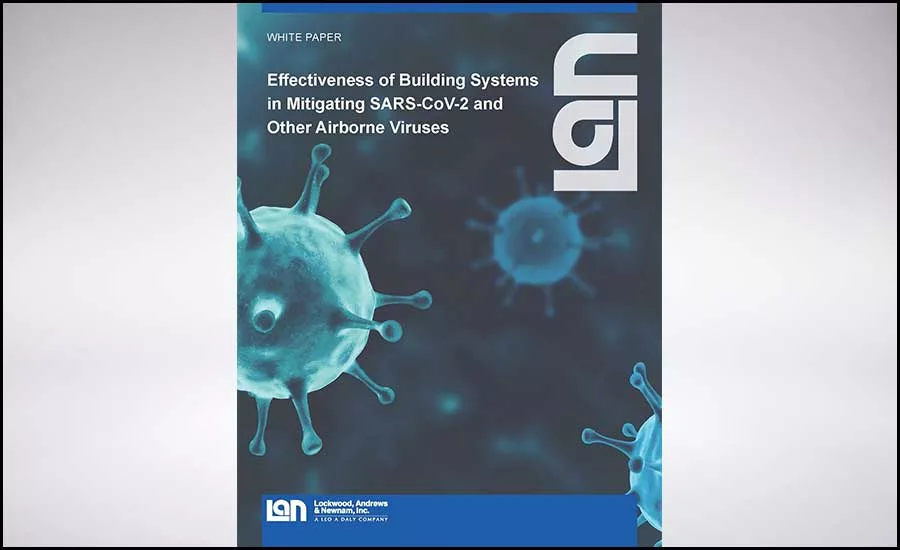
Effectiveness of Building Systems in Mitigating SARS-CoV-2 and Other Airborne Viruses
COVID-19 pandemic

The COVID-19 pandemic has brought a new set of concerns for commercial buildings.

December 10, 2020

Research has shown that transmission of SARS-CoV-2 most often occurs through the air via respiratory droplets sized greater than 5-10 microns in diameter. This transmission occurs when a person comes into close contact within three to six feet of an infected individual who releases respiratory droplets into the air by coughing, sneezing, talking, shouting, singing, laughing, etc. These respiratory droplets can contain the virus and may result in infection if they reach the mouth, nose, or eyes of a susceptible person. The reason why transmission in this manner occurs within close contact situations is that these larger droplets mostly fall out of the air within three to six feet. It is also suspected that direct contact with an infected person’s saliva, for example through kissing, can transmit the virus from person to person.

The second mode of SARS-CoV-2 transmission can occur when respiratory droplets from infected individuals land on and contaminate objects and other surfaces.

These contaminated surfaces are referred to as fomites. Studies have concluded that this virus can remain viable on surfaces for periods ranging from hours to days depending on the type of surface and environmental factors such as temperature and humidity levels. Fomite transmission of SARS-CoV-2 may occur when a susceptible person touches objects or surfaces contaminated with virus and then touches his/her mouth, nose, or eyes, or those of another person.

This white paper is intended to provide guidance for owners of commercial buildings, including K-12 schools, higher education campuses, and office buildings, to consider while returning to occupancy during the COVID-19 pandemic. 


Mitigating Sars

Share This Story

Looking for a reprint of this article?
From high-res PDFs to custom plaques, order your copy today!


Recommended Content

JOIN TODAY
To unlock your recommendations.

Already have an account? Sign In

  • HVAC-enrollment

    The Trades Are Back: HVACR Programs See Nearly 30% Enrollment Spike

    A new wave of future technicians is entering the pipeline.  
    News
    By: Matt Jachman
  • 2025 Top 40 Under 40

    2025 Top 40 Under 40 HVACR Professionals List

    The 11th annual Top 40 Under 40 list highlights those...
    HVAC Commercial Market
    By: Hannah Belloli-Oster
  • LG Ductless Mini-Split Systems

    The 9 Types of Heat Pumps

    As the U.S. moves toward electrification, heat pumps are...
    Heat Pumps
    By: Joanna R. Turpin

More Videos

Today's Boiler

Spring 2026 Issue

Today's Boiler - Spring 2026 Cover

Read More from Today's Boiler

Case in Point Logo

Smarter Hydronic Design for Data Centers - Free Webinar - January 22, 2026

Related Articles

  • Mitigating SARS

    Effectiveness of Building Systems in Mitigating SARS-CoV-2 and Other Airborne Viruses

    See More
  • April 6, 2005: Johnson Controls Installs Building Systems In New Hospital

    See More
  • Aug. 8, 2006: Schneider Electric Completes Acquisition of Invensys Building Systems

    See More

Related Products

See More Products
  • EHEP002028.jpg

    Principles of Heating, Ventilation, and Air Conditioning in Buildings, 1st Edition

  • Green Tips for Building Maintenance Engineers

See More Products

Related Directories

  • National Institute of Building Sciences-NIBS

    Created by Congress in 1974, NIBS advances resilient, sustainable infrastructure by connecting research, policy, and practice to shape standards and drive innovation in the built environment.
×

Sign Up. Stay Informed.

The #1 trusted source for the HVACR industry since 1926

SUBSCRIBE
  • RESOURCES
    • Advertise
    • Contact Us
    • Advisory Board
    • Classifieds
    • Submit a Letter
    • Directories
    • Store
  • ACCOUNT CENTER
    • Create an Account
    • Start a Subscription
    • Manage My Account
    • Sign Up for Newsletters
    • Visit Customer Service
    • Update Preferences
  • SERVICES
    • Marketing Services
    • Reprints
    • Market Research
    • List Rental
    • Survey/Respondent Access
  • STAY CONNECTED
    • LinkedIn
    • Facebook
    • Instagram
    • YouTube
    • X (Twitter)
  • PRIVACY
    • PRIVACY POLICY
    • TERMS & CONDITIONS
    • DO NOT SELL MY PERSONAL INFORMATION
    • PRIVACY REQUEST
    • ACCESSIBILITY

Copyright ©2026. All Rights Reserved BNP Media, Inc. and BNP Media II, LLC.

Design, CMS, Hosting & Web Development :: ePublishing