White Paint Could Reduce Surface Temperatures, Decreasing the Need for Air Conditioning
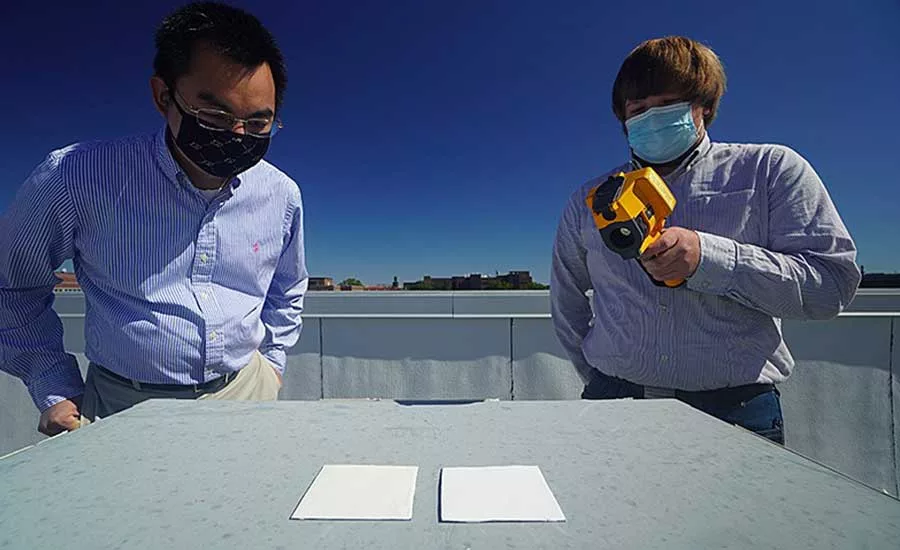
Purdue researchers Xiulin Ruan (left) and Joseph Peoples use an infrared camera to compare the cooling performance of white paint samples on a rooftop. (Purdue University photo/Jared Pike)
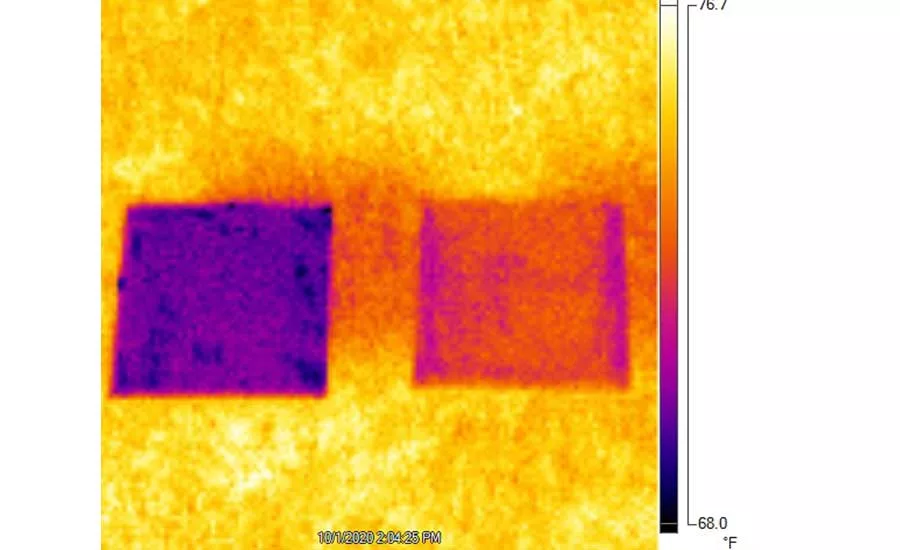
An infrared camera image shows that white radiative cooling paint developed by Purdue University researchers (left, purple) can stay cooler in direct sunlight compared with commercial white paint. (Purdue University image/Joseph Peoples)
What if paint could cool off a building enough to not need air conditioning?
Purdue University engineers have created white paint that can keep surfaces up to 18°F cooler than their ambient surroundings — almost like a refrigerator does but without consuming energy.
According to researchers, the paint would replace the need for air conditioning by absorbing nearly no solar energy and sending heat away from the building. Without the building heating up, air conditioning wouldn’t have to kick on.
“It’s very counterintuitive for a surface in direct sunlight to be cooler than the temperature your local weather station reports for that area, but we’ve shown this to be possible,” said Xiulin Ruan, professor of mechanical engineering, Purdue.
The paint would not only send heat away from a surface but also away from Earth into deep space where heat travels indefinitely at the speed of light. This way, heat doesn’t get trapped within the atmosphere and contribute to global warming.
“We’re not moving heat from the surface to the atmosphere,” said Xiangyu Li, a postdoctoral researcher at the Massachusetts Institute of Technology who worked on this project as a Ph.D. student in Ruan’s lab. “We’re just dumping it all out into the universe, which is an infinite heat sink.”
Earth’s surface would actually get cooler with this technology if the paint were applied to a variety of surfaces including roads, rooftops, and cars all over the world, the researchers said.
In a paper published Oct. 21 in the journal Cell Reports Physical Science, the researchers show that compared with commercial white paint, the paint that they developed can maintain a lower temperature under direct sunlight and reflect more ultraviolet rays.
Their proof is infrared camera images taken of the two paints in rooftop experiments.
“An infrared camera gives you a temperature reading just like a thermometer would to judge if someone has a fever,” Ruan said. “These readings confirmed that our paint has a lower temperature than both its surroundings and the commercial counterpart.”
Commercial “heat rejecting paints” currently on the market reflect only 80%-90% of sunlight and cannot achieve temperatures below their surroundings. The white paint that Purdue researchers created reflects 95.5% sunlight and efficiently radiates infrared heat.
Developing this paint formulation wasn’t easy. The six-year study builds on attempts going back to the 1970s to develop radiative cooling paint as a feasible alternative to traditional air conditioners.
The researchers considered more than 100 different material combinations, narrowed them down to 10, and tested about 50 different formulations for each material. They landed on a formulation made of calcium carbonate, an earth-abundant compound commonly found in rocks and seashells.
This compound, used as the paint’s filler, allowed the formulation to behave essentially the same as commercial white paint but with greatly enhanced cooling properties. These calcium carbonate fillers absorb almost no ultraviolet rays due to a so-called large “band gap,” a result of their atomic structure. They also have a high concentration of particles that are different sizes, allowing the paint to scatter a wider range of wavelengths.
According to the researchers’ cost estimates, this paint would be both cheaper to produce than its commercial alternative and could save about a dollar per day that would have been spent on air conditioning for a one-story house of approximately 1,076 square feet.
“Your air conditioning kicks on mainly due to sunlight heating up the roof and walls and making the inside of your house feel warmer,” said Joseph Peoples, a Purdue Ph.D. student in mechanical engineering and a co-author of the work. “This paint is basically creating free air conditioning by reflecting that sunlight and offsetting those heat gains from inside your house.”
Cutting down on air conditioning also means using less energy produced by coal, which could lead to reduced carbon dioxide emissions, Peoples said. The researchers have further studies underway to evaluate these benefits.
The researchers are working on developing other paint colors that could have cooling benefits. The team filed an international patent application on this paint formulation through the Purdue Research Foundation Office of Technology Commercialization. For further discussion on this intellectual property, visit https://purdue.edu.
Looking for a reprint of this article?
From high-res PDFs to custom plaques, order your copy today!