The Implications of Room Design on COVID-19 Transmission
IAQ is becoming a primary factor in building design.
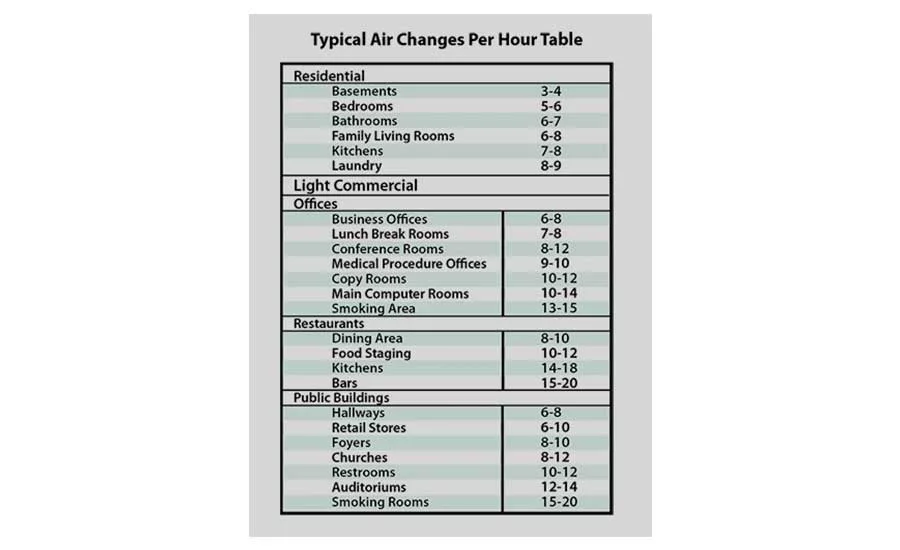
FIGURE 1. Typical air changes per hour per facility type.
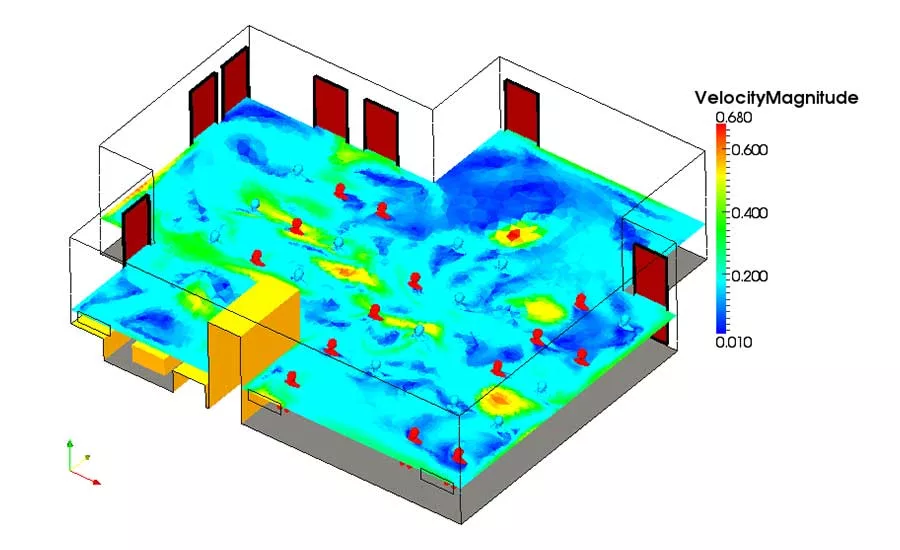
FIGURE 2. Due to poor diffuser placement, there may be sections of the room where the refresh rates are very low.
It was evident early on that COVD-19 is an airborne pathogen. “Superspreader Events,” such as those in the famous Guangzhou restaurant, the Diamond Princess Cruise Ship, the USS Theodore Roosevelt, and, most recently, the wedding in Millinocket, Maine, on Aug. 7, provided the evidence. In each of these cases, the common denominator was a high density of people in a relatively small area with inadequate ventilation and an infected person.
When the virus first broke, most health officials were advocating the idea the virus was spread from coughing or sneezing and that physical distance of approximately 6 feet and common-sense advice about hand-washing would be sufficient to protect people. The science behind this advice dates back to the 1930s under the direction of a scientist named William F. Wells. He theorized that virus transmission was created by droplets expelled from an infected person with a cutoff in size of approximately 5-10 uM. Using basic Newtonian mechanics, the distance of 6-8 feet was determined to be the distance a particle can travel before falling to the ground.
More recent work in this field reveals coughs and sneezes are actually multiphase events with turbulent gases. This extends the life of an expelled droplet from a fraction of a second to minutes and can cover distances that extend 20-30 feet based on the turbulence and speed of the gas cloud. Exit velocities ranging from 33-100 ft./sec. have been measured using high-speed cameras, and the resulting gas clouds are influenced by temperature, humidity, and surrounding airflow. Once evaporated, the pathogen nuclei may stay suspended in the air for hours.
These new realizations are concerning in their own right, but when coupled with a highly contagious pathogen from an asymptomatic carrier, the results become deadly. Studies have shown a person infected with COVID-19 can produce contagious pathogens at a rate 1,000 times greater than those produced from influenza prior to showing any symptoms. And there are many cases where the infected person will show little or no symptoms throughout the entire infectious cycle but still be highly contagious.
What does this all mean for designers and engineers in the built environment? IAQ is becoming a primary factor in building design. Prior to the arrival of COVID-19, IAQ was primarily relegated to thermal considerations. Occupants were either too hot or too cold, and HVAC designs were focused on solving that issue. However, with the arrival of COVID-19, the issue of air quality has taken center stage and will forever change the priorities of building scientists.
THE IMPLICATIONS OF ROOM DESIGN
Every room has a unique airflow based on the location of the supply and return diffusers and the volume and quality of the air entering the room. There are currently no building codes that regulate the placement of supply and return diffusers, as this is often left to the mechanical contractor. It’s not uncommon for them to be placed at the least expensive locations from a labor and materials point of view and not from an optimal air circulation point of view.
Each room also has an ASHRAE-specified air changes per hour rate (ACH) that sets the lower limits on how many times the air in the room is refreshed with clean air. This ratio is determined by dividing the volume of the room by the arrival rate of fresh air. The ACH number varies based on the type of room, its intended use, and the number of occupants. For example, an operating room has an ACH of 8-10, while an office will have an ACH of 3-4. (See Figure 1). Due to poor diffuser placement, there may be sections of the room where the refresh rates are very low (Figure 2).
Using computational fluid dynamics (CFD) modeling engineers can predict air parameters in the room, including velocity, temperature, and pressure, etc. In this image, the velocity of air as a function of color has been plotted. The blue regions are referred too as “dead zones,” as they have zero air velocity. This is also where high regions of pathogen concentrations will accumulate, giving a more ominous meaning to the term.
Each person’s immune system will react differently to the COVID-19 pathogen. To trigger the infection, a person must be exposed to a sufficiently high viral load. The goal of the design engineer is to reduce the concentration of the pathogen such that the viral load is below the trigger point using proper diffuser location and sufficient fresh or clean air.
STEPS TO TAKE
There are several steps building managers and design engineers can take to reduce the probability of COVID-19 transmission. Increasing filtration in HVAC systems to a MERV-13 level is an important first step. Increasing the ACH by introducing more fresh outside air into the room is another. Adding ultraviolet (UV) lights to HVAC systems is also recommended to kill bacteria and pathogens in the returning air. It is also important to review the placement of supply/return diffusers and determine if there are significant areas of poor circulation in the room.
However, for many indoor environments, these steps are not possible. For example, some old buildings use steam heat and no air conditioning. In these cases, local air filters are a good option. A variety of portable HEPA-based filtration units can be purchased at a reasonable price. These units provide an air quality equivalent to that found in a semi-conductor fabrication facility or surgical operating room. Many of these units include a UV lamp in them to kill the pathogens returned to the unit.
SUMMARY
The probability is high that the primary vector for transmission of COVID-19 is airborne. Each person has a unique threshold above which a high concentration of a COVID viral load will trigger the infection in the human respiratory system. The goal of building managers and design engineers is to reduce viral concentrations in rooms through proper airflow management; introduce clean, fresh air; and, when that is not possible, to clean the existing air with local HEPA filtration. By combining these techniques, engineers can begin to manage this highly contagious disease and build an environment that will reduce the possibility of future pathogen transmissions.
Looking for a reprint of this article?
From high-res PDFs to custom plaques, order your copy today!