Boston University Unveils Ventilation Improvements
As scientists continue to study ways the coronavirus can be spread, one question involves aerosol droplets that people exhale while breathing. Can those droplets circulate in the air long enough to be picked up by a ventilation system and recirculated through building ducts? There has not been a clear answer. But what scientists and the Centers for Disease Control and Prevention (CDC) have said — unequivocally — is that one of the most important things employers can do is to improve building ventilation and air circulation wherever possible.
That’s what Boston University’s Facilities Management & Operations staff is doing.
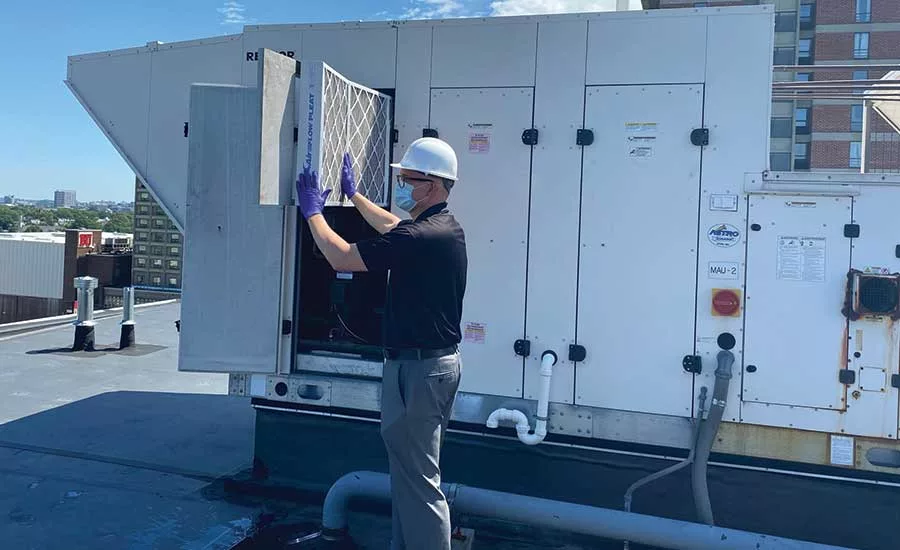
In one more move aimed at making the BU campus as safe as possible for the fall semester amid the coronavirus pandemic, workers are increasing the ventilation and improving air filtration in 120 campus buildings that have mechanical ventilation systems.
Specifically, two steps are being taken: workers are increasing airflow in indoor spaces by having HVAC systems in buildings run around the clock, instead of 12-16 hours a day, and new filters capable of capturing airborne viruses, including SARS-CoV-2 (the virus that causes COVID-19), are being installed in the systems that recirculate air in offices and classrooms.
That still leaves 198 buildings on campus that do not have HVAC, where the airflow depends more on opening and closing windows.
For those buildings, teams from Facilities Management & Operations are following the advice of the CDC and planning to use window fans to circulate the air. In advice to employers for their office buildings, the CDC says a key step is to “increase circulation of outdoor air as much as possible by opening windows and doors if possible, and using fans.” The CDC also says an important step is to “increase outdoor air dilution of indoor air.” Facilities staff is also considering installing portable air purifiers with high-efficiency particulate air (HEPA) filters in buildings needing additional airflow.
The steps BU is taking, combined with requiring people on campus to monitor their health symptoms daily, to wear masks, to maintain strict social distancing, and to submit to regular COVID-19 testing (while also following BU guidelines on quarantining and isolating), are all part of a broader University-wide strategy to resume residential life on campus starting in mid-August as safely as possible.
Gary Nicksa, senior vice president for operations, BU, said the steps facilities workers are taking will help move a greater volume of cleaner air through BU’s indoor spaces.
The strategies also follow the recommendations of the CDC and ASHRAE. The CDC website states: “Consider running the HVAC system at maximum outside airflow for 2 hours before and after occupied times.”
The filter change should make a big difference, said Nicksa.
Another factor that should help the air quality in BU buildings is that fewer people will be in them. With social distancing, and with some students planning to take classes remotely in the fall, classrooms should have 50%-80% fewer people than they had last year, Nicksa said. That means there will be significantly more air per person than previously. Increasing the amount of clean air per person in a room reduces the risk of exposure to COVID-19, because clean air helps dilute any airborne virus, making contact with the virus far less likely. Nicksa further said facilities workers are inspecting 800 classrooms to confirm they are getting sufficient air (the standard rate is at least 5 cubic feet of airflow per minute, per person, based on the room’s maximum occupancy).
To oversee BU’s efforts to combat the airborne spread of COVID-19, Facilities Management & Operations created a team of the university’s engineering and building systems staff, in-house HVAC technicians, building area managers, and BU Environmental Health & Safety staff. The university has also hired engineering and consulting firm Environmental Health & Engineering, with expertise in HVAC system design and operation, to assist with the work.
Editor’s Note: This article originally appeared on BU Today on Aug. 3. See the article in its entirety at http://www.bu.edu/articles/2020/bu-aims-to-move-more-and-cleaner-air-through-buildings.
Looking for a reprint of this article?
From high-res PDFs to custom plaques, order your copy today!