Mixing it Up: Making Airside Economizing Work for Data Centers
Temperature stratification can create significant cold spots that can cause freeze concerns for hydronic coils, negatively impacting evaporative cooling components.
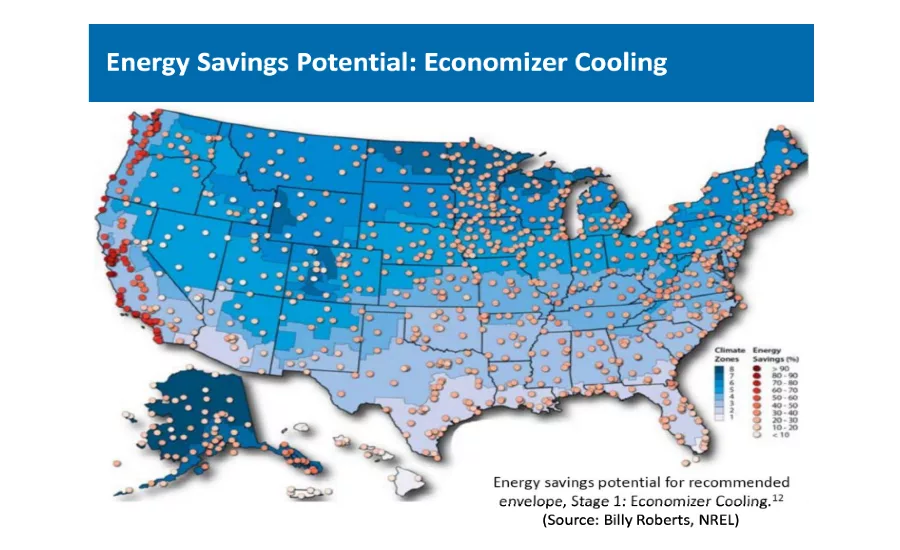
Energy savings potential for recommended envelope – Stage 1: economizer cooling. (Photo credit: Billy Roberts, NREL)
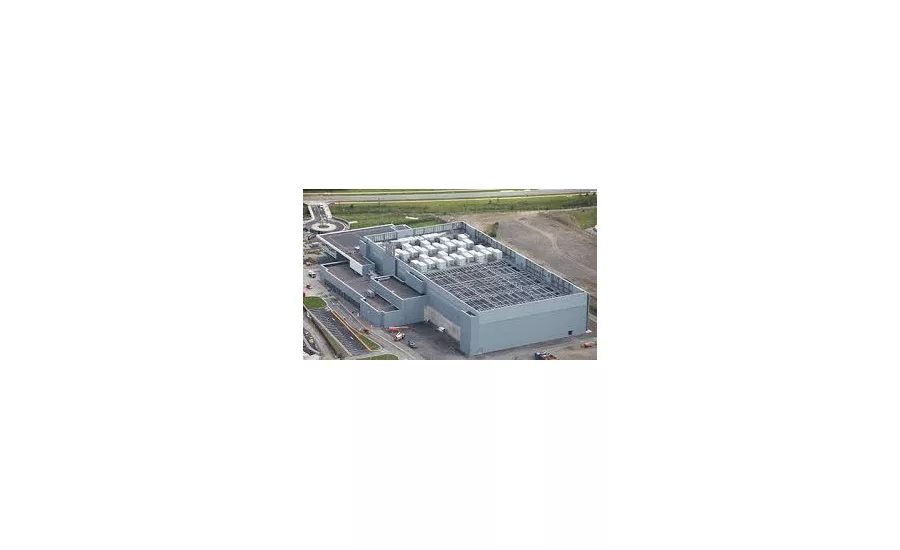
Depending on the location of the data center, airside economizing can save 30%-80% on cooling energy vs. chiller-based cooling systems.
Data centers and their cooling systems have been evolving for many years as engineers continually work on reducing energy costs and improving reliability and sustainability. Advances in the reliability and tolerance to environmental conditions of data center equipment have led many large-scale data centers to take full advantage of the outdoor ambient conditions to provide cooling for the servers and other critical network equipment to lower the PUEs for these facilities. Systems using airside economizing and evaporative cooling have consistently delivered PUEs in the 1.14-1.3 range.
Data centers are unique building applications for airside economizing. The heat created by the data center equipment and the 24/7/365 operation allows airside economizing to be the primary cooling source for a significant number of operating hours. Depending on the location of the data center, airside economizing can save 30%-80% on cooling energy vs. chiller-based cooling systems. One problem that data center design engineers face in utilizing airside economizing is the extreme temperature stratification that can occur in large air-handling unit plenums when the warm return air from the hot aisles fails to mix with colder outdoor air being drawn in to provide cooling and the correct supply air temperature.
Temperature stratification can create significant cold spots that can cause freeze concerns for hydronic coils, which can negatively impact evaporative cooling components. Since many of these units are using large fan arrays, the stratified air can propagate through the supply air into the cold aisle and to critical data center equipment. Data center design engineers often specify supply air temperature tolerances that cannot be met without proper mixing of the outdoor air and return air in the air-handling unit. These engineers have discovered that air mixing can significantly reduce temperature stratification and eliminate problems in the air-handling unit plenum and the supply air to the servers.
Static mixers have been used for more than 50 years in air-handling units with ventilation requirements. Applications like health care, education, and entertainment venues use static mixers to avoid cooling coil freeze concerns, eliminate nuisance unit shutdowns caused by freeze stat trips, and extend useable hours of economizer operation to reduce operating costs. As a “static” component with no moving parts, they are extremely reliable and made of corrosion-resistant materials. The image shows stratified airstreams, represented by red and blue smoke, enter the static mixer. The mixing device creates downstream air turbulence to promote effective mixing, reducing stratification in less than one mixer size in distance downstream of the mixer.
Static mixers are installed in a wall in the plenum downstream of the outdoor air and return air entry points into the air-handling unit mixing box or economizer section — just upstream of filters and the cooling heat exchanger. In many air-handling units, air mixing devices are installed in a dedicated section.
In recent years, dynamic mixers have been introduced into air-handling units. Dynamic mixers integrate outdoor air and return air control dampers for economizer control into a partitioning structure that allows mixing of these two airstreams at the point where the outdoor air and return air leave the control dampers. Dynamic mixers provide the same freeze protection and extended economizer use as static mixers but require minimal downstream distance and eliminate the need for separate outdoor and return air dampers in the air-handling unit. When plenum distance is critical, these devices can save considerable plenum length.
Dynamic mixers are typically installed in the mixing box or economizer section of the air-handling unit. Outdoor air and return air control dampers typically installed in the walls and ceiling of the mixing box are omitted leaving wall openings that align with outdoor air and return air compartments in the dynamic mixer. The frame on the dynamic mixer seals against the wall(s) and/or ceiling and floor of the section to allow all the entering outdoor air and return air to flow through channels where control dampers at the end of each channel direct airflow into the adjacent channel to promote mixing. Mixers can be installed at the air-handling unit OEM’s factory or in the field.
Whether using static or dynamic mixers, effectively mixing these airstreams can insure an even temperature profile of the supply air discharge from the air-handling unit to the cold aisles; eliminate operational problems associated with stratified airstreams in the air-handling unit, including freezing and heat exchanger performance issues; and allow full use of airside economization resulting in significant energy savings and lower PUEs.
Looking for a reprint of this article?
From high-res PDFs to custom plaques, order your copy today!