Berkeley Lab Launches New Research on Airborne Virus Transmission in Buildings
As society prepares to reopen indoor spaces and ease back into some sense of normalcy during the COVID-19 pandemic, a team of researchers at the U.S. Department of Energy’s (DOE’s) Lawrence Berkeley National Laboratory (Berkeley Lab) is launching a study of the risk of airborne transmission of viruses within buildings and how to mitigate those risks.
“As our leaders develop plans to get people back to work safely, we want to apply our expertise in air movement and contaminant removal to inform guidance,” said Brett Singer, head of Berkeley Lab’s Indoor Environment research group. “We’re trying to understand quantitatively what is the risk level under different scenarios of occupancy when you’re doing, for example, normal ventilation or extra ventilation or extra filtration.”
The team will use a combination of simulations and experiments to study the transport of droplets and aerosols within and between rooms.
“A key question is: What is the risk of a building occupant inhaling an infectious virus while in a room or building with one or more infected persons?” said Tom Kirchstetter, director of Berkeley Lab’s Energy Analysis and Environmental Impacts Division, and co-lead with Singer in the research.
Using computer models to study the fate of aerosols
Previous studies have found that respiratory fluid is expelled not only when a person coughs or sneezes but also when they talk, sing, or even just breathe. When an infected person emits these respiratory aerosols, they can land directly on people who are close by — which is thought to be the primary mode of virus transmission — or fall to the ground or other surfaces. But an as-yet unknown portion of the aerosols will also get mixed into the air in the room and eventually into other rooms in the building, representing a potential additional transmission route. The focus of this research is to assess that risk.
“There’s research now that the novel coronavirus actually is very stable in aerosols,” said Singer. “And there is previously published evidence of long-range airborne transmission of other viruses, including the SARS virus in 2003. Understanding how much virus remains airborne is essential to assessing the risk and identifying effective controls.”
The Berkeley Lab team will use computer models to study the transport and fate of aerosols emitted by an infected person in different configurations of room air distribution. Identifying scenarios where infectious doses could potentially occur in various building types, such as residences, classrooms, nursing homes, restaurants, and offices, will be a priority of the modeling activity. Then the team will conduct physical experiments and use detailed airflow models to examine the impacts of building controls, such as ventilation and filtration, on simulated respiratory fluid dispersion and concentrations.
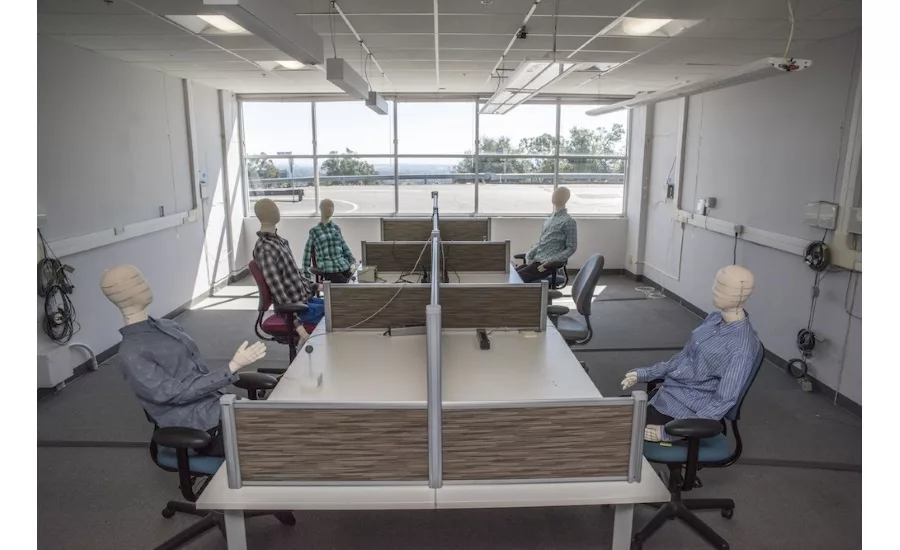
The experimental work will be conducted in Berkeley Lab’s FLEXLAB®, the world’s most advanced building simulator and testbed. FLEXLAB is regularly utilized by builders, architects, and government agencies to test ventilation systems and can simulate the most common HVAC configurations in commercial buildings. The research teams will also study the use of air-cleaning technologies, including building and room air filters, to reduce exposure risk. The team will not be using the actual SARS-CoV-2 virus for testing.
The goal of this research is to provide a set of recommendations for building operation that can decrease virus transmission risk, such as ventilation design and operation, and occupancy and occupant behavior, and communicate that information to public health agencies, Singer and Kirchstetter said. These recommendations would complement social distancing and surface cleaning, they added.
Until this new research has results available, Singer notes ASHRAE has posted a set of resources and guidance.
Calling on Berkeley Lab’s multidisciplinary strengths
Depending on the research trajectory, the team will collaborate with scientists from Berkeley Lab’s biosciences, computing sciences, and earth & environmental sciences areas as well as public health agencies to expand infection-tracking questionnaires. They will be looking to explore factors, such as occupant density, ventilation, air cleaning, and air movement within homes, schools, or businesses that are potential transmission sites.
What the Berkeley Lab research finds will be relevant not only to the current pandemic but more broadly to other viruses. “The insights generated by this research may be useful for controlling the spread of other respiratory infectious agents that come along in the future,” Kirchstetter said.
Berkeley Lab has a long history of research on energy-efficient buildings and indoor environments, including in ventilation and air cleaning, healthy buildings, and pollutant sources and exposures.
“We have a team of really strong indoor air quality scientists that has been doing relevant work for decades, and we have a lot of tools to draw on,” said Kirchstetter. “We’ve studied the transport and fate of many indoor pollutants. A lot of what we know can be directly applied here, and we have experimental facilities that can be configured to simulate air distribution in both commercial and residential buildings.”
Other key members of the Berkeley Lab team are Michael Sohn, who leads the indoor airflow and pollutant transport research group, and Woody Delp, a mechanical engineer and resident expert on filtration and aerosol movement around buildings. The Berkeley Lab team is actively engaged with researchers around the world, including at UC Berkeley and the California Department of Public Health.
The project is supported by Berkeley Lab’s Laboratory Directed Research and Development (LDRD) program, in which the lab directs funding to specific areas of research. Berkeley Lab, like DOE’s other national laboratories, is making COVID-19 research a priority at this time. For more information, visit www.energy.gov/science.
Looking for a reprint of this article?
From high-res PDFs to custom plaques, order your copy today!