Superior Cooling Tower Water Filtration is Key to Protecting Industrial Processes
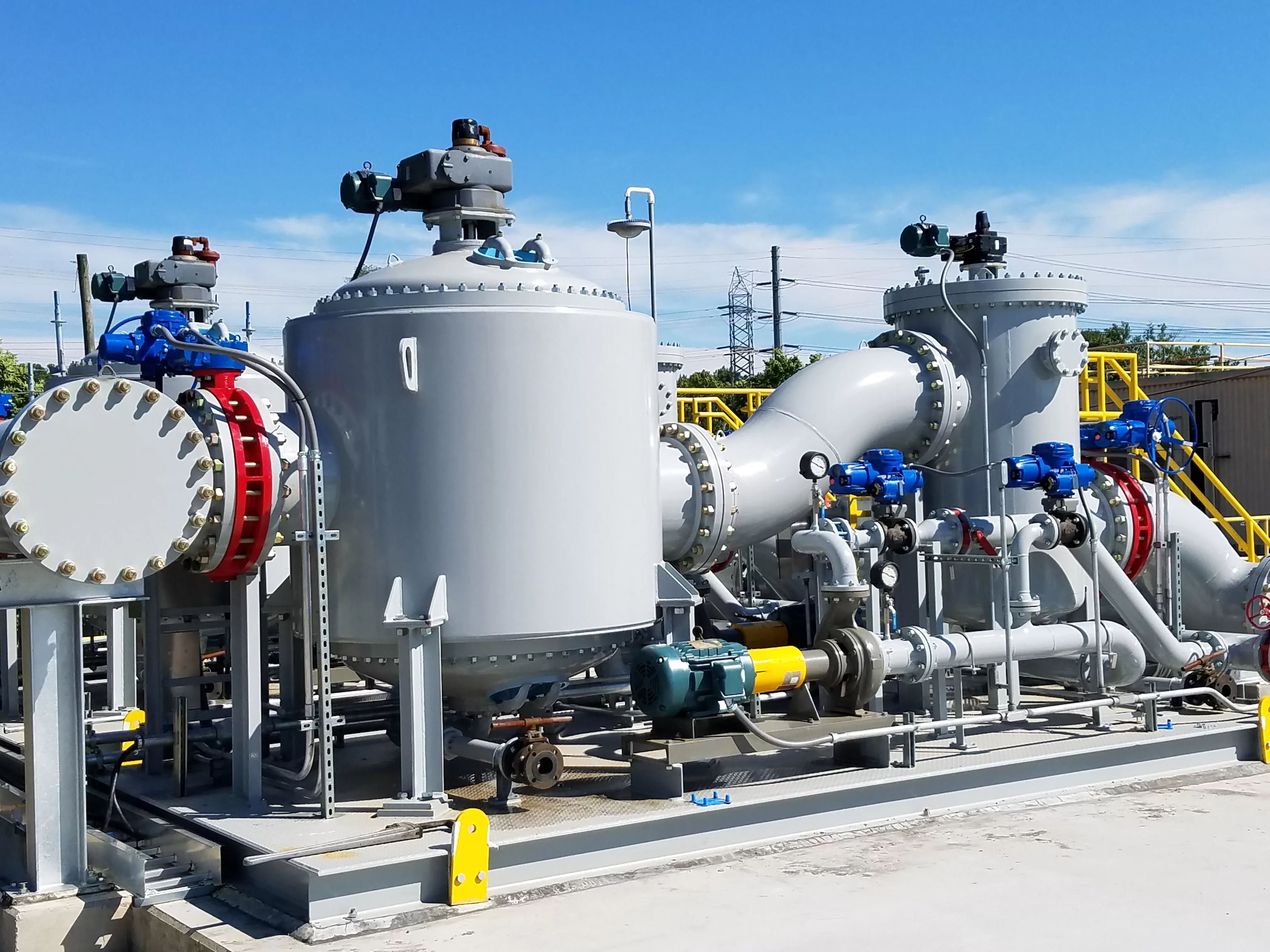
In industrial facilities, such as manufacturing/processing plants, mills/forges, and refineries, cooling towers are often used to remove heat from machinery, heated process material/fluids, buildings, and other sources by exchanging the heat using water or chemical solutions as a coolant.
However, when cooling towers are not closed circuit, air- and water-borne particulate can accumulate, fouling/clogging important downstream machinery and processing equipment, such as chillers, heat exchangers, spray nozzles, and small-bore piping in cooling circuits. This can significantly reduce the industrial facility’s process efficiency and uptime if not sufficiently addressed.
Because cooling towers rely on an evaporative cooling process with exposure to ambient air, any foreign material or elements in the air can easily get sucked into the tower, and a portion of that will either get dissolved into the water or remain suspended in the water. Water flowing through cooling towers can be contaminated from a number of sources, including ambient air, makeup water sources, and residue picked up from processes.
Since the hard water used in cooling towers contains scale-forming minerals (calcium and magnesium salts), the evaporative process leaves these solids behind in the water in high concentrations. Left undiluted, these minerals cause scaling on equipment surfaces. Even a small amount of scale in the system decreases the efficiency of heat transfer, resulting in decreased productivity in industrial processes. In severe cases, scale can completely plug heat exchangers and piping.
Abrasive particulate and suspended solids can also erode heat exchangers, pumps, piping, fittings, and valves, further raising repair and replacement costs. As a consequence, many industrial facilities resort to costly, time-consuming shut down of their cooling water systems a few times annually to clean the cooling tower and downstream equipment.
While traditional methods for cooling tower water filtration exist, such as bag filters, cartridge filters, sand media filters, and basket strainers, these have significant drawbacks in terms of reliability, labor intensive cleaning/change out, and excess downtime.
In response, the industry has developed an option for cooling tower applications that offers significantly greater reliability and efficiency. Today, multi-element, automatic self-cleaning strainers can help to optimize cooling and process efficiency, while minimizing maintenance and downtime.
Optimizing Process Reliability and Production
Bag filters generally can be effective at removing particulate between 5-200 microns in size. However, as bag filters accumulate debris, the units will cause water pressure to drop until the bags are manually cleaned or replaced. Additionally, operators must be careful not to rupture the bag during filtration.
Cartridge filters can be effective for fine filtration, usually between 0.5-50 microns, until they need to be changed. Then, the filter vessel must be taken offline during changeout, which also requires manual labor.
Sand filters do not usually require routine replacement because the filter media can be backwashed with clean water and reused, and the particulate can be disposed of in a drain. However, sand filters must be offline during the backwash process. Also, the backwash can dull the sand granules by grinding their sharp edges against each other, making them less effective at capturing and holding particulate.
Basket strainers are typically inexpensive to purchase but normally only remove larger particulate of 3,000-plus microns through perforated screen elements. Cleaning the units is also usually labor intensive.
To overcome these problems in regard to cooling tower applications, many plant and operations managers at industrial facilities now rely on multi-element, automatic self-cleaning strainers. Advanced designs provide an alternative to bag/cartridge/sand filters and basket strainers. Unlike those designs, a multi-element, automatic self-cleaning strainer can provide continuous removal of suspended solids/particulate. When utilized for industrial cooling tower water filtration, such strainers can reliably filter out sand, silt, and other suspended solids as small as 30-100 microns in size.
A significant feature of the multi-element design is in the engineering of the backwash mechanism, which enhances reliability. With many traditional strainers, the backwash mechanism comes into direct contact with the straining media. This can be problematic, as large, oversized solids often encountered with raw water can become lodged between the straining media and the backwash assembly. The result is straining media damage and/or rupture that can compromise filtration and even other equipment, hindering production. Instead, the multi-element design utilizes a tube sheet to separate the straining media from the backwash mechanism. This prevents the backwash mechanism from coming into contact with the media and damaging the elements.
Industrial operators often also need to consider how to best reduce filter fouling and required maintenance. Traditional strainers can become clogged quickly due to limitations in straining area. When that occurs, cleaning, media replacement or backwashing is necessary, which adversely affects productivity as well as maintenance costs. In this regard, the multi-element design provides three to four times the surface area of traditional strainers and pre-filters. This translates directly into less frequent backwashing so less water goes to waste, less power is consumed, and less maintenance is required.
While traditional media found in large basket designs can lead to collapse and failure under differential pressures as low as 35 psid, the smaller diameter of the media used in the multi-tube strainers enables the strainer to safely handle differential pressures in excess of 150 psig. This protects industrial processes and production, even during high differential pressure events, which could otherwise result in significant downtime.
As an additional protective measure, on advanced multi-element strainers, the drive system includes a shear key, which sacrifices itself in the presence of excessively large debris. So, if large debris were to cause mechanical problems within the strainer, the shear key breaks, protecting the unit’s rotating assembly, motor, and gearbox by halting the drive shaft rotation. Filtration continues, but operators notice an increase in differential pressure as the backwash cycle is interrupted and can take action to clear the obstruction and replace the shear key.
For industrial environments exposed to highly corrosive elements, upgrade options to materials such as super duplex and duplex stainless steels, titanium, Monel, Inconel, and Hastelloy also can provide resistance to corrosion and corrosion-related damage.
When considering technology for industrial cooling tower filtration systems, automatic multi-element, self-cleaning filters are an increasingly popular choice and a reliable, cost-effective solution. For more information, visit www.rpadams.com.
Looking for a reprint of this article?
From high-res PDFs to custom plaques, order your copy today!