Purdue University: More Accurate Climate Change Model Reveals Bleaker Outlook on Electricity, Water Use
If supply doesn't meet demand, expect power blackouts.
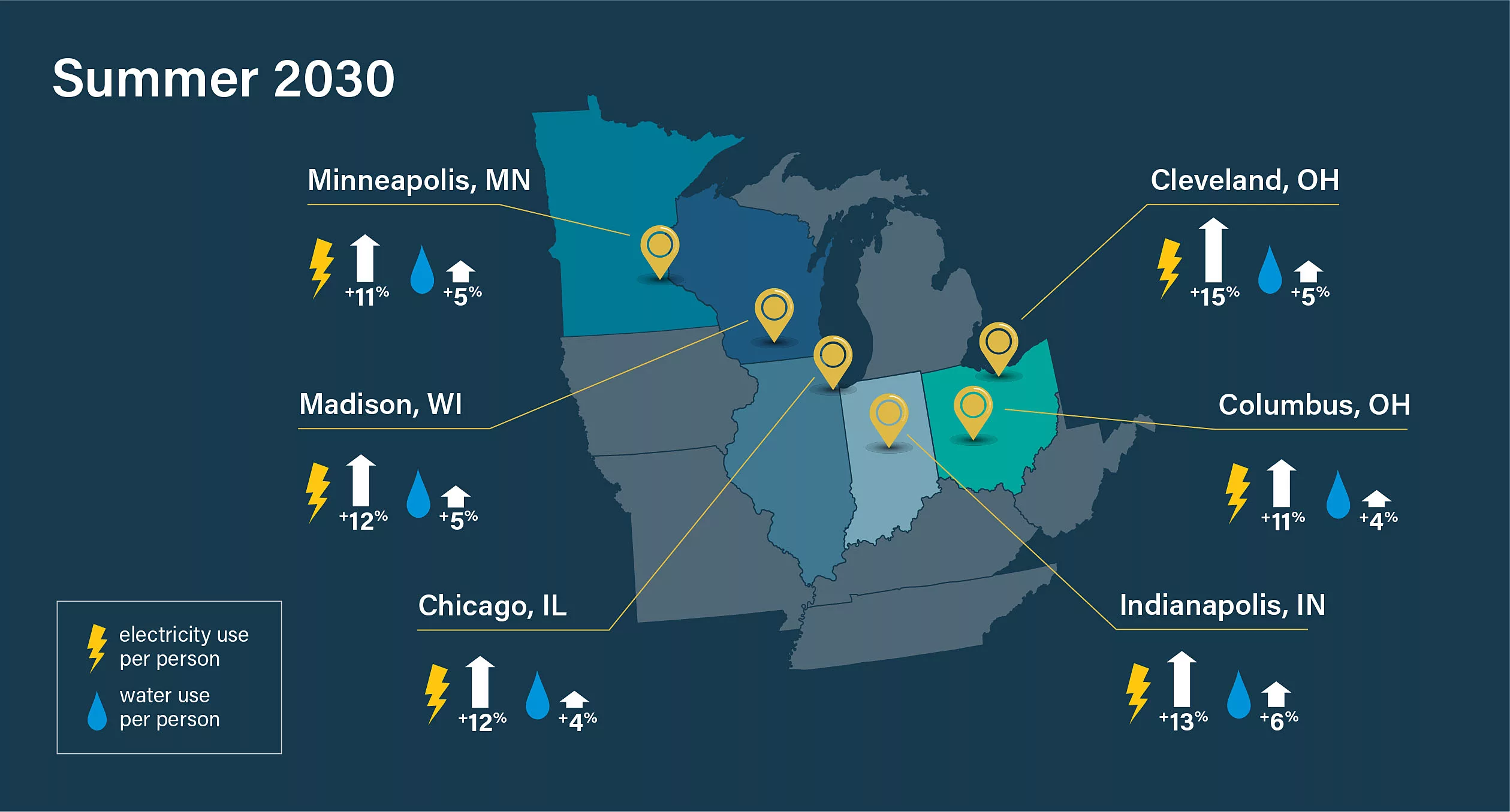
By 2030, global warming alone could push Chicago to generate 12% more electricity per person each month of the summer.
If the city generated any less electricity, it would be risking a power shortage that may require drastic measures to avoid rolling blackouts, according to projections from a model designed by Purdue University researchers. That estimated increase is larger than previous projections because it takes into account how consumers use electricity and water at the same time. The model also considers a wider range of climate features that affect this mixed use, such as humidity and wind speed, making predictions more accurate.
Consumers use both electricity and water when running a dishwasher, heating water, or landscaping. Cities also use water to generate electricity, and electricity to treat and distribute water.
Cities such as Chicago could experience blackouts by 2030 if they don’t prepare to meet projected increases in electricity and water use due to climate change, a new study reports. For a windy city, like Chicago, wind speed matters when estimating electricity and water use. Temperature might play a larger role in the Southwest, where droughts occur.
“Usually, electricity and water utilities work in silos,” said Roshanak “Roshi” Nateghi, a Purdue assistant professor of industrial engineering and environmental and ecological engineering. “But if we want to accurately capture climate-sensitive demand, we need to look at electricity and water together.”
Nateghi’s team partnered with Rohini Kumar, a postdoctoral researcher at the Helmholtz Centre for Environmental Research – UFZ in Leipzig, Germany, to develop the model.
In a study published March 5 in the journal Climatic Change, the collaborative team applied this model to five other cities in the Midwest: Cleveland; Columbus, Ohio; Indianapolis; Madison, Wisconsin; and Minneapolis.
As a whole, the model projected that the Midwest will be using 19% more electricity and 7% more water. And that’s just during the summer. The researchers started with the Midwest because the region typically experiences distinct seasons, but the model could be applied to any region.
While the model’s projections don’t yet take into account population growth or technological shifts, such as increased electric vehicle use, a common baseline model that utilities currently use to predict climate impact considers only how temperature and precipitation affect electricity and water use.
The model developed by Nateghi’s lab considers those variables, as well as relative humidity, wind speed, and large-scale climate phenomena, such as El Niño, which often leads to more mild winters in the Midwest.
“Adding in these other variables makes the model more representative of future climate change scenarios,” said Renee Obringer, the first author on this study and a Ph.D. candidate in environmental and ecological engineering at Purdue.
The model uses artificial intelligence to make predictions on climate change impact. As a learning algorithm, the model is fed years of data from a region’s utilities and weather services and then trained to predict changes in electricity and water use given certain climate change scenarios. These scenarios are when the earth’s temperature increases by 1.5°C or 2.0°C above its mean temperature during the pre-industrial period, approximately 1881-1910.
Climate scientists have predicted that global warming could cross the 1.5°C threshold by 2030 and the 2.0°C threshold by 2055. This means that for Chicago, the best-case scenario is that electricity use increases by 12% and water use increases by 4% if global warming crosses a 1.5°C threshold. But if a 2.0°C threshold is reached, then the worst-case scenario is a 20% increase in electricity use and a 6% increase in water use.
“Such scenarios are fundamental for understanding the joint response of electricity and water uses to future changes in climatic conditions as to understand to what degree our current management and technological strategies need to adapt to the future changes.” Kumar said.
The researchers found that, on average, for each city analyzed in this study, there could be a 10%-20% increase in electricity and 2%-5% increase in water during the summer due to a warming climate.
“A baseline model only looking at temperature and precipitation is used over and over again to develop policies. In the future, there could be significant shortages in water and electricity supply because these models have been significantly underestimating what the actual demand would be,” Obringer said.
While there’s always room for more accuracy, the researchers believe that the level of accuracy achieved by this model should warrant its use now by utilities and city planners to form more effective policies.
“This model provides a much better sense of potential risk for variability and change,” Nateghi said.
This work was funded by the National Science Foundation (grants 1826161 and 1832688) and the Purdue University Center for the Environment. For more information, visit www.purdue.edu.
Looking for a reprint of this article?
From high-res PDFs to custom plaques, order your copy today!