Case in Point
Montclair State University's Innovative Microgrid is a Model for All Universities
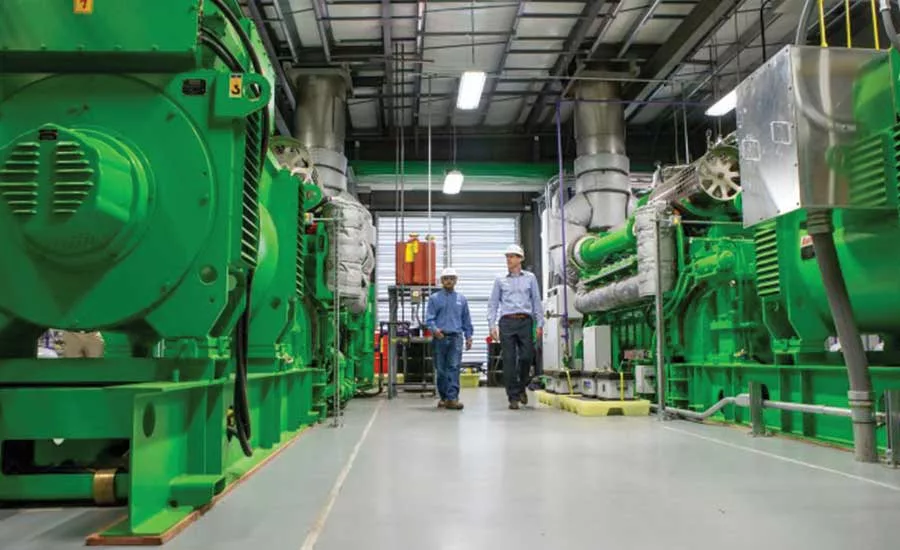
Montclair State’s power plant is built on a 5.4-MW natural gas turbine, which produces enough electricity to power 4,300 average homes.
A university is a lot like a small city, and Montclair State University is no exception. There are 21,000 students enrolled, and more than 5,000 live on-site. The campus has a life of its own, and what keeps everything going is power.
Following historic Hurricane Sandy and statewide interruptions to the power grid, school administrators realized they needed to become power-independent. Not only would it save money, but it would also be more environmentally conscious and reliable. With a long-term vision, they committed to develop and build a co-generation facility, or a combined heat, cooling, and power (CHCP) plant.
The problem with standard power plants is that they’re inefficient. That’s because to create electricity, they use a fuel — gas, oil, coal, or nuclear — to create steam that then drives a turbine. In the process, the system generates an enormous amount of useless heat, making it only about 30-35% efficient, at best.
The beauty of a CHCP plant is its efficiency: It harvests that heat through a heat recovery steam generator and uses it to power chillers and boilers, providing campuswide heating and cooling in addition to generating electricity. The result is well more than double the efficiency, upwards of 80%, while dramatically reducing its carbon footprint.
Of course, all power plants need upkeep. In May 2016, while the gas turbine at the CHCP plant was offline for annual maintenance, a car struck a power pole near the campus, taking down one of two electricity feeders from the local utility to the campus. At this point, the campus was still fully powered from the other feeder, which operates in parallel. But as luck would have it, the remaining feeder was taken out by what can only be considered as a fluke event: A large turkey vulture sat on a nearby power line, opened its wings, and bridged two lines, causing line fuses to blow. This left the campus with no electrical power except emergency generation for critical needs.
The university was forced to postpone final exams and extend the academic semester by a full day. To make sure the university never lost power again, administrators decided they needed to take one additional step in their march toward energy independence: the bold and breakthrough creation of a microgrid.
Surprisingly, microgrids aren’t actually new. The first was developed by Thomas Edison in 1882 at his Pearl Street Station in Manhattan. Many more rudimentary but effective microgrids were installed in rural areas and on farms across many states before rural electrification efforts took hold.
The university had already looked seriously at a microgrid after Hurricane Sandy barreled ashore and took out millions of utility customers across New Jersey and New York, including Montclair State. That’s because the university, even with its own CHCP plant, was still connected to the regional electric grid and depended on that connection to remain fully powered.
The university’s power plant is built on a 5.4-MW natural gas turbine, which produces enough electricity to power 4,300 average homes. It’s combined with boilers and chillers that provide steam for heat and chilled water for air conditioning, supplying a total energy solution to 4 million of the university’s 5.4 million square feet of roofed area. This kind of power plant isn’t unusual among larger campuses, and it worked — until it didn’t.
But the microgrid changed all that. Microgrids are local, independent, and automated. Local in the sense that they’re used for contained campuses, such as universities, military bases, industrial parks, major airports, and research and developing (R&D)/manufacturing plants. These are ideal locations for microgrids because electrical loads from their buildings and facilities can be easily tied together as a single unit. And it’s more efficient to generate electricity locally because considerable energy is typically lost as electricity travels long distances over high-voltage transmission lines.
The independence part is simple: Microgrids can totally isolate themselves from the regional electric grid, essentially islanding the entire campus. What’s more, microgrids are automated. Their controllers take inputs from electrical loads and orchestrate the best use of all available resources. It can respond to off-campus power disturbances in milliseconds and also determine how much, when, and where the microgrid supplies power or needs to take additional power from the local utility.
Beyond the 5.4 MW available from the gas turbine, as well as power directly from the grid, the microgrid incorporates 5.3 MW of emergency generation that can run indefinitely on natural gas or for more than four days on fuel oil.
The CHCP plant, combined with its microgrid, currently saves the university in excess of $4 million annually. It can regulate how much power it purchases from the regional grid and can actually sell power back to the grid operator when the controller determines that that’s the best economic choice.
By having the ability to export power back to the main energy grid, Montclair State is reducing its own energy use and becoming a more environmentally friendly and sustainable partner for its grid power provider, Public Service Enterprise Group (PSEG).
“Montclair State’s microgrid is an excellent use of innovative technology to help the university manage their energy use more efficiently,” said Dave Daly, president and COO, PSEG. “Their system integrates seamlessly with PSEG’s electric grid and is a positive step toward a more cost-effective energy future.”
“The university’s comprehensive and long-standing partnership with PSEG will continue to serve as an asset to Montclair State’s energy management,” said Shawn Connolly, vice president for university facilities. “It definitely helped to have a collaborative energy partner.”
Looking for a reprint of this article?
From high-res PDFs to custom plaques, order your copy today!