Increasing the Sustainability of Distributed Energy Systems in Health Care Facilities
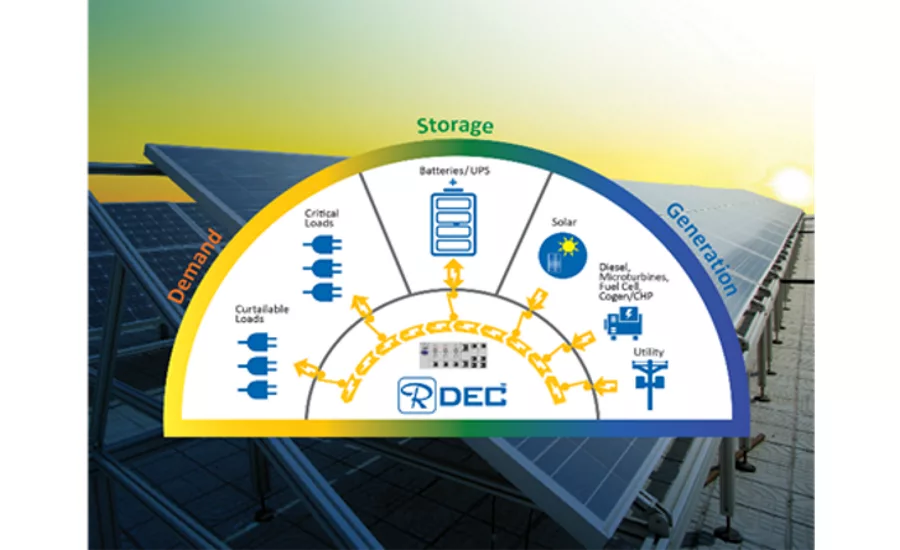
Continuous power supply is critical to maintain health care facilities and the health and safety of patients during emergency operations. As a result, hospitals must have robust power systems to continue operations in the event of a grid outage. Most of these systems are powered by diesel generators. As health care companies seek to improve their sustainability and protect their power systems against risk, they are beginning to incorporate renewable energy into their distributed energy power systems. Sustainable options like solar power with battery backup can mitigate the risks of traditional backup power sources while also reducing environmental impact.
Mission-critical power systems
Traditionally, hospitals’ emergency backup power systems have been designed to remain off during normal conditions, and then to kick in immediately when grid power supply is lost. Most hospital power systems consist of (a) grid power, (b) a diesel generator designed for emergency use only, (c) in some cases a cogen/CHP generator to provide on-going distributed energy, and (d) controls to shut down non-critical loads during an outage. A distributed energy controller acts as the physical and system control conductor of the orchestra of generation and demand resources, providing safe, reliable, continuous power.
While diesel generators are safe and reliable, their energy costs are higher than solar energy’s zero marginal cost. They also produce emissions and can be subject to emissions penalties if used too much outside of an emergency, and they are subject to fuel unavailability risk in the event of a natural disaster.
Although hospitals contract with a fuel supplier to replenish diesel stores during emergencies, conditions during very severe emergencies, such as floods or earthquakes, can prevent fuel from being delivered.
Renewable energy’s role in powering health care
Increasingly, health care facilities are considering renewable energy sources as part of their power generation portfolios. While 100% renewable solar and battery-powered systems are theoretically possible, in most instances they would require more space than is available (due to the need to build a system large enough to produce electricity both for daytime use and to store it for nighttime and for days when clouds reduce solar power production). What is more often feasible is to incorporate solar and energy storage as space allows and use these resources to supplement and diversify more traditional nonrenewable sources. These facilities will be able to use the lowest cost and cleanest power first — solar — followed by cogeneration or grid power and by diesel generation in an emergency.
Benefits and challenges
Since solar power with battery backups is not dependent on delivered fuel, on-site solar generation serves as insurance against the risk of fuel interruption by reducing diesel generation and allowing fuel stored on-site to be used for longer periods in an emergency. In addition, as a renewable resource, solar systems help achieve corporate sustainability objectives.
There are three challenges to incorporating solar power and battery systems in a health care mission critical facility. First is addressing the concerns of facility power managers that intermittent generation sources, such as solar, can be safely integrated into a mission critical power system without jeopardizing reliability.
A state-of-the-art distributed energy controller can safely and reliably achieve that integration. Second, PV systems require space, and space at health care facilities, especially rooftops, can be limited. Creative siting, such as PV-covered parking canopies, can provide options. Lastly, some of the cost savings for solar power and batteries come from federal investment tax credits and accelerated depreciation. Not-for-profit organizations can harness these benefits by leasing systems from system integrators. With forethought, these challenges can be addressed as health care facilities plan to incorporate sustainable power systems into their power portfolio.
Conclusion
Continuous power supply, regardless of emergency circumstances, is critical to the operation of hospitals and other health care facilities. Incorporating solar power and battery backup into a hospital’s power generation portfolio with care given to the challenges these systems present can improve power supply availability, sustainability, and cost — even through major emergencies.
Looking for a reprint of this article?
From high-res PDFs to custom plaques, order your copy today!