Puzzling Together a 2,400-ton Cooling Tower in 400 Sized-to-fit Pieces
How one design firm strategically made everything fit in One Logan Square’s retrofit
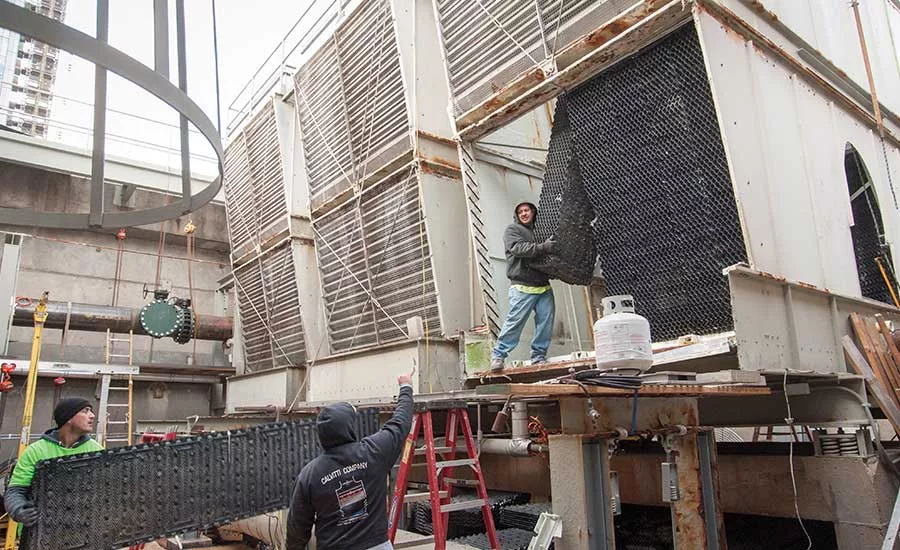
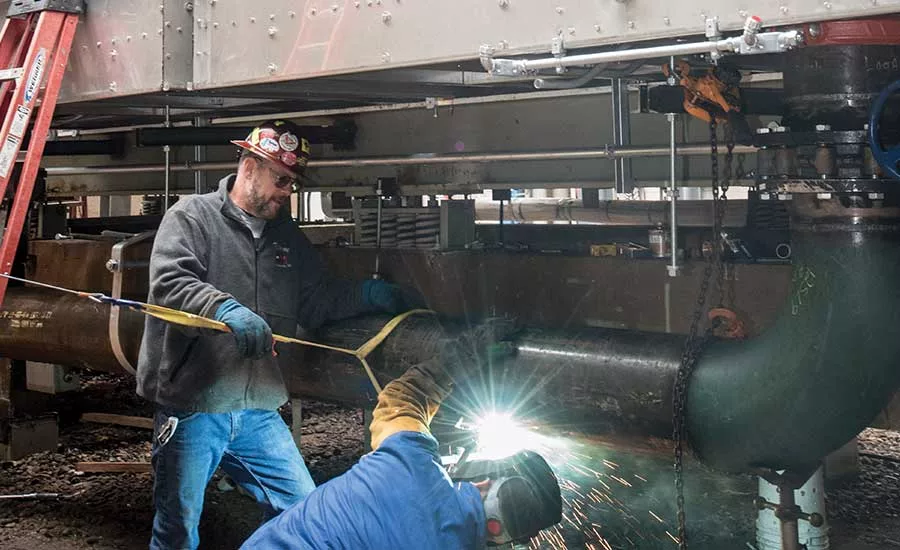
FIGURE 1. Limbach welders assemble an equalizer line near the end of the project.
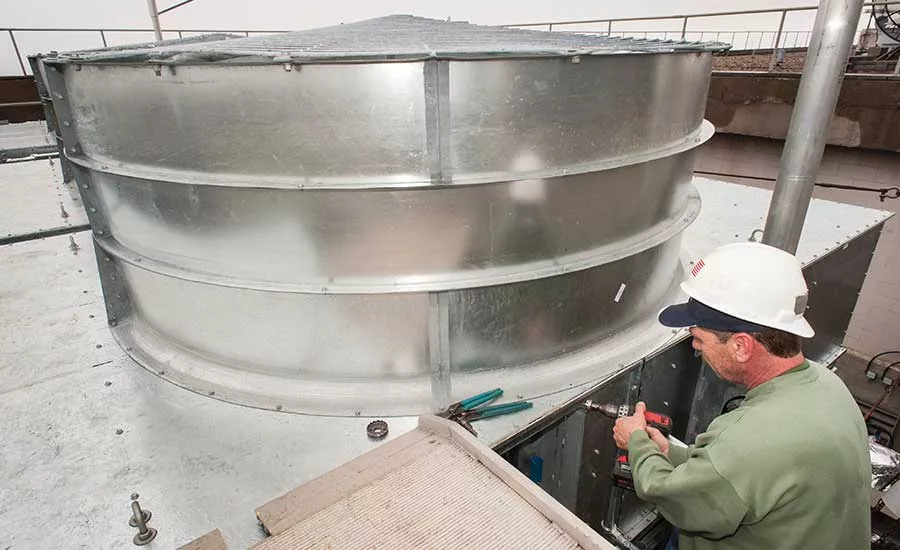
FIGURE 2. Neither a crane nor helicopter were options to lift equipment to the roof, so the new cooling towers were delivered knocked down and required assembly on top of the building.
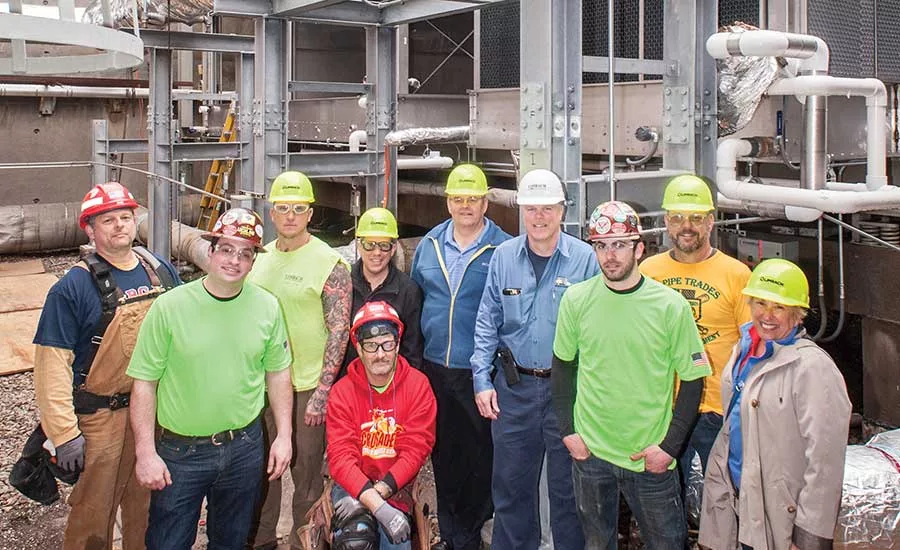
FIGURE 3. Calvitti Co. and Limbach Co. completed the retrofit over the 2107-2018 heating season without taking the system offline for more than 12 hours.
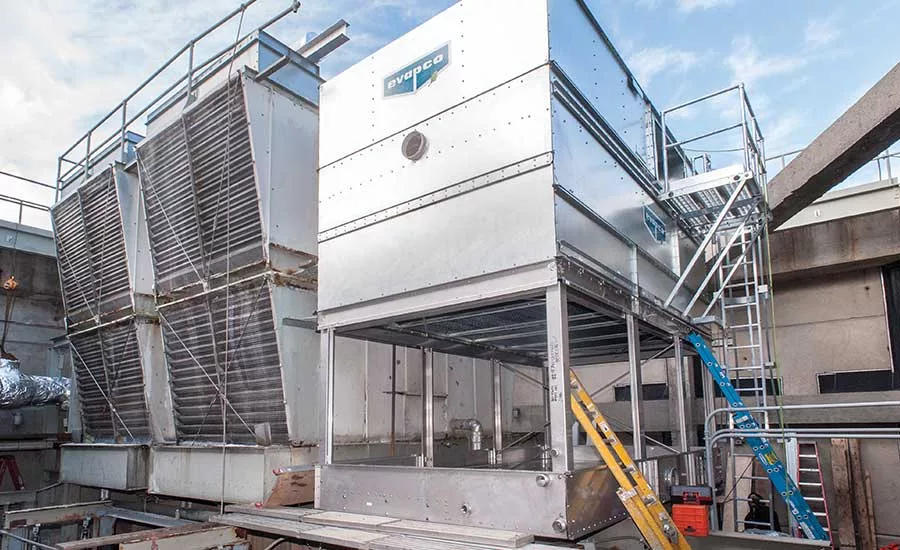
FIGURE 4. The existing three-cell crossflow cooling tower was replaced with a stainless steel Evapco AT Series counterflow system.

FIGURE 5. Built in 1983, One Logan Square is a 32-story office tower in Center City Philadelphia.
There’s no one-size-fits-all solution for a cooling tower replacement. This is especially true in urban population centers and atop high-rise buildings.
Built in 1983, One Logan Square is a 32-story office tower in Center City Philadelphia. It stands out aesthetically from its surroundings due to its trapezoidal footprint. The building was recently renovated, and the last remaining need was the replacement of the original cooling tower.
“We take great pride in each of our properties, and it is our priority to continually invest in creating high-quality, sustainable, innovative buildings that continue to attract high-caliber tenants,” said Tom Holden, Brandywine Realty Trust’s chief operating engineer at One Logan. “We elected to replace the three-cell cooling tower to improve efficiency and optimize the building’s systems, and while it presented engineering and logistical challenges, we knew it would be worth the investment and that our expert partners would execute the intricate project well.”
Limbach Co. LLC has serviced the building’s entire chiller/boiler system for years. As one of the largest design-build construction companies in the country, Limbach was a logical partner for the project. Cooling tower replacements are commonplace for the large firm. The team quickly realized that the scope and unique challenges of replacing the 2,400-ton cooling tower at One Logan made the ambitious project a true collaborative process.
Joint Effort
Brandywine engaged a consulting engineer to determine the required tower specifications and sizing and to act as the owner’s representative during the selection process. Their job was made more difficult because the existing towers hadn’t been certified for capacity by the Cooling Tower Institute (CTI). The building operators knew that the existing towers were inadequate, but it was up to the consulting engineer to determine the requirements.
After a careful analysis of the chiller, tower, and pump operations, the consulting engineer determined the required tower capacity. The building owner requested that the new towers be more accessible, so features such as access ladders, hatches, and davit arms were specified.
With the tower specifications in hand, the Limbach team donned hard hats to determine the best way to fit the new towers to the existing site. Designers inspected and measured steel dunnage and located existing supply, return, and equalizer piping. It was determined that the existing steel was of adequate size and condition to be reused for the new towers and that the existing vibration isolation spring mounts could also be reused, greatly simplifying the installation. Even the VFDs could be used again, though the electrical feeds would need to be reworked.
Although the existing piping was adequately sized, the supply and return arrangement would need to be modified to accommodate the new towers as well as the existing pipe supports.
From these determinations, the construction and design teams could make ample use of their design-build approach. The teams spent a day together on-site to develop a piping and support layout that would fulfill the new tower requirements. The plan called for building to occur in stages. New piping and electrical connections were identified and laid out to allow tie-in to existing systems with minimal downtime.
“Avoiding downtime on this project was quickly identified as the first concern,” said Christine Batchelor, account manager at Limbach. “But the fact that neither a crane nor helicopter could be used to exchange the cooling towers greatly complicated things.
“Our team of Joe Carango and Tom Sherwood knew we needed to tap the expertise of Eric Calvitti, director of field operations at our tower subcontractor, Calvitti Co., to have a successful project,” she added.
The restrictive layout of the mechanical space, along with the inability to lift the cooling towers to the roof, required a six-month design process. Limbach worked with Calvitti Co. — leaning on the company’s 60 years of experience with cooling tower applications — to replace the original crossflow cooling tower for a new, CTI-certified Evapco AT Series counterflow tower.
Tim Schmidt, with rep firm Energy Transfer Solutions (ETS), and Adam Radford, global products manager, Evapco, also weighed in and focused on the need to deliver an unassembled cooling tower with previously selected CTI certification.
“CTI Certification was the key on this job because the existing tower was underperforming despite being sized for the full cooling load,” said Radford. “Some of that was due to its age, but tower certification didn’t exist 35 years ago either. Brandywine needed proven and tested technology that would provide 100 percent capacity while also fitting the available space.”
The AT Series towers are available with a 20-by-18-foot box size, which allowed the installation of three cooling cells in the penthouse space without requiring any steel rework, which would have added substantial cost.
But the mechanical design was only half of the equation. Once the system was on paper, a plan to execute the work needed to be determined. Limbach technicians would handle all piping, electrical, and control work, while the Calvitti Co. would be in charge of tower construction.
Avoiding Downtime
“The Calvitti Company focuses primarily on cooling tower installations, but they’re adept at fan balancing, pump repair, and vibration analysis as well,” explained Batchelor. “The way they designed and implemented the replacement at One Logan is impressive.”
Calvitti’s plan maintained partial cooling capacity throughout the whole process by phasing replacement of the cooling tower cells. Beginning the project in early November 2017, a deadline was set for the following April. It was imperative to have an operational cooling tower during the entire process. As one unit was installed, another unit was always up and running.
Two of the existing three cells were temporarily piped and controlled to maintain operation while one cell was demolished. Within two weeks, the first cell of the new Evapco tower was erected.
The remaining towers were taken apart in early January. While winter weather meant frigid rooftop working conditions, it also ensured that the first cell of the new tower could easily handle the building’s entire cooling load on its own.
“The final two cells were removed and replaced simultaneously,” said Calvitti. “Our crew worked side by side with Limbach’s welders during demo and construction, and everything went smoothly. All told, there was only one scheduled 12-hour period of downtime over the weekend.”
No Way But Up
The challenge of keeping the system operational throughout the project was upstaged by only one problematic logistical element. Physically removing the old towers from the roof and getting the new ones to the 32nd story mechanical penthouse took a good deal of foresight on the part of Calvitti Co. and Evapco.
“Considering the size of the cooling tower cells and the building’s 400-foot height, using a crane was out of the question,” said Calvitti. “Generally, when height is the obstacle, we hire a helicopter service, but the facade surrounding the cooling tower was designed in a way that a helicopter lift wasn’t possible either.”
The open-air portion of the penthouse features diagonal concrete bracing in two corners, providing mere inches of clearance from the original tower and only several feet from the new, smaller unit. With the full weight of a cooling tower suspended from a cargo helicopter, the margin of error was too small to complete the operation safely.
The only remaining option was to use the building’s cargo elevator as the conduit to transport the old cooling tower down and the new one up — piece by piece.
Knock Down, Drag Out
“We used demolition saws to cut the old tower into manageable pieces and palletized them before sending them down the elevator,” said Calvitti. “I calculated 18,000 pounds of debris per cell.”
A cleaner job, though more complicated, was bringing the new equipment up. All material was delivered on a single day in late October. Some components, like a 600-pound, 20-inch inlet water tee, provided a weight challenge, while others were limited by the dimensions of the elevator.
The AT Series towers aren’t designed for delivery in an 8-by-10-foot elevator. It’s here, before the design was even finalized, that Radford and Tim Schmidt at ETS modified the tower design to fit the dimensions of the elevator. Ultimately, the new cooling tower went up in 400 pieces, sized to fit.
“Evapco is willing to work with us to accommodate challenges like this one,” said Calvitti. “I don’t think any other manufacturer would have custom built a tower for this job.”
The floor and casing panels, along with framework, required the most modification. Once upstairs, panel segments were bolted together with gaskets in between. Calvitti explained that the increased labor was negligible compared to the cost of a crane or helicopter, even if those means of transportation had been available.
New piping support steel was also designed in sections so that it would fit onto the elevator and could readily be assembled in place on the roof. Piping would also be brought to the roof in the freight elevator, limiting the length of any one section to 10 feet. Because of the preconstruction collaboration, systems were deliberately laid out to adapt to these unusual site requirements.
“Things came together without problems because we had anticipated the logistical issues as well as the implementation plan,” said Neal Ryan, project manager, Limbach. “Our engineers knew how we were going to build things, and they designed accordingly. The piping supports came together just as planned, enabling the ambitious schedule to be met.”
Eye on Efficiency
Providing the same cooling capacity within the existing mechanical footprint was an absolute necessity, but reducing maintenance costs and raising efficiency weren’t overlooked during the design phase.
Thanks to improved fan design, tower design, and fill material, each of the new cooling tower cells uses a 40-hp fan motor, replacing the 50-hp models that served the original tower. A few years ago, Limbach retrofitted the existing fan motors with Yaskawa VFDs. Those drives were still serviceable and were reused on the fan motors supplied with the new tower.
Because squeezing as much capacity and efficiency out of the existing mechanical footprint was so critical, the AT Series tower benefits from the use of Evapco’s EvapJet nozzles. With its larger coverage pattern that reduces inconsistent voids and water loading, the nozzles provide up to a 3.5 percent increase in thermal performance over conventional nozzles and dramatically reduce the number of nozzles needed.
“The EvapJet nozzles have a very large orifice and no moving parts, meaning less maintenance,” said Calvitti. “They come installed on the inlet water piping, so we give the nozzles very little thought during or after installation.”
Brandywine expects to see a decrease in energy costs, and a substantial life cycle cost improvement over the previous cooling towers.
“Start-up of the last two cells took place in early March — more than a month before deadline,” said Holden. “It’s absolutely amazing what Calvitti and Limbach were able to accomplish in a single day.
“We use very few contractors in this facility because our engineering department handles most of the work in-house,” concluded Holden. “But I have complete trust in both of those companies.”
Looking for a reprint of this article?
From high-res PDFs to custom plaques, order your copy today!