Case in Point
Dehumidifier Retrofit Helps Community Pool Dive Into Energy Savings
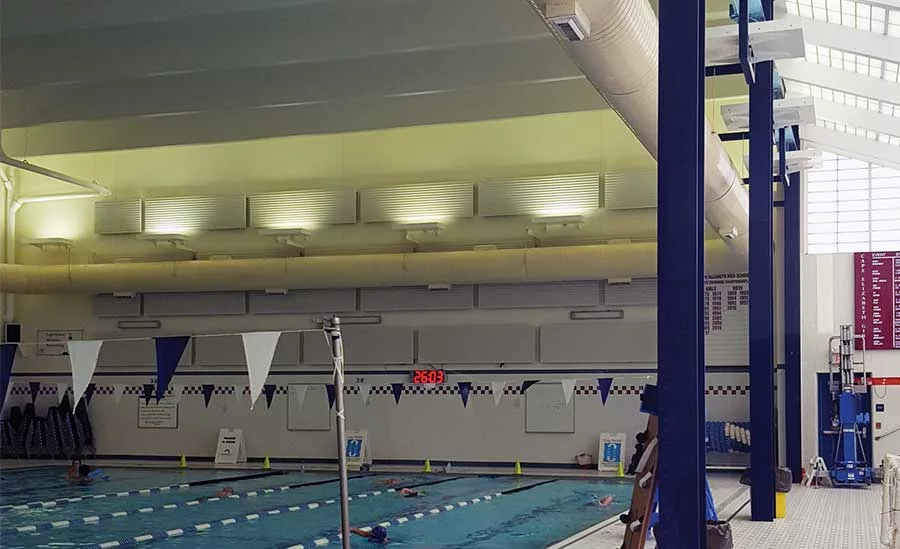
The Donald Richards Community Pool in Cape Elizabeth, Maine, recently finished an $800,000 renovation that included new boilers and a new dehumidifier system. Officials said the retrofit will improve IAQ, keep relative humidity in check, and decrease maintenance costs.
The retrofit of the Donald Richards Community Pool HVAC system was by no-means a conventional drop-in replacement. Instead, Cape Elizabeth, Maine, officials opted for an upgrade that reduced their refrigerant liabilities and chloramines, efficiently recovered heat, increased mechanical equipment life cycles, and more.
The $800,000 renovation included new pool support pumps, filters and UV water disinfection systems, and other improvements. However, dehumidifier replacements and new energy-intensive mechanical systems are anticipated to do the most work in bringing the retrofit’s payback under nine years.
The design was conceived by Greg Marles, CPO, CPM, LEED-GA, the city’s former director of facilities and transportation. Marles then handed his goals list to engineering firm, Harriman Associates in Auburn, Maine, for CAD execution and confirmation.
The city accomplished several design objectives, including a reduction in chloramines and improved IAQ, increased boiler efficiencies, and decreased maintenance costs. The project also cut environmentally damaging refrigerant use by 75 percent, returned the natatorium to 83°F and 81° space and water temperatures, respectively, and achieved 50 percent rh.
The project was the pool’s third HVAC retrofit after installing a modern direct expansion (DX) dehumidifier in 1996 to replace the original supply/exhaust system that didn’t offer dehumidification.
The former 30-ton dehumidifier was a two-circuit, four-stage model that had surpassed its life cycle. Space temperatures were an uncomfortable 85° and rh averaged 75-85 percent, because the primary compressor was inoperable, and the secondary compressor/circuit couldn’t maintain levels.
“The dehumidifier had degraded enough to where it required approximately $30,000 annually the last four years to maintain,” said Marles.
This dehumidifier also made it impossible to maintain ASHRAE-recommended two-degree differential between space and water temperature to minimize evaporation, which also added to high rh levels. Instead, space/water temperature differentials fluctuated as much as 10°.
“It was a Catch-22 situation,” said Marles. “The dehumidifier’s shortcomings prevented me from maintaining rh set points, and because the rh was high, the resultant higher space temperature increased evaporation rates that the dehumidifier couldn’t handle.”
Further surpassing the dehumidifier’s moisture removing capacity shortcomings, the city had added an inflatable obstacle course that increased water evaporation by 10 percent.
Other operational challenges were intolerable rates of chloramines, a very common respiratory irritant byproduct present in indoor pools where chlorine molecules chemically bond with contaminants and form a heavy gas along the water surface.
Marles’ goals were to maximize equipment life cycles where the previous equipment fell short. For example, the protocol features coils and a double wall-insulated encasement fully dipped in an anticorrosion coating. Unlike the previous dehumidifier, the protocol’s design positions components and electronics in protected compartments out of the humid, chemical-laden airstream.
Most importantly, the unit is designed with dozens of sensors and transducers that report more than 60 real-time parameters to its on-board CommandCenter, which can be accessed remotely by Seresco’s proprietary web browser-based WebSentry from a smartphone or PC. Marles’ successor, Perry Schwarz, director of facilities and transportation, checks operating parameters at least weekly. Facility maintenance mechanic Bernie Shannon checks natatorium temperatures and rh daily as well as the software’s recorded historical data for any unwanted space or water temperature spikes that last 24 hours.
If the protocol encounters a problem, WebSentry sends an alarm immediately to authorized personnel. With the ability for periodic monitoring, the dehumidifier is assured to run as efficiently as it was designed rather than discovering an inefficiency during a semi-annual service call.
The retrofit design also required glycol to limit the city’s reliance on refrigerants that can potentially leak and cause environmental damage and costly repairs. For example, the Protocol dehumidifier uses 75 percent less refrigerant than the unit it replaced. Instead, heat rejection uses glycol piped to dry coolers. Glycol is a fraction of refrigerant costs, uses polyvinyl chloride (PVC) pipe instead of expensive copper pipe, is environmentally friendly, and doesn’t require EPA-certified service technicians.
“I like the fact that a factory is a controlled, cleaner environment that limits noncondensable contaminants that can occur from field soldering and assembly,” said Marles.
Although the penthouse’s 32-inch pedestrian door posed no problem for removing the old dehumidifier when dismantled in pieces, rigging in a new intact dehumidifier was impossible. Instead, the city built in a construction addendum to reconstruct the penthouse wall with two 4-by-7-foot doors that would enable any future equipment replacements. Another accessibility innovation was requesting a dehumidifier configuration that offered the greatest access and serviceability within the small penthouse.
The design also included three new condensing boilers — one boiler manufactured by Viessmann Manufacturing Co. to isolate the 10,000-gallon spa’s heating; and two condensing boilers manufactured by Rinnai Corp as backups to the Seresco dehumidifier’s heat recovery pool water heating. The natatorium is now maintained to tight tolerances of 83° and 81° space and water temperatures, respectively, to minimize evaporation and supply unprecedented air comfort.
The city also designed a tie-in of the adjacent high school’s two existing high-speed, oil-fired space heating boilers via a heat exchanger, which saves the facility several thousand dollars in annual energy costs. The boilers now tie into pool and spa water heating as a winter months option since they typically use only two-thirds of their 6 million-Btu capacity. In spring, summer, and fall months the facility’s BMS can automatically convert to the condensing boilers again.
The new six Pulsar pool water pumps manufactured by Pulsafeeder Engineered Products were also outfitted with VFDs manufactured by Siemens USA that are controlled by the BMS to efficiently control flow rates according to usage. Two pumps supply the Seresco heating mode, and an additional two control heat rejection to the pool or dry cooler so that optimum energy efficiency is accomplished.
Looking for a reprint of this article?
From high-res PDFs to custom plaques, order your copy today!