ANSI/ASHRAE Standard 170-2017 -- What's New?
Additions include the approval of adiabatic humidifiers, control clarifications, and more.
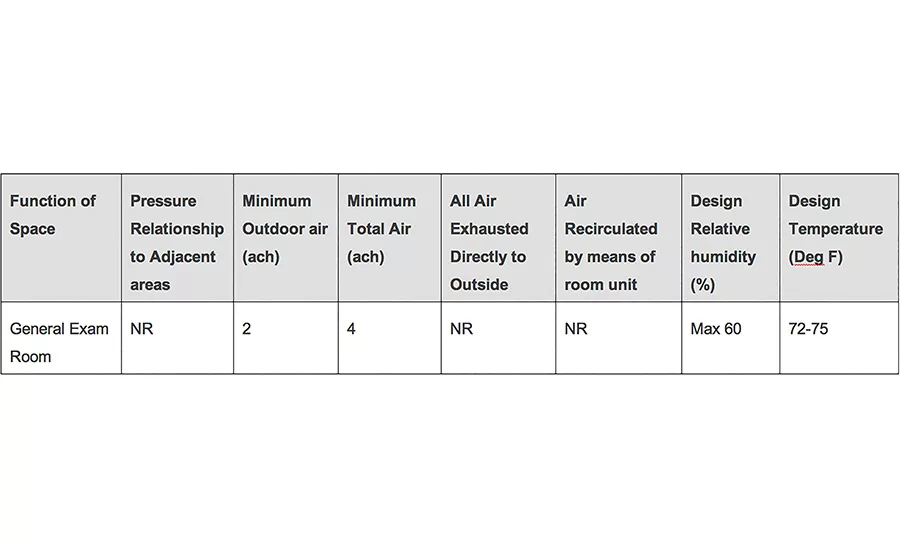
TABLE 1. General exam room.
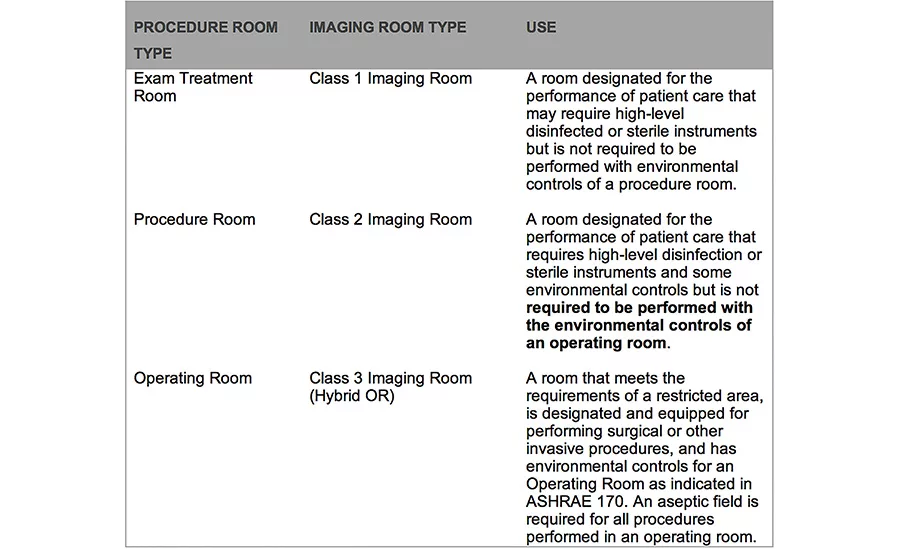
TABLE 2. FGI Guidelines 2018 – Imaging Classification.

TABLE 3. Updated ECT requirements.
The provision of adequate ventilation is an essential factor in maintaining patient wellbeing in a health care setting; therefore, maintaining acceptable IAQ has become a huge challenge for health care facilities. One of the most important parts of ensuring proper IAQ is supplying the appropriate amount of ventilation to replenish oxygen, remove carbon dioxide, and reduce the activity of airborne pathogens.
ASHRAE 170, “Ventilation for Healthcare Facilities,” was first published in 2008 to address the specific ventilation needs and engineering requirements in a health care environment. Prior to 2008, there was no specific standard available to address the ventilation requirement for health care facilities. Prior to 2010, ASHRAE standard 62.1, “Ventilation for Acceptable Air Quality,” contained Appendix E, which was specific to health care facilities. This part of ASHRAE 62.1 no longer exists, as those requirements were completely transferred to ASHRAE 170 when it was issued in 2008. The standard has been incorporated in the Facility Guideline Institute’s Guideline for Design and Construction of Healthcare Facilities since 2010.
Health care engineers should be aware that this standard only serves as a minimum requirement and does not prevent a more stringent approach by the city, state, or federal government. During design, it’s important to coordinate what standard is more stringent for application to a health care project. There are more than 100 types of spaces with different uses in health care environments, and the standard stipulates a minimum engineering design requirement for each type of space.
The new ANSI/ASHRAE/ASHE Standard 170-2017, “Ventilation of Health Care Facilities,” can be adopted in part or as a whole by authorities for health care facility construction and private organizations. In 2018, FGI incorporated Standard 170-2008 as part three of its Guidelines for Design and Construction of Hospitals. This includes all addenda, present and future, issued by ASHRAE. The Center of Medicare and Medicaid Services (CMS) no longer adopts design standards (with the exception of the Life Safety Code), and every state will vary in its adoption process of the FGI Guideline 2018. The joint commission, federal agencies, and authorities in 39 states use the FGI guidelines either as a code or a reference standard when reviewing, approving, and financing projects or when surveying, licensing, certifying, or accrediting newly constructed facilities. Some states have written their own standards and use the guideline as a model (e.g. California, Texas). The following is a summary of the adoption of this guideline throughout the U.S.:
-
Thirty-nine states have adopted some edition of the guidelines (this includes Wisconsin, which has adopted only the HVAC requirements);
-
Seven of the states that have adopted the guidelines permit use of a more recent edition than the one the state has adopted in some instances;
-
Four states do not adopt but allow use of the guidelines as an alternate path to compliance in some instances; and
-
Seven states do not use the guidelines in any official capacity, although most of these appear to use the documents for reference.
There were several addenda issued for ASHRAE standard 170-2013. These addenda to the standard have been published to provide updated requirements to address committee input and suggestions, improve coordination between the standard and the FGI guidelines, and reflect determinations from proposed changes and requests for interpretations. These addenda have been incorporated in the new ASHRAE 170-2017.
The 2017 edition includes several significant improvements:
-
The addition of adiabatic humidifiers as an acceptable type of humidifier;
-
A new type of exam room with lower requirements for less acute applications;
-
Clarification that controls to change pressure relationships between spaces are prohibited for all spaces, not only airborne infection isolation and protective environment rooms;
-
A reduction in requirements for electroconvulsive therapy procedure rooms;
-
A reduction in requirements for laboratories when allowed by certain calculations;
-
Higher requirements for higher hazard exhaust airstreams;
-
Coordination of space temperature requirements in the sterile processing department with other industry groups; and
-
Clarification of the definition of the primary diffuser array in operating rooms.
The 2018 FGI documents consist of three separate books; this 2017 edition of the standard for ventilation of health care facilities was also reformatted into three sections: hospital spaces, outpatient spaces, and nursing home spaces.
Humidification
Section 6.6 addresses the new humidifier requirements. When outdoor humidity and internal moisture sources are not sufficient to meet the requirements of Tables 7.1, 8.1, or 9.1, humidification shall be provided by means of the facilities’ air-handling systems. Steam or adiabatic high-pressure water-atomizing humidifiers shall be used.
The new guideline incorporated the addendum that allowed the addition of adiabatic humidifiers as an acceptable type of humidifier for inpatient health care facilities. Adiabatic humidification systems allow water particles to be better absorbed by the surrounding air system, improving indoor air management. Water treatment for these adiabatic humidification systems is needed to ensure water remains pure, clean, and free from biological contaminants, improving the microbiology of the hospital environment. Hence, humidifier systems will require reverse osmosis (RO) water, UV sterilization, and filtration to maintain purity.
The expectation is to use these systems in health care facilities, where steam is not available or in a new health care system, where the facilities personnel want to reduce the reliance on steam due to the difficulty in maintaining steam pipes and appurtenances.
Burn units are now required to have individual humidifiers to enhance the indoor environment for burn patients.
A new type of exam room with lower guidelines for less acute applications
The guideline now includes general exam rooms in Table 7.1 with a reduced air change requirement. The requirement reduces the ach to 4 from the 6 ach that was used for all exam rooms in the previous standard.
Imaging Rooms using Anesthetic Gases
Imaging rooms using anesthetic gases shall meet air change rate requirements for operating rooms.
These changes in imagining rooms serve to coordinate with the new FGI guidelines that redefine the imagining criteria for hospitals.
Clarification that controls to change pressure relationships between spaces are prohibited for all spaces
Section 7.1 of the hospital guideline stipulates that controls intended to switch the required pressure relationships between spaces from positive to negative, and vice versa, shall not be permitted. This addresses the confusion on whether a room can be positive for one procedure then changed to negative for another. This was a confusion that was created due to health care planners trying to combine procedure rooms that have opposite pressure relationships.
A Reduction in guidelines for electroconvulsive therapy procedure rooms
The American Psychiatric Association (APA) defines electroconvulsive therapy (ECT) as a medical treatment that is most commonly used in patients with severe major depression or bipolar. ECT involves a brief electrical stimulation of the brain while the patient is under anesthesia. The guideline now incorporates addendum K that was published in August 2016. Table 7.1 was updated to show the new criteria for ECT procedure rooms.
A Reduction in guidelines for laboratories when allowed by certain calculations
Table 7.1 contains minimum requirements for laboratories but also includes Normative Notes (f) and (v). Note (f) states that higher ventilation rates above the total ach listed shall be used when dictated by the laboratory program requirements and the hazard level of the potential contaminants in each laboratory work area. Lower total ach ventilation rates shall be permitted when a hazard assessment is performed as part of an effective laboratory ventilation management plan per ANSI/AIHA/ASSE Z9.5. American National Standard for Laboratory Ventilation 13 determines that either (a) acceptable exposure concentrations in the laboratory work area can be achieved with a lower minimum total ach ventilation rate than is listed in Table 7.1, or (b) a demand control approach with active sensing of contaminants or appropriate surrogates is used as described in ASHRAE Handbook — HVAC Applications, chapter 16 (Laboratories).
Note (v) states that room temperature ranges that exceed the minimum indicated range shall be permitted if required by the laboratory program or laboratory equipment.
Higher guidelines for higher hazard exhaust airstreams
The guideline defines additional requirements for higher hazard exhaust airstreams, such as AII rooms, bronchoscopy and sputum collection exhaust, pharmacy hazardous-drug exhausted enclosures, and laboratory work area chemical fume hoods. The guideline now includes an exception that allows the relaxation to the 25-feet horizontal discharge location from the outside air intake if a re-entrainment analysis is done to show it can be placed at a reduced separation.
Coordination of space temperature guidelines in the sterile processing
The sterile processing requirement by The Association of periOperative Registered Nurses (AORN) and Association for the Advancement of Medical Instrumentation (AAMI) is no longer listed in the new guideline. Table 7.1 contains the Normative Note (z), which directs engineers to AAMI Standard ST79 11 for additional design information for these spaces.
Clarification of the definition of the primary diffuser array in operating rooms
In operating rooms, there is a requirement for supply air to be concentrated over the operating table and extend 12 inches on all sides. The ceiling array above the table must be at least 70 percent diffusers. Smoke evacuation is no longer required in operating rooms.
Summary
ASHRAE 170 is a standard that is being continuously maintained. This process of maintenance is managed by the ASHRAE 170 standard committee. All proposed changes and published addendum are a result of committee member initiatives, proposed changes that arise as a result of new information received, and requests for information from health care designers. The FGI guidelines are reviewed on a four-year cycle, which is very different from the ASHRAE 170 standard. The ASHRAE 170 standard is published one year before the FGI guideline.
References
- Facilities Guidelines Institute. 2018. Guidelines for Design and Construction of Hospital.
- Facilities Guidelines Institute. 2014. Guidelines for Design and Construction of Hospital and Outpatient Facilities.
- Facilities Guidelines Institute. 2010. Guidelines for Design and Construction of Health Care Facilities.
- AIA. 2006. Guidelines for Design and Construction of Health Care Facilities. American Institute of Architects.
Looking for a reprint of this article?
From high-res PDFs to custom plaques, order your copy today!