Case in Point
Data Center Logs A Low PUE Via Air Distribution Design
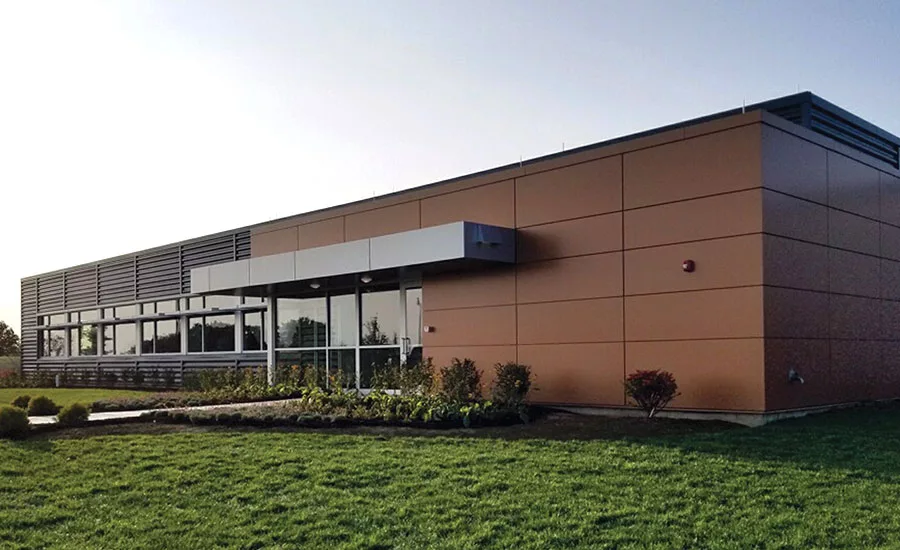
Involta Northpointe’s 40,000-sq-ft data center in Pennsylvania was able to achieve Tier III certification due to a unique design involving fabric duct and VFDs.
Involta Northpointe, a recently-opened, 40,000-sq-ft data center in Freeport, PA, is already recording a 1.3 power usage effectiveness (PUE). This places the data center in the top 5% of efficient multi-tenant data centers nationwide. The performance statistics haven’t gone unnoticed. Involta recently signed one of the nation’s top health care providers, University of Pittsburgh Medical Center, as Northpointe’s anchor tenant.
Uptime Institute issued Northpointe a Tier III Certification, which includes HVAC capabilities of cooling 725-kW/hr of critical heat load even during a power interruption.
Involta has continually strived for higher efficiencies. For example, Northpointe’s HVAC design is 52% more efficient and uses half the energy of Involta’s first co-location opened in 2008.
Northpointe’s success is due to a series of progressive HVAC design modifications Involta’s design team made when constructing and retrofitting its 12 other co-locations comprising 300,000 sq ft. Innovations include developing data center-specific air dispersion, VFD on cooling systems, and supply/return air plenum designs.
The Involta team includes in-house designers Jeff Thorsteinson and Lucas Mistelske. The team also includes outsourced consultants, architects, and engineers: Jason Lindquist, P.E., associate at consulting engineering firm Erikson Ellison & Associates (EEA); Scott Friauf, president of general contractor Rinderknecht & Associates; and fabric air dispersion manufacturer DuctSox.
Northpointe features a common industry methodology of computer room air conditioners (CRAC) that supply displacement ductwork runs centered above electronics rack cold aisles. However, that’s where the similarities stop.
“The data center industry has come to realize that strategic air dispersion, not more cooling volume, is the secret to effective rack cooling, facility efficiency, and minimal equipment failures,” said Thorsteinson.
Traditional metal ductwork in earlier Involta locations fell short of the company’s cooling goals even though there were sufficient room temperatures and CRAC capacity. The main shortcoming was metal duct’s inherent high velocities resulting in turbulences that prevented electronic equipment fans from drawing more cooling into the racks.
Consequently, Involta collaborated with DuctSox to develop DataSox, an air dispersion duct that’s specifically aimed at solving air distribution challenges unique to data centers.
The design solved velocity, volume, and turbulent air dispersion issues. At Northpointe, it’s positioned over the cold aisle in double 36-in-diameter, 36-ft long runs. A majority of air is distributed through the fabric porosity consisting of micro perforations located on the bottom half of the round, static-free fabric. There are also field-adjustable, directional nozzles running linearly down both sides, allowing higher concentrations for hot spots.
Lindquist also specified dampers for duct take-offs in the event that a duct run is uninstalled for reconfiguration or adjustments. Generally, data center-specific fabric air dispersion is factory-designed for a particular project’s specifications. In the field, however, the nozzles can be throttled and redirected to eliminate any damper balancing commonly required in conventional ductwork projects.
The CRACs discharge 64°F air and the racks generally draw in 64°F to 67°F air. Return air temperatures to the CRACs’ return plenum ranges from 82°F to 95°F.
Cold aisle temperature uniformity in conventionally designed data centers can surpass a 10ºF differential compared to conventional data center air distribution designs. However, Northpointe’s design records very slim cold aisle differentials of only two degrees from the top to bottom.
Northpointe’s mechanical room configuration designed by Rinderknecht splits the data center into 200-rack and 180-rack halls. In the centrally located mechanical room, each bank of ten 24-ton DA085 upflow CRACs by Vertiv is positioned along the wall of the room it supplies. For example, the 200-rack room is anchored by 10 CRACs supplying approximately 13,000-total cfms controlled by VFDs. Each CRAC offers redundant refrigerant circuits and fans. The CRACs’ two-stage scroll compressors switch to free cooling when outdoor ambient temperatures drop to 54°F or less. The CRACs reject heat to rooftop high-efficiency micro-channel condensers.
The VFDs operate the CRACs at 20% to 40% capacity. However the i-Vu BAS by Carrier can call for more in high humidity situations.
“Running at these lower fan speeds, obviously saves us a lot of energy,” said Thorsteinson.
Rinderknecht’s energy-efficient building envelope consists of a structural steel and metal stud-framed frontend construction for offices, storage, and other non-data rooms supplied HVAC by Voyager Series rooftop systems by Carrier. The data halls are constructed of tornado-proof, 12-in-thick, pre-cast concrete cores. Roof R-value insulation averages approximately R-36 and far surpasses ASHRAE 90.1 building energy code standards and adds to the facility’s total energy savings.
Rinderknecht also designed a supply plenum and separate return air plenum that connect to each data hall’s bank of CRACs. The return air collection of taking rising warm air and delivering it to a plenum arrangement the CRACs share is an innovation Rinderknecht designed.
The HVAC section of Uptime certification wasn’t easy. Uptime Institute certifiers had never before seen such a plenum arrangement and air delivery system. Therefore, they required unusual data from EEA, such as calculations on the mechanical spine pressurization, or unprecedented worst-case scenarios of extreme pressurization, airflow, and temperature events.
“They were initially quite skeptical of our HVAC approach and required test data that was well beyond typical certification requirements, but ultimately we proved the energy efficiency, airflow uniformity, and performance claims,” said Thorsteinson.
Rolled steel warehouse company builds redundancy and reduced costs with HTHV
A steel warehouse and distribution company in Butler, IN, decided to add 66,000-sq-ft to its existing 100,000-sq-ft facility and needed to address the heating requirements for the newly expanded facility. They planned on replacing the aging indirect-fired air-turnover unit that was used to heat the original 100,000-sq-ft facility with new higher-efficient units that would heat the planned 166,000-sq-ft building and reduce yearly utility costs.
Because a single indirect-fired air-turnover unit couldn’t provide any redundancies and generated excessive utility bills during the winter heating months, the steel warehouse and distribution company decided to use Cambridge High Temperature Heating and Ventilation (HTHV) technology instead.
The company’s two main requirements for a new system were to lower their monthly heating costs and to provide a redundant solution that would heat their new facility during the winter months — all while meeting their ROI requirements.
Cambridge Engineering, with the help of a local HVAC mechanical contractor and the manufacturer’s representative, joined together to provide a solution that was specific to the building needs. Of particular concern were the multiple overhead cranes the facility used to move the large rolls of steel throughout the space, and the fact the roof structure on the existing 100,000 sq ft wouldn’t support a heavy rooftop unit. Since new units couldn’t interfere with the cranes and couldn’t be placed on the roof, the decision was made to use through-wall vertically mounted HTHV units located on the exterior walls of the facility. The new four-unit HTHV solution met the owners’ two main requirements, along with additional benefits:
1. Lower utility costs. As a 92% thermal efficient solution, the HTHV technology dramatically lowered utility costs when compared to the lower efficiency air-turnover unit.
- Cost to operate the single indirect-fired air-turnover unit — $0.73/sq ft
- Cost to operate four Cambridge HTHV units — $0.25/sq ft
Even though the building size increased by 66% to 166,000 sq ft, the owner realized a decrease in natural gas usage of 33%.
2. The four HTHV units provided the building owner with heating redundancies. They no longer had to worry about heating their facility if one of the units went down.
3. The new wall-mounted vertical units wouldn’t interfere with the existing cranes.
4. Better indoor air quality. The HTHV technology uses 100% outside air. The technology is also a ventilation device as well as a heating solution. More outside air means better indoor air quality for the occupants. Buildings don’t need to breathe, but people do.
Looking for a reprint of this article?
From high-res PDFs to custom plaques, order your copy today!