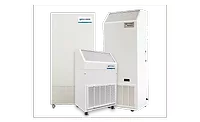
Air cleaning system keeps HVAC loads, IAQ in check

With the arrival of a new ventilation system, a logistics company in Arkansas was able to reduce the conditioning of outside air, which helped in taking one chiller off line and reducing HVAC load and utility costs.
ArcBest, a multibillion-dollar logistics company in Fort Smith, AR, recently outgrew its headquarters. Designed for an occupancy level of 850 people, the headquarters has grown to 1,085 people plus visitors. Ten percent of the people work nights, requiring 24/7 conditioning of air.
The growth drove a need to introduce more outside air to maintain air quality. All of this outside air had to be conditioned, increasing electrical energy costs. In addition, the extra outside air caused draftiness on cold winter days, and during the summer the extra outside air flow through the air handlers resulted in some parts of the building getting too cool.
“I previously got calls from people that they were cold during the summer, which was a direct result of having to introduce so much chilled air into the building to meet the appropriate CO2 levels,” said Richard Rieske, director of corporate facilities at ArcBest. “Likewise, they felt drafts during the winter due to all the outside air that was being used to ventilate the building. When the HLR (HVAC Load Reduction) modules are running, our people are more comfortable.”
The 190,000-sq-ft headquarters has five floors of office space separated into two wings (east and west primary zones) which are each served by a dedicated AHU. Two staircases connect all building floors. The building has a central core and a peripheral open office plan. There is a computer room on the first floor and executive offices and conference rooms at the southern side of the fourth and fifth floors.
Building return air is an open plenum suspended ceiling type while air is ducted to line diffusers. Building pressurization is regulated on each floor by return air mounted exhaust fans.
The building has a Carrier iVu Building Management System (BMS) running BACnet over MSTP, which can optionally be integrated with enVerid’s HLR® BACnet to control the outside air damper.
All outside air intake for the HVAC system is DCV dependent (controlled by space CO2 sensors). The outside air damper is actuated based on an averaged CO2 value on a per floor section basis. Each floor has about ten CO2 sensors strategically distributed. Although each floor has an open floor plan, CO2 sensors residing in the eastern section on each floor were averaged separately from those in the western section. CO2 set point is observed by the BMS to actuate outside air damper position.
The building’s central plant on the ground floor had two packaged hermetic centrifugal liquid single-speed chillers (375 tons each). On warm days, the second 375-ton chiller was required, but with new enVerid HLR modules they typically only need a single chiller. The peak HVAC cooling capacity has been reduced by about 273 tons.
“Running a second chiller significantly increased our energy utility costs” said Tom Daigle, manager of building systems at ArcBest. “By using the enVerid HLR modules, we are not conditioning as much outside air, and we are projected to save $63,709 annually.
The kickoff began with a site survey by the enVerid team of the building mechanical layout, an IAQ assessment, and identification of potential locations for integrating the HLR 1000E systems.
The site survey assessed the spaces that are cooled and heated, and documented the existing hydronic systems, power meters, and all DCV, VAV, and AHU interactions in the building, including dampers, sensors, and exhaust systems.
The survey measured and planned for the positioning and installation of the HLR modules. In this phase, the team also checked for wireless connectivity options and suggested connection points to the BMS.
Lastly, the team took snapshot baseline measurements of CO2, energy use, and other air quality indicators.
The central plant mechanical room on the first floor houses two AHUs: one which conditions the western side of the first floor and the other that conditions the computer UPS room, which is isolated and separated from the office space.
The eastern mechanical room contains the AHU that conditions the eastern side of the first floor. Inside the mechanical rooms each AHU has their supply air, return air, and outside air ducted. Each mechanical room has an outdoor air inlet from a louvered plenum on the mechanical room north-east exposure. A return air exhaust fan is connected to a louvered plenum on the mechanical room north-west exposure.
The enVerid project team selected and supervised electrical and mechanical subcontractors with the customer’s approval. Additionally, the enVerid project team continues to work with ArcBest’s facilities management post-installation to optimize energy, IAQ, and environmental comfort.
Using HLR technology, ArcBest could take advantage of ASHRAE 62.1 Indoor Air Quality Procedure (IAQP) and use 65% less outside air compared to using the ASHRAE 62.1 Ventilation Rate Procedure (VRP). As a result, the annual energy savings for heating and cooling are calculated to be $63,709.
For IAQ, contaminant concentrations were measured prior to the HLR operation, then again after the HLR module had been installed and running for at least one week. IAQ monitoring was performed per EPA standards and the results were analyzed and certified by an independent lab.
The HLR reduced peak HVAC load by 273 tons, which corresponds to a 36% decrease in total HVAC load. This savings impacts the “demand charges” on ArcBest’s utility bill. In addition, when ArcBest replaces the HVAC equipment in the future, the peak capacity required will be 36% less, providing significant savings in capital expense.
Based on standard calculations, the energy savings for reducing outside air by 26,640 cfm equates to $63,709 annually, using a standard energy model as well as Fort Smith temperature and humidity data from each hour over the past five years.
ArcBest was also able to conserve on cooling tower water, with standard calculations showing a reduction of 2.175 million gallons of water and a savings of $11,535 in water and wastewater charges.
Looking for a reprint of this article?
From high-res PDFs to custom plaques, order your copy today!