Natatorium improves IAQ, spectator comfort with dehumidification retrofit
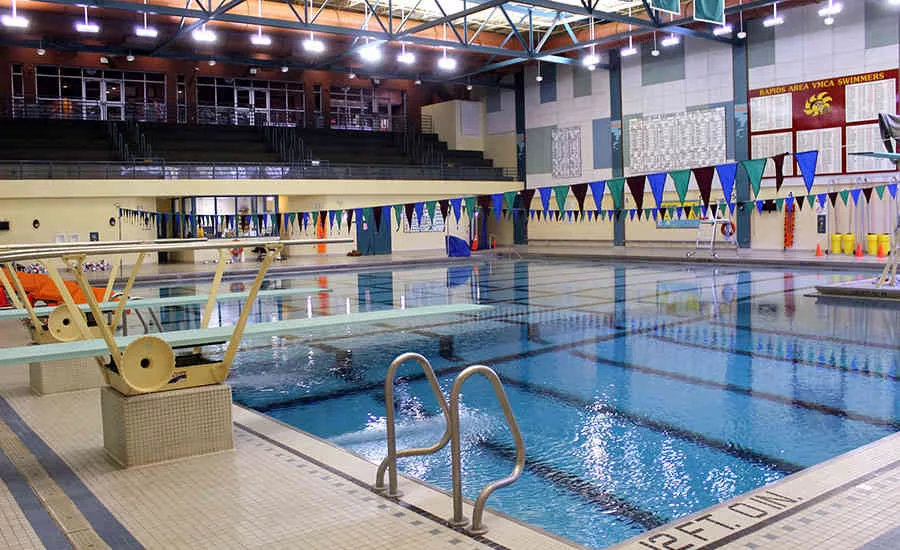
When Forest Hills Public Schools needed a new dehumidification system for its indoor pool, engineers put together a system that not only improved IAQ and energy savings but also fit into the existing footprint.
The Forest Hills Public Schools Community and Aquatic Center in Forest Hills, MI, needed to replace two aging 24-ton dehumidifiers for its 12,000-sq-ft natatorium. Rather than a drop-in replacement for the 25-year-old center, the school district saw the retrofit as an opportunity to improve spectator comfort, swimmer IAQ, and cut future operational costs.
Previously, the 32,400-sq-ft spectator grandstands received the same 82°F temperatures as the pool area. Furthermore, pool and deck surface chloramine accumulation affected swimmer breathing.
“The difference in air comfort and air quality for the spectators as well as the swimmers after the retrofit has been incredible,” said Kelly Swieter, CPO, aquatic supervisor at Forest Hills Public Schools.
The retrofit didn’t come without challenges for consulting engineer James B. Harrison, P.E., associate lead project engineer at GMB Architecture + Engineering. Harrison faced a mechanical room that was inaccessible and lacked floor space to accommodate new units large enough to increase room air change rates. Equally challenging were return and supply ductwork sizes incapable of providing new room air change rates code-compliant with today’s standards.
Instead of altering the original mechanical room’s access doors and cramped floor space, Gernot Ruenschke, AIA, project architect at GMB, designed a 720-sq-ft mechanical room add-on to accommodate the new 32-ton NP-Series Protocol replacement dehumidifier manufactured by Seresco USA. The new ground-level mechanical room was favored over a rooftop placement because it provides easier maintenance staff access and a controlled climate.
The unit dehumidifies the space to 50% rh, uses compressor waste heat for free 80°F pool water heating, cools and heats the space to 82°F, and uses exhaust air to pre-heat the outdoor ventilation air. In the event of extreme cold weather, the natatorium can tap into the pool’s 995-MBH hot water/pool water heat exchanger by Taco and supplied by the building’s two Copper Fin II, 1,220-MBH hot water heating boilers by Lochinvar. The heat and energy recovery, combined with direct drive fans and VFD, makes the new units significantly more efficient than the original dehumidifiers, according to Harrison.
Per Swieter’s request, the unit’s capacity was sized larger for more demanding swim period humidity loads, such as warmer water and space temperatures for senior swimming, or cooler water and space temperatures during swim meets.
According to the manufacturer, the Protocol uses up to 80% less refrigerant than a conventional DX dehumidifier by substituting glycol for heat rejection to an outdoor split system dry cooler. The unit’s internal dehumidification refrigeration circuit is factory-sealed, which eliminates the expense of onsite EPA-certified installers.
The natatorium’s original two return air duct openings were located in the back wall of the 300-seat grandstands and drew humid, 82°F, chemical-laden air through the spectator breathing zone. This return air location also created air stratification throughout the pool area that could lead to respiratory difficulties during high occupancy periods.
GMB’s improved air turnover solution included newly-positioned high and low return air grilles, with a 40/60 airflow ratio, respectively. The high grilles are mounted in a ceiling located 10-ft above the west end of the pool and also mounted on return ductwork located 30 ft above the southwest end of the pool. The low return was designed by GMB as a dual-purpose 84-ft-long concrete swimmer bench. The bench’s concealed plenum draws chloramines off the pool surface through several perforated metal openings located in the face of the masonry bench support and into an underground concrete tunnel duct leading to the new mechanical room’s dehumidifier for heat recovery and exhaust.
Chloramines accumulation is a pool industry-wide challenge, therefore an ultraviolet water sanitation system by Engineered Treatment Systems was specified. When combined with all the other measures GMB built into the retrofit, chloramine levels have dropped to nearly zero, according to Swieter.
GMB reused the original mechanical room to house an 8-ton NE-200 Series dehumidifier that’s dedicated to quadrupling the spectator section’s air changes/hr to eight while providing a more comfortable temperature and humidity of 76°F and 50% rh. The mechanical room needed no alterations for access because the dehumidifier’s two modular enclosures are designed specifically for retrofits with 32-in-wide door frames. Once dollied through the door, the project mechanical contractor simply connected the two four-ton modular units in tandem using their factory-aligned connections designed for piggybacking into one small horizontal footprint. Each modular section has its own compressor, blower, and refrigeration circuit, but together they can operate as a one- or a two-stage unit.
Included in the retrofit was the replacement of the existing spiral round perimeter supply duct system with a new larger diameter Universal Spiral Air spiral round duct system. The new 72-in-diameter main perimeter supply ductwork was the largest possible size for fitting through ceiling joists. The larger ductwork helped double the room air changes/hr to four, which complies with the four to six air changes/hr natatorium design recommendation from ASHRAE.
Engineers working on the dehumidifier retrofit at the Forest Hills Aquatic Center successfully specified a system that cut down on refrigerant use and virtually eliminated chloramines from the air.
Looking for a reprint of this article?
From high-res PDFs to custom plaques, order your copy today!