A New Spin On VRF & Ventilation
A Tennessee district faced an old school HVAC challenge: aging ventilators and space constraints. So this team tried a new-school variation on common VRF retrofits to deliver improved efficiency and critical IAQ: they decentralized the outdoor air, combining enthalpy wheel and VRF components within a single classroom enclosure.
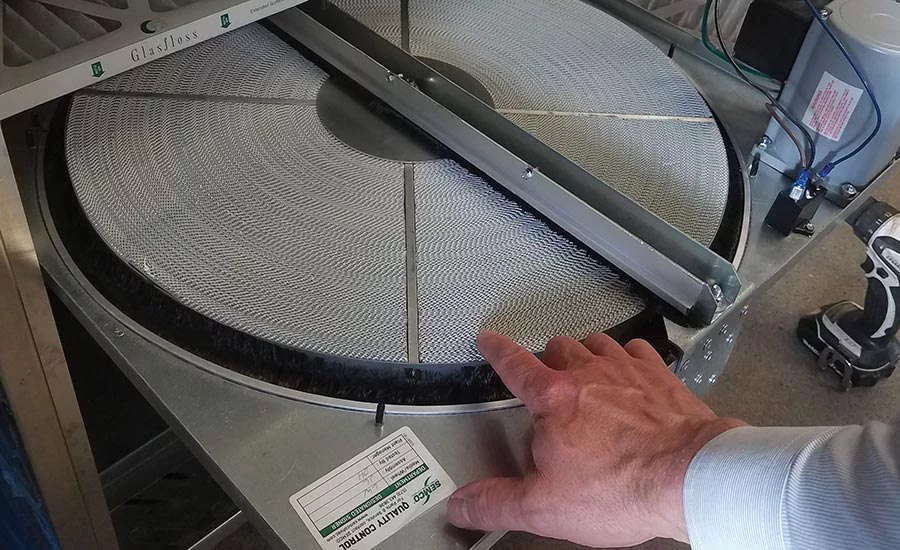
IMAGE 1. A custom-made 21-in aluminum enthalpy wheel with molecular-sieve desiccant was specified for condition-ing outdoor air inside each classroom unit ventilator. The wheel also conditions recirculated air for a total latent and sensible solution. (Photo courtesy of Four Seasons Inc.)
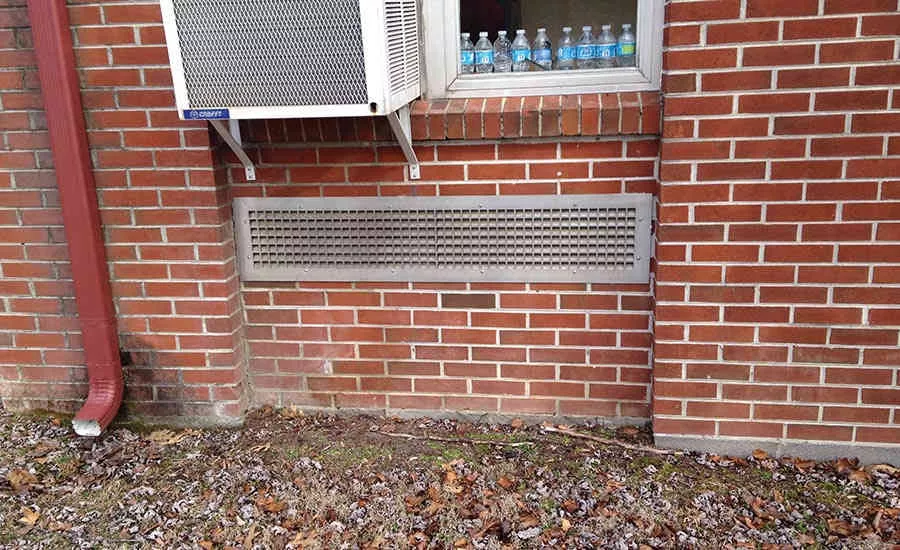
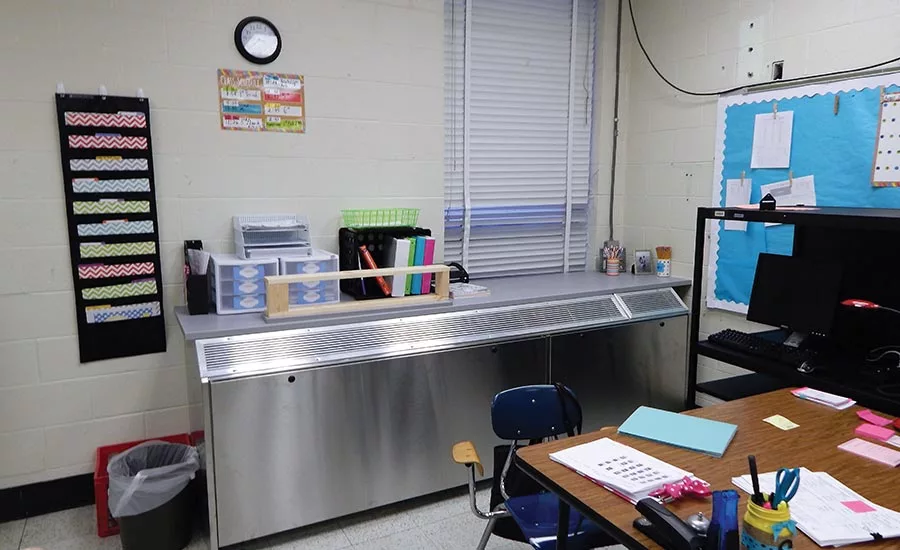
IMAGE 2. Before the retrofit, Union County Public School buildings had radiators and window units for classroom heat-ing and air conditioning. Now they have new VRF unit ven-tilators with enthalpy wheels for self-contained outdoor air supply that reduces the humidity load substantially.
Engineers retrofitting non-air conditioned schools to variable refrigerant flow (VRF) the last few years have relied on centralized packaged DOAS to comply with ASHRAE 62.1 outdoor air standards.
However, en route to providing a VRF retrofit solution for four Union County Public Schools (UCPS) in Maynardville, TN, engineers and contractors may have originated a new trend. They decentralized outdoor air because the schools' limited ceilings weren't practical for ductwork from a centralized unit. Thus UCPS's engineers and contractors developed what may be, to their knowledge, the industry's first VRF and dedicated enthalpy wheel combination self-contained inside a unit ventilator-style encasement. What's innovative is that these efficient 32-in (H) by 104-in (L) by 30-in (D) unit ventilators with an VRF/enthalpy wheel are easy drop-in replacements for conventional ventilators that have dominated the classroom HVAC market the last 50 years.
The retrofit project was designed by J. Rusty Willock, P.E., principal with Engineering Services Group Inc. in Knoxville; and Jonathan Yeager, P.E., of eSolutions in Knoxville, a manufacturer's representative with design/build engineering capabilities and a focus on emerging energy-efficient HVAC products. Randy Guignard, president of project mechanical contractor Four Seasons Inc. in Knoxville, designed the unit ventilators (and is now manufacturing the system in-house under the Revolutionaire brand). The system replaced the original aged steam radiators and window air conditioners in classrooms at Horace Maynard Middle School (HMMS), Sharps Chapel elementary, Maynardville Elementery, and Big Ridge Elementary School. Also assisting with the project design was Semco LLC, which supplied heat recovery enthalpy wheels custom-manufactured for the project, and Mitsubishi Electric Heating & Cooling, the VRF equipment supplier.
The retrofit has garnered positive feedback for indoor air comfort and more than doubles the 8 SEER rating of the old system, promising significant annual energy savings and payback. The project's results are supported with an energy performance contract by Johnson Controls Inc., which also manufactures the Metasys BMS that controls buildings throughout the district.
Guignard and Yeager's original VRF unit ventilator-style retrofit system was designed for the Nashville Metro Public School system, but without energy recovery because existing enthalpy wheels were too large to fit the encasement. The design's second generation progressed to energy recovery when Guignard and Yeager worked with SEMCO to custom-build a unitary (aluminum) wheel cassette (UWC) that was 21-in-diameter x 3.75-in deep using molecular sieve desiccant material. The horizontally-mounted UWC-21 wheel reduced the peak cooling capacity by 1.5tons per unit, for a total project reduction of 37.5 tons versus a VRF-only unit and increasing efficiency by approximately 15%. Adding the enthalpy wheel provided room to spare regarding meeting the requirements for ASHRAE 90.1 Standard, "Energy Standard for Buildings – Except Low-Rise Residential Buildings."
ROI Or RER?
Yeager and Guignard chose molecular sieve desiccant/aluminum substrate enthalpy wheels for their higher latent capacity versus plastic wheels with silica gel desiccant. Air Conditioning, Heating and Refrigeration Institute (AHRI) certification lists a .30-in w.g. pressure drop with the UWC 21-inch wheel, whereas many plastic wheel brands range up to as high as 1-in w.g., according to Guignard's research.
"We wanted the highest performance that an aluminum wheel offers," said Yeager, who also viewed aluminum as a good option with regard to maintenance.
Guignard also looked past common ROI considerations, citing AHRI Guideline V, "Calculating the Efficiency of Energy Recovery Ventilators and Its Effect on Efficiency and Sizing of Building HVAC Systems" as evidence that wheel selection should be calculated for recovery efficiency ratio (RER) instead of ROI.
The RER takes into consideration the efficiency and the static pressure of a desiccant wheel replacement. Intended for service contractors, engineers, and building owners, Guideline V provides a means for calculating the impact of applied energy recovery equipment on the energy efficiency of the HVAC system at a single selected operating condition.
More simply, the calculations comprehensively take a host of factors into consideration, such as geographical climate, fan/motor efficiency, exhaust air transfer ratio (EATR), pressure drop, energy recovery methodology, and many other parameters. Guideline V also allows service contractors or their manufacturer representatives to calculate ERV wheel comparisons and arrive at a comprehensive savings for heating and cooling, rather than just a wheel manufacturer's efficiency rating that may not consider all the cost variables.
VRF and Outdoor Air Design
Generally, the UCPS project uses 24-ton, ground-mounted Mitsubishi City-Multi Series VRF condensers supplying approximately eight classroom unit ventilator evaporator coils. Each room is overseen by the JCI control system and occupancy sensors, which cut unit ventilation operation by more than 50% during unoccupied periods, according to Yeager.
Each unit sports quiet-running fan/blower and ECM motor assemblies from Rosenberg USA Inc. Guignard selected Rosenberg’s M11-A1 Ecofit backward-curved motorized impellers for being quieter, taking up less space, and offering better efficiency than other options. The combination of the efficient aluminum wheel with the fan blower/motor assembly resulted in exceptionally low enthalpy wheel energy use, he said.
Each unit ventilator draws in approximately 30% outdoor air with the wheel's fan blower/motor assembly. The unit ventilator's cabinet acts as a plenum because it mixes the outdoor air conditioned by the enthalpy wheel with the return classroom air conditioned by the VRF evaporator coil. A second fan blower/motor assembly returns and supplies classroom air. A damper system automatically exhausts return air.
The 30% outdoor air surpasses ASHRAE 62.1's classroom cfm/person recommendations and equates to approximately 350 to 400 cfm of outdoor air. That's slightly more than what's needed for providing outdoor air to hallways and other common areas drawn by bathroom exhaust fans. Large spaces such as cafeteria or gyms at the four schools either have multiple VRF/energy wheel ventilators or more conventional equipment, such as the HMMS auditorium's 15-ton, 6,000-cfm York rooftop unit.
Cost/Efficiency Equilibrium
The final choice of VRF/energy recovery wheel unit ventilators was a compromise between a costly/high-efficiency or an inexpensive/less-efficient solution. The most efficient solution — geothermal with water source heat pumps-based unit ventilators — was too costly at an estimated $2 million, much of which would be applied toward bore fields for each of the four schools. A less efficient and inexpensive option costing an estimated $300,000 was heat pump ventilators for each classroom; however, it didn't include updating the school to current ASHRAE 62.1 outdoor air or ASHRAE 90.1 energy sustainability standards.
"Our solution's (VRF/energy wheel recovery) cost was a compromise between the two alternatives, plus it provided outstanding outdoor air and significant energy sustainability," said Yeager.
Conventional VRF — rooftop condensers feeding ceiling cassette and wall evaporators, plus separate DOAS with ductwork running through unfinished ceilings — was not practical in this case, according to Yeager.
Concealed ceiling ductwork was virtually impossible because of a 4-in buffer between the ceiling and roof deck in most older UCPS facilities. Running ductwork in soffits was also problematic because lowering ceiling heights would violate local code's 9-ft minimum ceiling height. The only other alternative was running ductwork outdoors, an unaesthetic approach that would have required costly high R-value insulation in addition to the aforementioned disadvantages.
United Services in Powell, TN, was the installing contractor for the auditorium sheet metal ductwork as well as all the project's piping and HVAC systems installation. The previous steam boiler system was also removed and replaced with electric boilers for domestic hot water.
While the VRF/enthalpy wheel unit ventilator equipment costs were similar to a full VRF system combined with centralized DOAS equipment, the UCPS project saved upwards of 15% in construction costs, mainly associated with running ductwork, such as labor installation, multiple roof access and sealing points, ceiling patchwork/repainting, and other costs.
There was little classroom downtime as a two-man crew can charge and install one ventilator in four hours after school hours. Guignard said in schools that already have conventional unit ventilators, the VRF/enthalpy wheel models are designed as drop-in replacements not needing flooring, molding, or wall painting cosmetic work. Guignard also offers an optional bookcase that connects to the unit ventilator and hides any disturbances of flooring or wall paint.
"The bookcase becomes a piece of furniture and the top of the unit ventilator can be a work surface because they're both made of a laminate that can come in any color selected by the architect," said Guignard.
The trend in HVAC for decades has been centralization, such as rooftop units supplying an entire building or central plants supplying one facility or an entire campus. These innovations at UCPS could be spearheading a new trend toward decentralization in education settings. Self-contained VRF/enthalpy wheel units can provide a classroom retrofit solution for long-term savings using heat recovery, moderate first-cost equipment outlays, lower installation/labor costs, and less building envelope disruption associated with ductless systems, plus healthier IAQ, according to Yeager. ES
The Design’s Next Steps
Guignard's expects his next-generation design will incorporate similar VRF/enthalpy wheel equipment in a vertical unit that would also target classroom vertical fan coil drop-in replacements with a slimmer enclosure and lower-dB, higher-efficiency fans.
Another design variation will target multi-zone rooftop systems that are supplied either by on-board DX and electric heater systems or by central plant chillers/boilers. Expecting room for efficiency gains over that approach’s continuous heating and cooling simultaneously to multiple zones, Guignard has designed a drop-in replacement unit incorporating one large enthalpy wheel for dedicated outdoor air and a VRF system with an evaporator coil for each zone. The zone ductwork would stay in place and the replacement unit's zones would be factory-matched to the existing multi-zone unit's configuration. The replacement unit sizes would range from small tonnage up to 40 tons.
“Unit ventilators combining VRF with enthalpy wheels to decentralize outdoor air are going to revolutionize the education facility HVAC market as many decades-old, less efficient conventional unit ventilator systems reach the ends of their lifecycles," predicts Yeager.
Looking for a reprint of this article?
From high-res PDFs to custom plaques, order your copy today!