Commissioning Mini-Split Systems

In many buildings, there are isolated spaces with a continuous cooling load even when the buildings are unoccupied. These can be server rooms, communication closets, main distribution frame rooms, laboratory equipment rooms, etc., and they are often scattered throughout a building.
If these spaces are cooled by the same central air handlers that serve the occupied spaces, the 24/7 cooling demands will require the air handlers to operate 24/7. With the ability to program time-of-day schedules with unoccupied set back temperatures and airflows for individual zone terminal units, it is now possible to reduce the after-hours demands on the central equipment. However, the true 24/7 cooling loads typically represent a very small percentage of the central system load. As such, it is necessary to circulate more air than is strictly required to cool the 24/7 spaces because the air handling equipment can only turn-down a certain amount before becoming unstable or unable to deliver cooling air to the spaces requiring it.
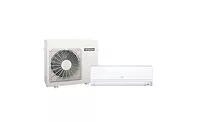
It is common to install dedicated DX refrigerant split systems to serve these spot cooling loads. These are typically “mini-splits” with a streamlined wall-mounted indoor evaporator/fan console and an outdoor condensing unit. In theory, mini-splits are very simple systems, but in practice there are a number of things in which commissioning professionals should be interested. As with the other “simple” systems I have been addressing in this column recently, the complexities are primarily associated with controls.
First, is the mini-split cooling system the only source of cooling for the 24/7 space or is the mini-split supplemental to cooling provided by the central air handling system when the central system is operational?
Supplemental cooling. If the mini-split is supplemental, is it controlled by the same BAS as the central system or is it controlled solely by its local thermostat?
-
If controlled by the BAS, when is the mini-split enabled? Is it based on a time-of-day schedule opposite to the air handling unit’s occupancy schedule? Is it controlled to a higher space temperature setpoint to ensure that the mini-split system is only activated when the central system is unable to maintain the normal space temperature set point?
-
If controlled by the BAS, what can the BAS actually “control?” Does the BAS simply enable the mini-split to cool to its local thermostat set point or does the BAS actually command the mini-split fan, fan speed, and/or compressor operation?
-
If controlled only by a local thermostat, is that mini-split’s thermostat lockable to prevent its set point from being lower than the central system zone setpoint? Are there notes in the BAS system user interface explaining the manual intervention required at the mini-split thermostat if the BAS setpoint is adjusted? If the mini-split setpoint is lower than the BAS zone set point, the mini-split will be engaged instead of the central (presumably more economical) cooling even when the air handler is operating.
-
If the mini-split is controlled only by a local thermostat, is there a BAS alarm when the space temperature is significantly below the BAS setpoint? This would be a means for confirming the mini-split cooling is not the lead source of cooling for the 24/7 space.
Standalone cooling. If the mini-split is the only source of cooling for the 24/7 space, what do we know about the thermostat? Today, the industry standard thermostat for mini-split systems is a remote controller with a wall-mounted bracket for holding the thermostat when it is not in someone’s hands. What provisions are there for making sure the remote control does not walk out of the 24/7 room or otherwise become lost?
What operational features and options does the thermostat have, and how are they selected and changed? I have run into mini-split thermostats that can do everything except make breakfast. In addition to providing a user interface for setting the desired space temperature, the remote thermostat controls the fan on/off, controls the fan speed, and controls the rotation of directional supply air vanes.
In these spot cooling applications, the only control that matters is turning the fan on high and starting the compressor when the space is above setpoint and turning the fan off and stopping the compressor when the setpoint is satisfied. Any other features are just asking for trouble, but it seems like a “dumb” wall-mounted thermostat to provide those functions is a special order, if available at all. What steps can be taken to prevent operators or other well-meaning personnel from overriding the “smart” thermostats to perform differently and, perhaps, less efficiently?
In summary, technology advances have enabled simple systems to have very complex controls. Mini-split systems are a perfect example of “just because you can, doesn’t mean you should.” Beware of complexities that may hinder the ability of these simple systems from meeting the owner’s project requirements. ES
What operational features and options does the thermostat have and how are they selected and changed? I have run into mini-split thermostats that can do everything except make breakfast.
Looking for a reprint of this article?
From high-res PDFs to custom plaques, order your copy today!