Case In Point
LAX reaches new efficiency heights with UV-C
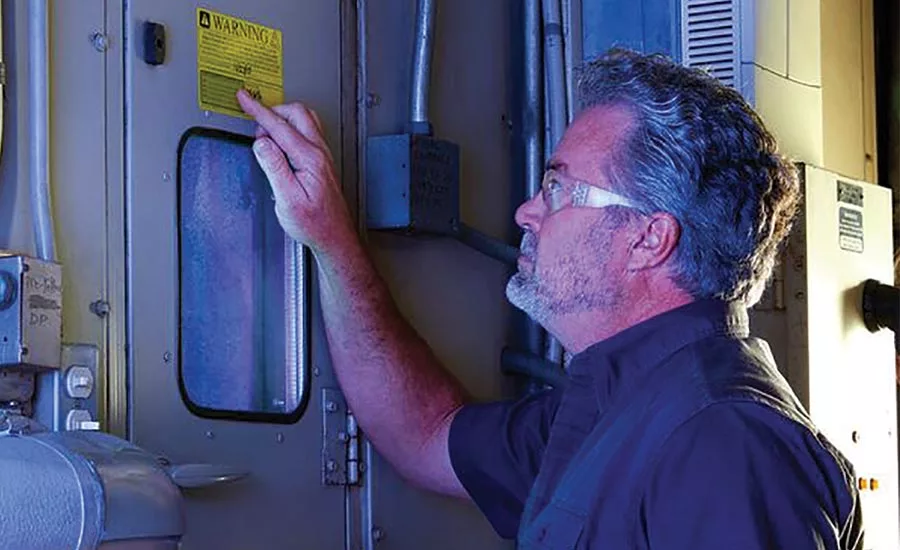
A project team member inspects a UV lamp installed in one of LAX’s more than 200 air handlers. The lamp’s UV-C energy inactivates microbial growth on the air handler’s cooling coils, boosting energy efficiency and indoor air quality.
With nine terminals totaling several million square feet of floor space, Los Angeles International Airport (LAX) is one of world’s busiest airports.
Keeping travelers comfortable and safe falls to the airport’s facility management teams, who routinely look to boost efficiencies and decrease maintenance calls. While solving a minor air conditioning issue, one facility manager identified a way to improve IAQ for the entire airport.
“A tenant in Terminal 2 complained of a musty smell in their offices,” recalls Richard Yakel, the airport’s air conditioning supervisor. “We quickly determined that the odor resulted from the buildup of mold and bacteria on the air handler evaporator coil — a very common condition, especially given our humid, seaside environment.”
Although Yakel’s maintenance crews could remove the mold with solvents and elbow grease, he knew that mechanical cleanings and antimicrobial agents were only a temporary solution. He recognized that without a continuous maintenance program, the conditions would quickly reappear.
Moreover, the organic buildup on the coil had caused a pressure drop that reduced the volume of air passing through the coil as well as its heat-transfer efficiency. In other words, biofilms that can be several millimeters thick can “choke” an air handler, severely inhibiting system performance. Also, he reasoned that if there was trouble in one of the airport’s AHUs, similar conditions might be found in some of the facilities’ other 200+ AHUs.
Seeking a more permanent solution, Yakel turned to Jim Edson with Santa Clarita-based NUView Environmental to learn if ultraviolet germicidal irradiation (UVGI) would be a cost-efficient and lasting means to remove such biological growth.
According to Edson — a distributor for UV Resources — UV-C energy degrades the organic matter. Ionization drives UV-C’s power to alter chemical bonds, causing lasting damage to DNA, ultimately killing the cell. Over time, the 254-nm germicidal wavelength also reflects deep into the coils to eliminate the build-up that mechanical and chemical washing often misses. Once gone, biological growth won’t re-form as long as the lamps are maintained.
This would solve Yakel’s air quality issue. However, Edson explained that this benefit is just the tip of the UV-C iceberg. Besides improving IAQ, UV-C can improve airflow, boost heat exchange efficiency, and reduce maintenance needs. According to officials with UV Resources, this is all accomplished for an average equipment cost of less than $0.15 per cfm.
Yakel was intrigued, but he wanted to verify performance before committing to using UVC airport-wide. He decided to conduct a test installation on the odorous AHU. Yakel’s team first measured the unit’s static pressure and airflow levels using a Magnehelic differential pressure gauge.
Following this baseline measurement, the team installed high-output DEF (Double-Ended Fixture) UV-C fixtures from UV Resources in the 14,000-cfm AHU. Pressure readings were taken monthly for the following six months.
“My team and I were surprised by how quickly the germicidal wavelength cleaned the HVAC evaporator coil, fan motor housing, and blades. However, we were truly stunned to witness a 15% (2,000 cfm) increase in airflow levels after just a week of operation.
“Almost immediately after installing the UV-C fixtures, the troubled air handler was able to meet thermostat set points and there was no odor,” he says.
The experiment’s timing proved fortuitous. The airport was in the initial stages of planning a multi-year, $4.11 billion improvement project that would include renovation of existing facilities, as well as a major expansion of the Tom Bradley International Terminal. UV-C lighting has been included in the HVAC design standards for LAX.
Yakel made a case for equipping all of the airport’s 200+ air handlers with UV-C as a way to enhance indoor environmental quality for passengers and employees.
Each of the airport’s terminals has multiple air handlers, ranging from five in Terminal 1 to 30 in Terminal 4. AHUs range in cooling capacity from 10 to 40 tons, some of which have been in place for decades.
According to Edson, none of this was a problem: the UV-C will work with any type of air handling equipment regardless of brand, capacity, or age. The required number of UV-C fixtures varies by unit size, but UV Resources’ software program specifies the exact amount of UV-C energy needed based on the height and width of the coil and plenum. Some of LAX’s really big air handlers needed 24 UV-C fixtures to do the job.
At the end of the first three-year contract period, more than 75 air handlers had been retrofitted with UV-C.
The plug-and-play wiring meant that Yakel’s crew could retrofit the DEF fixtures in house, while new AHUs would be required to have UV-C already installed. Workers prefabricate rows of fixture assemblies in the shop, minimizing downtime for the air handlers.
The UV-C fixtures have reduced maintenance costs and freed crews up for other tasks. Following the addition of the UV-C fixtures, the airport’s maintenance crews still visually inspect the air handlers and coils, but generally don’t have to clean the cooling coils as often.
Yakel sees cost and time savings as fringe benefits. His main goal was to improve indoor air quality for the millions of people who use the airport each year.
“We haven’t had any more complaints,” he said.
Looking for a reprint of this article?
From high-res PDFs to custom plaques, order your copy today!