search
Ask ACHR NEWS AI
cart
facebook twitter instagram linkedin youtube
  • Sign In
  • Subscribe
  • Sign Out
  • My Account
  • NEWS
  • TECHNOLOGY
    • Heating & Boilers
    • Cooling & Chillers
    • Pumps & Flow Controls
  • SECTORS
    • Commercial
    • Health Care
    • Data Center
    • Educational Facilities
  • DESIGN | CONSTRUCTION
  • OTHER TOPICS
    • High-Performance Buildings & Automation
    • Ventilation and IAQ
    • Commissioning
    • HVAC Retrofits
  • TODAY’S BOILER
    • Today’s Boiler Archives
    • Today’s Boiler Digital Edition
  • MORE
    • Case Studies
    • Podcasts
    • Videos
    • Directory
    • Webinars
    • ES NEWS Store
    • White Papers
  • SIGN UP
  • Back to The NEWS
Engineered Systems NEWSHVAC Engineering SectorsVentilation and IAQCommercial HVAC

Lazy Mold!

What causes mold to grow? And what are the true best indoor tactics for preventing it?
By Stephanie Taylor, M.D., M. Arch, CIC
Lazy Mold!
October 8, 2016

Mold concerns became highlighted in the 1920s, when commercial and military needs for safe storage and transport of supplies focused attention on preventing biological deterioration of materials. To prevent this, basic conditions that had been used for decades as guides for food storage in small, agrarian communities (damp: bad for grains, good for root vegetables) were applied to warehouse construction and management with the expecta­tion of preserving high material values. When mechanical control of indoor climates linked temperature and humidity requirements to energy con­sumption, tighter setpoint values were adapted from these early food preservation practices.


MYTHBUSTED: MOISTURE

Instead of food preservation, let’s look at buildings and mold. Mold is extremely lazy compared to cells which use photosynthesis or glycolysis to create energy for metabolizing foodstuff. For mold to grow, it needs to be supplied with the proper water level, temperature, oxygen, pH, and nutri­ents. If any of these are withheld, growth decreases.

Of all the components needed for growth, water is the easiest to restrict in buildings. Consequently, building managers often reduce indoor rh to desert-like levels of 15% to 20% with the rationale that decreasing atmospheric rh will decrease available water for mold growth. This thinking is erroneous! Contrary to this popular belief, fungal organisms cannot extract water from even very humid air to use for growth.

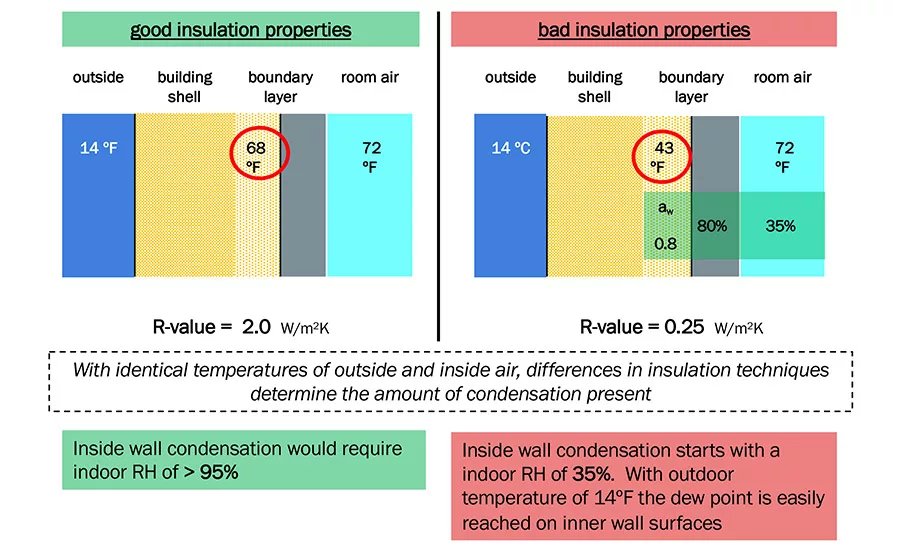
Besides spills or leaks, the liquid water in buildings which mold can use comes from gas-phase water molecules encountering cold surfaces and then condensing into liquid water. The culprit here is the cold surface, not the air. In poorly insulated buildings, the dew point at which condensa­tion forms is easily reached, as shown in Figure 1.

This means that humidifying your indoor air to healthy levels of 40% to 60% will not lead to mold growth unless the building shell or other materials such as cold water pipes are not properly insulated.

Scientists have known since the 1930s that liquid water in materials determines mold growth, not the rh of the atmosphere. Experimental evi­dence from as far back as the 1930s shows a linear relationship between moisture in materials and the hydrolytic deterioration from fungal growth. In all chemical reactions, the concentration of reactant (the water concentration in the material cell wall) controls the rate of a reaction. Conversely, reaction kinetics show that atmospheric rh is not related to the rate of degradation. A report of the U. S. National Bureau of Standards (1947) states, “RH permitting growth of molds varies from 76 to 96 percent for different species; thus protection of materials is assured when the atmospheric RH is below 75 percent.” Even the strict Smithsonian Museum building codes to prevent fungal growth on wooden artifacts recommend a rh range between 45% and 65%.

HVAC systems are notorious for amplifying fungal growth and distributing microorganisms, and they are an excellent source of water through condensation, water droplets, and wet insulation material. In addition, limited visual access means that often HVAC systems are ignored until there is an outbreak of building associated illnesses. The solution to this problem is to prevent leaks and condensation through proper insulation — not by creating a desert-like atmosphere. Drying out indoor air to unhealthy levels is analogous to stopping a fatal hemorrhage by draining out the patient’s the blood. It is better to simply bandage the wounds. ES

Share This Story

Looking for a reprint of this article?
From high-res PDFs to custom plaques, order your copy today!


Dr. Stephanie Taylor is the president and founder of Building4Health Inc. After working as a physician for many decades, Dr. Taylor obtained a Masters in Architecture as well as Infection Control certification. Her lifelong commitment to patient care includes focusing on improving the healthcare physical environment and clinical work processes to help patients heal quickly and save hospitals valuable dollars. Dr. Taylor is a graduate of Harvard Medical School (MD), and Norwich University (Masters Architecture). She has numerous research publications in Nature, Science, and other peer-reviewed journals. She can be contacted at stephanie@b4hinc.com or (860) 501-8950.

Recommended Content

JOIN TODAY
To unlock your recommendations.

Already have an account? Sign In

  • HVAC-enrollment

    The Trades Are Back: HVACR Programs See Nearly 30% Enrollment Spike

    A new wave of future technicians is entering the pipeline.  
    Training and Education
    By: Matt Jachman
  • 2025 Top 40 Under 40

    2025 Top 40 Under 40 HVACR Professionals List

    The 11th annual Top 40 Under 40 list highlights those...
    HVAC Commercial Market
    By: Hannah Belloli-Oster
  • LG Ductless Mini-Split Systems

    The 9 Types of Heat Pumps

    As the U.S. moves toward electrification, heat pumps are...
    Ground Source Heat Pumps
    By: Joanna R. Turpin

More Videos

Today's Boiler

Spring 2026 Issue

Today's Boiler - Spring 2026 Cover

Read More from Today's Boiler

Case in Point Logo

Smarter Hydronic Design for Data Centers - Free Webinar - January 22, 2026

Related Articles

  • A Physical View IAQ

    Lessons from Unspeakable Tragedies

    See More
  • A Physical View IAQ

    Monitor Your Personal Hygrometer

    See More
  • A Physical View IAQ

    Construction Zone: No Breathing

    See More

Related Products

See More Products
  • TGW_Entry Level_cover.jpg

    Technician’s Guide & Workbook for Entry Level Tech's

See More Products

Events

View AllSubmit An Event
  • September 14, 2013

    Mold Remediation Certification Course

    Ever wonder what the next step is after a mold sample comes back from the lab with high results or you see visible mold?
View AllSubmit An Event

Related Directories

  • American Air & Water Inc.

    UV air cleaners, UV surface sterilizers, ultraviolet fixtures, UV lamps, mold disinfectant, mold cleaner.
×

Sign Up. Stay Informed.

The #1 trusted source for the HVACR industry since 1926

SUBSCRIBE
  • RESOURCES
    • Advertise
    • Contact Us
    • Advisory Board
    • Classifieds
    • Submit a Letter
    • Directories
    • Store
  • ACCOUNT CENTER
    • Create an Account
    • Start a Subscription
    • Manage My Account
    • Sign Up for Newsletters
    • Visit Customer Service
    • Update Preferences
  • SERVICES
    • Marketing Services
    • Reprints
    • Market Research
    • List Rental
    • Survey/Respondent Access
  • STAY CONNECTED
    • LinkedIn
    • Facebook
    • Instagram
    • YouTube
    • X (Twitter)
  • PRIVACY
    • PRIVACY POLICY
    • TERMS & CONDITIONS
    • DO NOT SELL MY PERSONAL INFORMATION
    • PRIVACY REQUEST
    • ACCESSIBILITY

Copyright ©2026. All Rights Reserved BNP Media, Inc. and BNP Media II, LLC.

Design, CMS, Hosting & Web Development :: ePublishing