Spot Heating: An Underemphasized Skill
From warehouses to hospitals, new spaces provide new design opportunities.

When I got started in the HVAC business half a century ago, I was very fortunate to work for a small firm where I learned a lot about design engineering from some really knowledgeable and practical HVAC engineers. The business we were in was designing HVAC for hospitals, colleges, universities, research facilities, and museums. All of these facilities required very sophisticated central air systems, heating systems, and chilled water systems.
While I loved my job, the people I worked with, and the work we did, I left the company after eight years to work somewhere else to get a different perspective on the HVAC design engineering industry. At that time, I had the opportunity to go to an “engineering-architectural” firm with the emphasis on industrial design engineering where, quite honestly, these systems were far from sophisticated. The company focus was on warehouses and sewage treatment plants.
Now there are certainly complicated HVAC systems within an industrial building, but many of these facilities had little need for full air conditioning, high-efficiency air filtration, or close temperature and humidity control. Our task usually focused on heating and ventilation with small commercial air conditioning for the office space. From a people/sq-ft perspective, these industrial buildings had very few occupants, with large portions of the facility having open space and higher-than-normal ceiling heights.
Exposed underside of roof structure was the norm where large central AHUs would discharge supply air via a two- or four-direction discharge nozzle. Some of these areas only required spot heating and minimal ventilation because the space was used for high-inventory storage and warehousing of products. Spot heating and minimal ventilation were also required at the loading docks where the openings for the trucks could be about 100 sq ft of opening to the outdoors per truck dock. Trucks parked at the loading dock would frequently also require spot heating, a.k.a. snowmelting, of the area outside the loading dock (a topic for another time).
Sure, hospitals, colleges, universities, research facilities, and museums each could have limited storage/warehouse and a loading dock, but not of the magnitude of those industrial buildings I was now being introduced to at my new job. This was an engineering culture change for me. The more experienced industrial engineers in the office were not proactive to mentor me on the business, so I was left to my own means to research the company’s past projects, as well as to get out to some of these facilities to see first-hand how HVAC systems were engineered.
I initially was overwhelmed by the challenges of heating and space air pressurizing a loading dock when you are faced with five or six roll-up doors to accommodate a tractor-trailer’s roll-up door size (approximately 8 ft wide and 9 ft high). Ordinarily, I’d design the supply air to be 20% more than the return air or exhaust air in a hospital room requiring a positive pressure. Heck, how do you stop the cold air from entering into the warehouse’s enclosed loading dock when the wind outdoors is at 30 mph? This required a whole different heating and ventilating strategy, and did anyone care if this loading dock was a comfortable 76˚F in the air conditioning season?
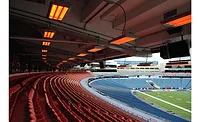
So I began to learn all about infrared heating and learned that infrared heaters heated objects and not the space, similar to standing out in the sun and feeling the heat on your face. In the case of a loading dock, infrared heaters were designed and laid out to keep the workers warm and not try and keep the loading dock warm. I had never experienced this concept when designing a hospital patient room, but I must say that radiant heating, as well as cooling, has finally found a place in the HVAC patient room design today. It only took about 40 years to catch on.
I still find spot heating and ventilation an interesting concept (see last month’s column) that does offer the building operator the opportunity to save energy when a creative HVAC design engineer takes the time to research how infrared heating and cooling works. It can open the door to new, innovative design engineering ideas. Instead of broad-brushing the building with lots of supply air, I believe we should apply the KISS concept and rethink how we can keep occupants comfortable while minimizing the number of central AHUs, multi-row coils, and stacks of filters to achieve space comfort. ES
Looking for a reprint of this article?
From high-res PDFs to custom plaques, order your copy today!