Danfoss EnVisioneering Symposium explores sustainable commercial refrigeration

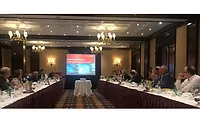
On September 30, Danfoss hosted its 25th EnVisioneering Symposium, “Refrigerants2Sustainability: Risks, Options, & Opportunities in Commercial Refrigeration.” The event in San Diego addressed how an increasing industry-wide focus on refrigerants and energy is driving changes in the design, deployment, and maintenance of refrigeration equipment and supermarkets and in the potential for industry-utility partnerships.
“Regulations — both energy and refrigerant — are driving a shift in the commercial refrigeration market,” said Lisa Tryson, director of corporate communications and public relations for Danfoss “The industry is facing an unprecedented number of regulations, which will change the landscape of approved technologies and impact supermarkets and commercial refrigeration equipment.”
Pamela Gupta, manager of the greenhouse gas reduction strategy section of the California Air Resources Board (CARB), provided keynote remarks for the symposium with an introduction to the regulations and policies pushing industry in California to reduce greenhouse gas (GHG) emissions.
According to Gupta, of all the hydrofluorocarbon (HFC) emissions released in the state, 86% can be attributed to refrigerants. Similarly, 36% of HFC emissions result from commercial refrigeration systems using more than 50 pounds of refrigerant. To help reduce the impact state-wide, California has established reduction targets for short-lived climate pollutants (SLCPs), including a 40% reduction of fluorinated gas (F-gas) emissions by 2030 based on current (2013) levels. SLCPs also include methane and black carbon.
"If we can achieve significant levels of SLCP emission reductions globally,” Gupta explained, “we can actually reduce or control global temperature rise by almost .5-degree Celsius by mid-century.”
Some of the policy design considerations for reducing F-gas emissions include: meeting states' emission reduction targets, ensuring the timely transition of R-22 systems to the lowest possible GWP alternative, incentivizing improvements in energy efficiency, and providing flexibility for the industry to minimize costs and meet the objectives as cost-effectively as possible.
Measures under consideration from CARB include financial incentives for new, low-GWP (less than 150 GWP) commercial refrigeration systems; a ban on the sale of very high-GWP refrigerants, which are generally defined as having a GWP of 2,500 or greater; a phasedown of HFC production and consumption similar to the amendment proposed by North America to the Montreal Protocol; a prohibition of high-GWP refrigerants in new stationary refrigeration and air-conditioning systems; and limits imposed on refrigerant GWPs, but this has yet to be defined.
Such regulatory actions in California could help to dictate the path forward for other states. However, as participants pointed out, there remains a sense of uncertainty within industry about how to proceed, particularly as doing business across state lines means a complex web of compliance — in conjunction with those set forth by the U.S. Environmental Protection Agency –— and the lifespan of allowed substances is not guaranteed.
For supermarket end users, the goal is an end-game refrigerant solution — not interim, incremental changes.
Keilly Witman of KW Refrigerant Management Strategy elaborated, “The choice is not where [the industry] is going to wind up [in terms of refrigerant options]; it’s when do you want to move in that direction and how many steps do you want to take in between because financial choices may be limited.”
To prepare for the move toward sustainable refrigerants and energy efficiency, several commercial refrigeration end users and equipment manufacturers already are taking action.
CASE STUDIES
According to Tristam Coffin, sustainable facilities coordinator — northern California region, Whole Foods Market has seen promising energy efficiency data at its 14 stores with natural refrigerant systems compared to stores with HFC systems. He noted, however, that the natural refrigerant stores require revised safety precautions and procedures, and emphasized the increased importance of collaboration and commissioning among all stakeholders, including controls and equipment manufacturers, in the design, installation, and maintenance phases of a store.
Likewise, Paul Anderson, senior group manager — engineering, Target Corporation, described similar successes with CO2 refrigeration systems in terms of reduced energy consumption and carbon impact, but explained that achieving greater efficiency levels means finding a balance between energy efficiency and refrigerant GWP — especially considering the store’s geographical location, climate, and format. In stand-alone coolers, Target also has used refrigeration systems with R290 and has found the total energy savings to be greater than similar coolers with CO2.
At a recently-opened Piggly Wiggly store in Columbus, GA, Masood Ali, global leader of Heatcraft Worldwide Refrigeration’s Center of Excellence for Alternative Systems, explained how an NH3/CO2 cascade refrigeration system is optimizing the life cycle climate performance (LCCP). The use of an HFC-free system, he noted, is helping to reduce by up to 20% the system’s total cost of ownership, and, due to ammonia’s thermophysical properties, should be at least 15% more efficient although other tests have proven ammonia to be approximately 25% more energy efficient.
Moving forward, Coffin underscored the need for industry training and education, which he suggested would only help to decrease the costs associated with natural refrigeration systems, thereby reducing initial system costs to improve payback.
Furthermore, Anderson called for continued innovation throughout the industry and for the sharing of experience with low-GWP refrigeration systems, noting that it’s important that end users “trust but verify” data when making decisions about the low-GWP system most appropriate for an application.
UTILITY PARTNERSHIPS
Increasing adoption of low-GWP refrigerant systems that reduce GHG emissions by further decreasing costs could also be expedited by the development of utility incentive and rebate programs, similar to those established for energy efficiency initiatives.
During the symposium, both Southern California Edison (SCE) and Sacramento Municipal Utility District (SMUD) discussed the initiatives being developed to encourage customers to make the transition to low-GWP refrigerants that simultaneously reduce a system’s impact on the electric grid.
However, there are still gaps to be crossed in order for these low-GWP or natural refrigerant incentive programs to fulfill the objectives of the utility and be attractive to customers.
As a private, community-owned utility, R. Ryan Hammond, senior energy advisor, specifically outlined SMUD’s existing programs for energy-efficient commercial refrigeration systems, including a custom incentive program, and noted it is investigating the options for a natural refrigerant incentive program. But, he also noted concerns about the availability of technical resources and parts, the integration of natural refrigerant technology with existing systems, and the costs associated with installation and maintenance.
Another gap, participants highlighted, is the changing baseline for system efficiency as new regulations dictate refrigerant use and move the bar for what is acceptable in terms of both emissions and energy consumption.
Both SCE and SMUD emphasized the need for engagement and collaboration between utilities and industry in the testing of equipment and the development of mutually-beneficial programs.
Participants agreed that broad collaboration is necessary for the industry to make the transition to low-GWP refrigerants.
For more information about Danfoss’ EnVisioneering Symposia Series, visit http://www.danfoss.us/industry-outreach-and-engagement/.
Looking for a reprint of this article?
From high-res PDFs to custom plaques, order your copy today!