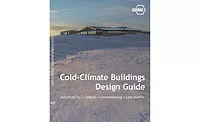
Cold climate challenges addressed in new ASHRAE publication

Buildings in arctic and subarctic climates face not only challenges related to cold but also remoteness, limited utilities, permafrost, and extreme temperature shifts. Designers must meet these challenges while keeping occupants comfortable and minimizing impact on the environment.
The newly published Cold-Climate Buildings Design Guide from ASHRAE aims to provide information on the issues commonly faced by designers in these climates. The idea for the guide came from a working session at the 7th International Cold-Climate Design Conference held in 2012 and co-sponsored by ASHRAE, SCANVAC, and REHVA.
“Harmonizing human comfort with the climatic realities of these environments is a balancing act,” said Erich Binder, who oversaw the writing of the guide. “Strategic design is key to building, commissioning, and operating efficient and long-lasting cold-climate structures.”
According to ASHRAE, a cold climate is defined by a combination of factors that create a unique set of building design challenges. These factors include temperature, frozen precipitation, wind, humidity, thermal comfort, thermal envelope/enclosure, maintainability, permafrost, and frozen ground and remote building locations.
Following are tips from several committee members for designing, operating, and maintaining buildings and systems in cold climates.
• What happens when building air exfiltrates a building envelope in cold weather is similar to what happens in cooling coils in hot humid weather — understanding psychrometrics is essential to understanding building envelope performance in cold climates.
• The colder the climate, the more important it is for critical equipment to be sheltered — you can’t expect service personnel to properly repair HVAC equipment in a winter blizzard.
• In extreme climates, windblown snow takes on a consistency similar to sand and requires special design techniques to keep it from getting into the HVAC intakes.
• The manual also covers the design impacts from non-mechanical components of a facility such as the building envelope and roof construction. For instance, snow and ice sliding down off a metal roof can shear off mechanical roof penetrations as well as hoods on the exterior wall below.
• A building envelope must address all modes of heat loss to be truly efficient; ignoring any mode of loss may lead to excessive thermal transfer.
• Frost can be devastating for HVAC equipment, blocking intake hoods, filters, coils, etc.
• Design out cold bridges in both building fabric and engineering penetrations.
• Avoid or minimize any external service pipe runs.
• Locate air inlets and exhausts in locations that avoid snow drift and blockage.
• Ensure condensing pipes never freeze and block.
• Provide safe access to roof mechanical plants in all weathers — frozen roof surfaces can be a hazard.
Frank Mills, who helped write the guide, noted that the book applies to all climates that have a heating season, not just the very cold ones.
“We do cover the extreme cold climates very well, but we also have very useful information for any buildings which have heating for part of the year,” he said. “This covers a lot of climate regions including Europe where I am.”
In addition to cold-climate considerations in HVAC calculations and system design, this book’s chapters cover sustainability, controls, building design, and commissioning, all from this distinctive climatic perspective. The book also includes an appendix with seven case studies of buildings located in cold and extreme cold climates.
To order, visit www.ashrae.org/bookstore.
Looking for a reprint of this article?
From high-res PDFs to custom plaques, order your copy today!