Museum Quality HVAC
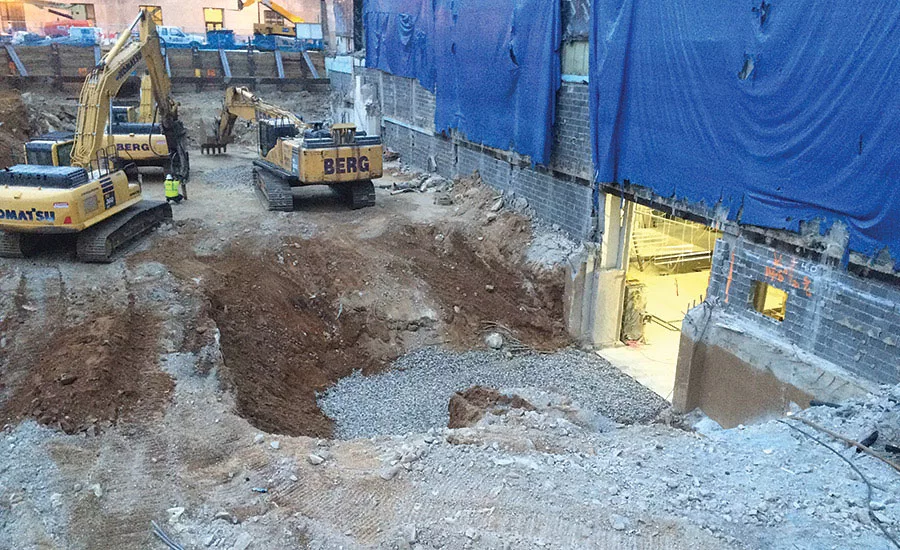
FIGURE 1. A demolished portion in the former below-grade wall of the parking garage that will host the future central utility plant. This hole provides an access point to the parking garage level P2 (two levels below-grade). Delivery of the central plant equipment was timed to coincide when planned excavation reached this level. This timing required the design-assist team to order the equipment early. The purchase order was placed to the manufacturers of the chillers, boilers, pumps, and select air handling units before 100% construction documents were even submitted.
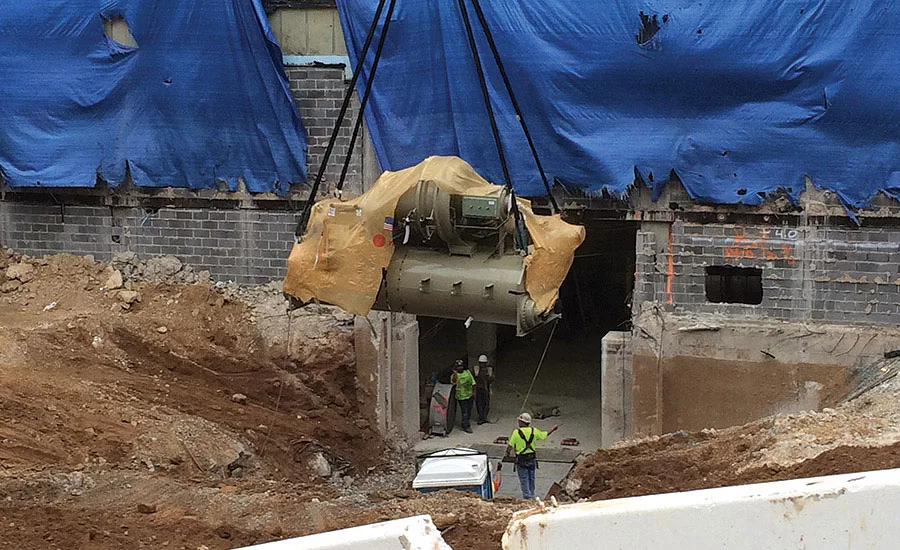
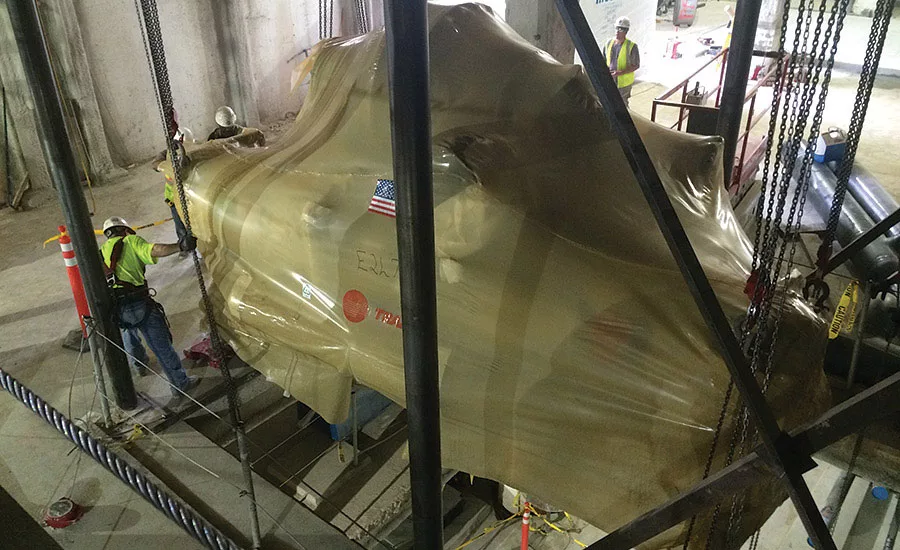
FIGURE 3. After accessing the garage at level P2, the equipment still needed to be lowered to the P4 level. A portion of the P2 slab was demolished, just large enough to rig the equipment down. After installation of the equipment is complete, the hole in the P2 slab shown here will be refilled, as well as the hole made in the exterior wall shown in Figures 1 and 2.
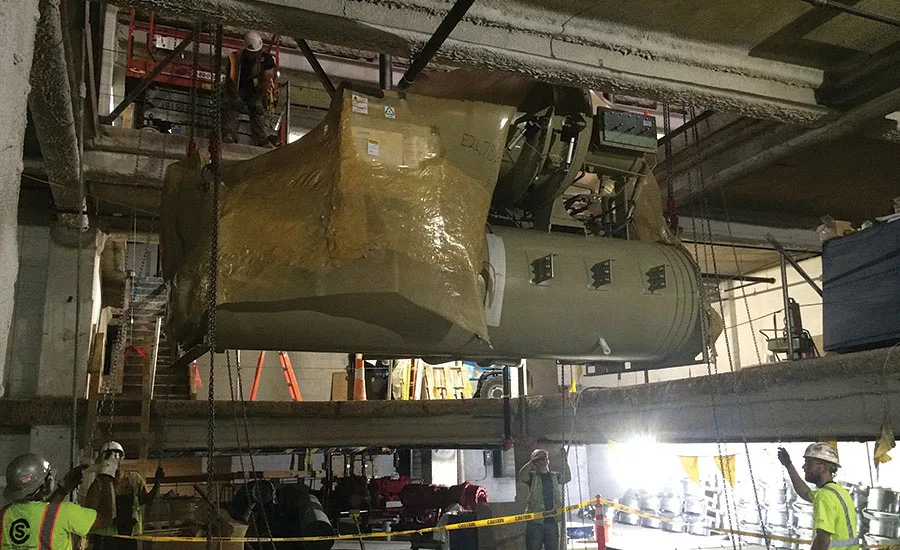
FIGURE 4. Another angle of a chiller being lowered through the slab hole from the P2 garage level to the P4 level.
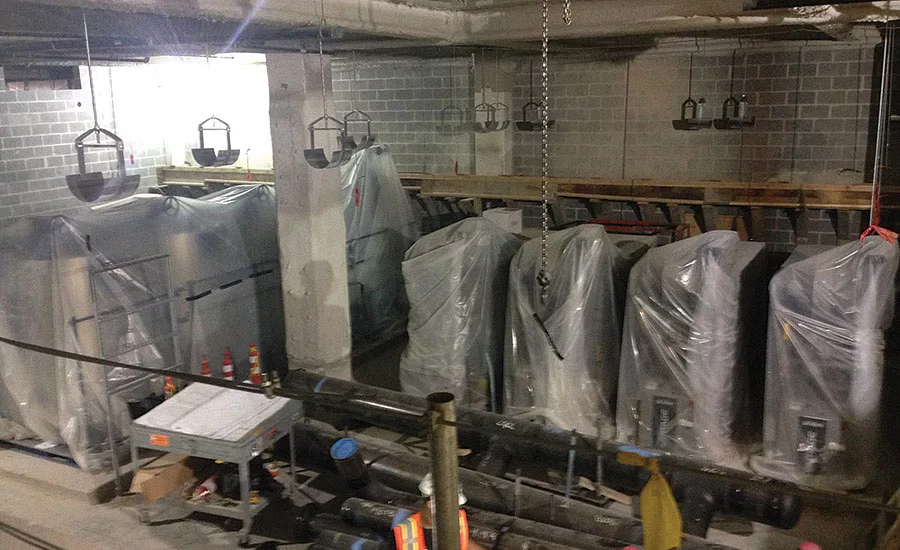
FIGURE 5. Equipment in its final place at the P4 parking garage level. Hot water boilers and the clean-steam system are shown here. The photographer was standing on the P3 level, which was demolished above the equipment to provide the required double-height space. Fitting the equipment around the existing parking garage structure was a challenge. Overhead piping is not yet installed in this photo, but some hangers for the piping can be seen.
On an existing conditions site survey in Washington, the engineering design and construction teams met in the lowest level of an existing underground parking garage, where they found cars parked in the designated location of the central utility plant for the future Museum of the Bible. In a few months’ time, the parked cars would be replaced by chillers, boilers, pumps, and other associated central utility plant equipment after repurposing the space during construction.
Without question, installing large central utility equipment in this space would be challenging. At an elevation of 30 ft below grade, the future utility plant is fully enclosed on all sides by only ground and an operational parking garage with a 7-ft clearance. For a person parking their car, getting down to this location could be done by weaving down the garage ramp. For the design team, the question was not how to get a car down here, but rather an 800-ton chiller.
SPECIFIC NEEDS …
Adding to the complexity of the engineering systems is the importance and size of the project. The Museum of the Bible (MOTB) will be a non-sectarian 460,000-sq-ft museum focusing on the history and impact of the Bible, with its core collection being a compilation of more than 40,000 biblical antiquities and rare biblical texts and artifacts. The museum will contain a mix of uses including exhibit space, library resources, meeting spaces and guest rooms for visiting scholars, space for certain affiliated museums and their exhibits, and accessory retail uses, including a gift shop and food service establishments.
Maintaining indoor environmental quality is critical to the preservation of the historical artifacts that will be displayed in the museum. Temperature and humidity setpoints will need to be met at all times or else damage could be done to the artifacts, many of which are in paper or book form. After careful consideration with the client, it was decided that the mechanical system will be able to maintain 70˚F, 45% rh in the exhibit spaces throughout the entire year. Flexibility was added in the plant design to allow the client to adjust setpoints in the future for different needs. HVAC zoning was carefully considered to allow for different setpoints in exhibit areas hosting different types of artifacts, which will allow the preservation team to set optimized temperature and humidity setpoints for the different artifacts.
Maintaining temperature and humidity setpoints in Washington, D.C. is a challenge. Summers are hot and very humid, while winters are cold and dry. Meanwhile, the museum expects a high volume of visitors, which complicates the internal loads and, more specifically, the sensible heat ratio of the exhibit spaces. Lastly, specific air changes per hour and outdoor air changes per hour were desired to prevent potential contaminants from lingering near the artifacts for periods of time. Despite the highly variable external and internal loads, it is important that the indoor environment remain constant for preservation purposes.
For summer conditions, the chilled water plant was designed to provide chilled water at 40˚F to counter the humidity of the incoming outdoor air and high volume of museum visitors. The AHU cooling coils were pushed to an approach of 2˚F, resulting in a design leaving-air dewpoint of approximately 42˚F. For winter conditions, a low-pressure clean steam humidification system was designed to humidify the cold and dry incoming outdoor air. The heating hot water plant provides 150˚F hot water. The supply air is reheated at the zone level for all exhibit spaces. The humidifiers are located at the zone level for the critical exhibit areas, and they are also located at the system level for units serving spaces with less sensitive exhibits.
The client understood the monetary and social benefits of conserving energy, and thus desired an efficient building. Energy-saving measures were implemented throughout the entire mechanical system. The dedicated outdoor air unit includes enthalpy wheels to relieve the stress of the polar Washington weather conditions. The chilled water system can operate in water-side economizer mode, and it was sized for the entirety of cooling loads in winter. The heating hot water system uses high-efficiency condensing boilers.
… IN A SPECIFIC SPACE
While implementing these complex design features, the mechanical design was limited to what could fit in the existing historical structure — and more importantly, to what could be practically constructed in the designated area for the central utility plant of the existing parking garage. Thus, an optimization challenge was presented to the design team. The variables were plentiful and included the mechanical loads, energy-saving measures, space limitations, existing conditions and construction limitations, and cost considerations.
It was decided that a mechanical design-assist would provide the best product to the client. The project could not meet expectations with a traditional design-bid-build delivery because of the amount of design and construction challenges that were presented. Through the design-assist process, the engineering design and construction teams were able to select and model an innovated mechanical solution for a complex building.
The main central plant equipment for the Museum of the Bible comprises the following:
Chilled water
- Three equally sized water-cooled chillers in parallel
- Four condenser water pumps in parallel, sized at N+1
- Four chilled water pumps in parallel, sized at N+1
- One heat exchanger for water-side economizer
Heating hot water
- Four condensing boilers
- Two hot water pumps, sized at N+1
Clean steam humidification
- Three high-efficiency gas fired steam boilers
- Reverse osmosis system
- Water softener
As of the date of this article, construction of the project is ongoing, but the large central utility plant equipment is delivered and placed in the former parking garage structure. The path that the equipment took is best described by the photos.
The central utility plant design for the Museum of the Bible could not have been done as successfully without the participation of all members of the design-assist team. This project is a great example of one that excelled with a non-traditional delivery method. The solution was designed drawing on input from the mechanical engineers, mechanical contractor, general contractor, and architects, and that resulted in a central plant design that would not have been matched had a traditional design-bid-build delivery method been used. While the challenge of getting the large equipment into the parking garage structure may be near complete, the design-assist team is looking ahead to the many more complex challenges on this project. The Museum of the Bible is expected to be open to the public in 2017.
ABOUT THE AUTHORS
Ionel Petrus is a licensed professional engineer and has over seven years of mechanical design experience. In addition to being a LEED AP, he is also a Certified Energy Manager. Ionel has just completed a master’s of science degree in Engineering and Technology Management from George Washington University. His experience includes designing HVAC systems for commercial buildings, research laboratories, healthcare facilities, and museums. He performs energy calculations, ROI analyses, as well as life-cycle cost analyses. Most of his responsibilities have included preparation and development of contract documents, both drawings and specifications for permit, bid and construction. Ionel has also been responsible for job site observation, coordination of the design team, overseeing of other team members, interaction with construction team, and attending design and construction meetings.
Daniel McGee is a mechanical engineer with SmithGroupJJR in Washington, D.C. He graduated from Penn State in 2013 where he studied Architectural Engineering.
Dan Gallagher is a Project Constructability Lead at Southland Industries, a national MEP building systems firm. Licensed Master Plumber in Maryland and the District of Columbia and has over 30 years’ experience in commercial construction. Dan designs and coordinates complex building construction projects throughout the DC Metro area using 3-D BIM modeling. He also has extensive field experience overseeing the installation of mechanical and plumbing systems for several noteworthy projects.
Don Posson has over 27 years of experience in the field of mechanical engineering and has led the development of a wide variety of large and small scale projects. Don is an inspirational leader in the design of high-performance environments for higher education, science and technology, and cultural facilities and serves as the co-director of sustainable design at SmithGroupJJR. His primary responsibilities include project design leadership beginning with the programming phase and system conceptualization; energy analysis, estimating, supervision of design and production documents; construction supervision, and commissioning.
Keith Meacham is a Project Manager at Southland Industries. He is a graduate of Architectural Engineering from Pennsylvania State University and has over 6 years of Project Management experience. His management background includes new construction and renovation for Homeland Security, U.S. State and Defense Departments, historical preservation, education, and high-rise residential. His core responsibilities involve the planning and oversight of preconstruction/construction activities for the mechanical and fire protection portion of the job.
Looking for a reprint of this article?
From high-res PDFs to custom plaques, order your copy today!