Case in Point
Historic dorms get energy makeover with VRF, geothermal
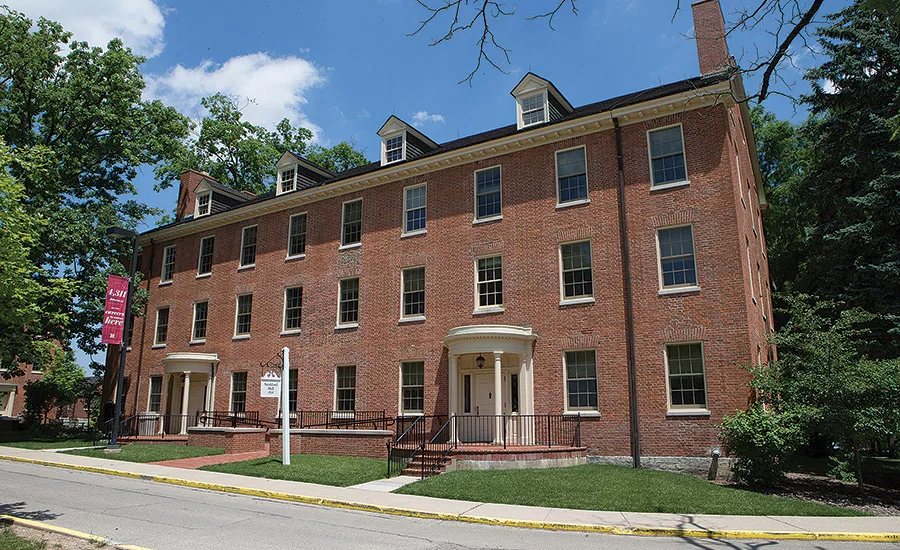
On February 17, 1809, just 15 days before James Madison succeeded Thomas Jefferson as the fourth President of the United States, Miami University was founded. Established in Oxford, OH, on land set aside under the conditions of the Miami Purchase of 1794, Miami University of Ohio is the 10th-oldest public university in the U.S.
Three-story Elliott Hall was built for $7,000 in 1825 as a men’s residence hall with rooms for 35 students. Known then as Old North, Elliott was designed in the Federal style and modeled after Connecticut Hall at Yale University.
Nine years later, Miami built a second residence hall, Stoddard (Old South), a mirror image of Elliott. Steam heat, electric lights, and what were considered modern bathrooms at the time, were added to both halls in 1899. In 1936, the halls were remodeled again, including building envelope insulation. It was at this milepost that today’s names were formally dedicated: Elliott, for Scottish-born Charles Elliott, a much-admired professor of Greek, and Stoddard for Orange Nash Stoddard, professor of natural science. In 1972, both halls were placed on the National Register of Historic Places.
To grow its campus and shrink energy costs, Miami in 2010 tasked its physical facilities department to develop a utility master plan to the year 2050. Because temperatures underground are relatively constant (around 55?F), Miami made geothermal heating and cooling a centerpiece of its sustainability strategies. The university is committed to ending on-campus coal burning by 2025.
“Geothermal is very advantageous for our climate in Ohio, where heating and cooling loads are closely matched over the year,” said Doug Hammerle, P.E., Miami’s director of energy systems. “This helps balance the well field temperature and maximize the efficiency of the system.”
Miami’s utility master plan included improving the efficiency of the two oldest buildings on campus.
“Updating Elliott’s and Stoddard’s HVAC systems was a dramatic showcase for demonstrating our commitment to sustainability,” Hammerle said.
To find the best technology to complement the geothermal, Hammerle turned to Brian Isaacs, director of corporate sales for Habegger Corp. in Cincinnati.
When Isaacs learned of Miami’s sustainability goals and the unique needs for cooling and heating the university’s two older buildings, he immediately thought of VRF zoning systems from Mitsubishi Electric US Cooling & Heating Division.
“I was introduced to Mitsubishi Electric’s VRF systems by the local sales representative,” Isaacs said. “I read their engineering manual and witnessed several VRF system installations around Cincinnati.”
Isaacs invited Hammerle and two local engineering firms to a nearby Mitsubishi Electric training center for a demonstration. In this group was Alec R. Carnes, P.E., CEM, LEED AP BD+C, senior principal of Heapy Engineering in Dayton,
Hammerle was impressed by the expert training center demonstration and the level of engineering design. But what really sold him was the simultaneous cooling and heating capability of the WR2-Series heat recovery water-source units.
He explained that 90% of the buildings on the 880-acre campus are heated by a central steam plant, and more than 50 major buildings are cooled by two central chiller plants.
“A current limitation with our two-pipe fan coil system is they can do either heating or cooling but not both at the same time,” Hammerle said. “This causes comfort control issues during mild weather. The Mitsubishi product solves this problem by being able to do both cooling and heating, irrespective of the temperature outside.”
Hammerle was especially interested in the potential for energy savings the Mitsubishi Electric system offered — especially on the heating side. “It’s impossible for a fossil fuel heating plant to hit a COP of 1, whereas with combined geothermal and watersource heat pumps, it’s possible to hit a COP of 10.”
To verify this, Hammerle asked Heapy Engineering for an extensive energy modeling analysis. Heapy’s model showed a total building energy usage of 43 kBtu/h per sq ft per year. Carnes recommended that Hammerle accept the Mitsubishi Electric VRF zoning system for Elliott and Stoddard.
“This unique VRF, two-pipe option will enable Miami to maintain the historical and architectural integrity of these two legacy structures,” Carnes said. “Mitsubishi Electric systems are simply better engineered. Coupled with the geothermal wells, this will be far more efficient than a traditional system.”
Seventeen 600-ft geothermal wells were placed under the sidewalks surrounding the halls. As modern footings were unknown 150 years ago, the hand-dug basements had no space for the Mitsubishi Electric WR2-Series heat pumps. An easy-to-access mechanical room was built into the attic of each hall for the three heat pumps and centralized controller. To maintain the architectural integrity, custom cabinets were designed and built to house the indoor units for each room.
“These cabinets are beautiful,” Hammerle said. “None of this would have been possible without the two-pipe system design. The interior would have been severely cut up with a hydronic four-pipe system.”
In 2011, Elliott and Stoddard switched from coal-fired steam heat to geothermal heating and cooling. Metered as one, the two halls showed annual energy usage of 740,000 kBtu/h for the fiscal year 2010-2011. Following the Mitsubishi Electric geothermal installation, this number dropped to 346,000 kBtu/h — a 61% decrease in energy consumption compared to 2010. The oldest buildings on campus are now the most energy efficient.
“This new system has already saved us a ton of money and enables me to have many more satisfied customers,” Hammerle said. “The Mitsubishi Electric engineering has performed so well that I can say with certainty that VRF is my system of choice for all new outlying buildings on campus not tied into the central plant.”
Looking for a reprint of this article?
From high-res PDFs to custom plaques, order your copy today!