Improve Pump Operations with VFD Network Multiplexing
From setting up node addresses to the nuances of lead and lag pump operation, explore the opportunities for tailored, more efficient performance and increased redundancy.
Single VFDs are often integrated into new and existing applications due to the huge amount of energy savings and programming benefits. Specialty pump drives often go above and beyond the requirements of simplex (one drive and one pump) applications. These same specialty pump drives can be used to communicate with each other without a host controller. This is called network multiplexing. If all of the drives and motors are common to one application, network multiplexing will be the preferred operation mode for staging and destaging the pumps based on demand.
Setup
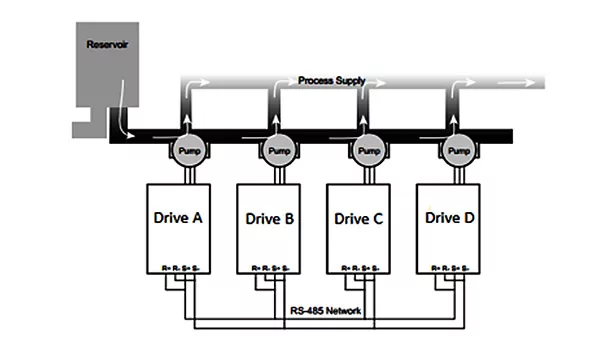
Network multiplexing requires a network connection between the drives. The connection can be wireless via radio adapters or hardwired as Figure 1 shows. In this diagram, the four drives are using an RS-485 connection daisy-chained together. Each drive uses the network connection to share critical system values such as feedback, set-point, speed, and sequencing commands. Before delving too deep into the many advanced functions available, let’s keep to the basic requirements needed to establish communication.
In tune with all networks, each drive will need a unique node address. If a duplex system is being utilized, one drive will be address 1 and the other will be address 2. The node address is arguably one of the most important parameters to set up. If a system is improperly programmed, this may result in an address conflict causing the network to not operate as desired. As an example of a node address, consider how a postal carrier does his job. The carrier looks at the unique street address on the mail to be delivered and proceeds to deliver it to that address. Now imagine if two neighbors had the same address. The address is no longer unique and only one gets the mail. This is the way information is delivered to the drives.
In addition to the wiring and node address setting, the drive must be told that it is operating in a network mode. Lastly, the number of drives on the network needs to be set. After these basic steps are completed, it is good practice to cycle power to the units to confirm the serial communications settings take effect. Once you have all of these pieces in place, you have a functioning network.
Operation
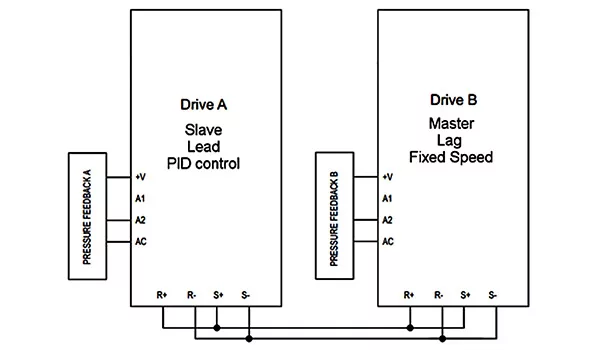
At power up, one of the drives becomes the master. The drive that is the master acts like a PLC on a network, telling itself and the other (slave) drives when to run or stop. “Master” and “slave” are used to describe the functions of the drives from a networking viewpoint. From an operational viewpoint, the terms “lead pump” and “lag pump” are used. It is very important to understand that master-slave does not directly correlate to lead pump and lag pump. Just because a drive is designated as the master drive does not mean it is the lead pump. During operation, the lead drive provides the setpoint for the entire network. The lead can alternate from one drive to another, so it is a good idea to keep the same setpoint on all drives. It is vital to understand that the lead drive is given this title because it is the one that is providing the variable speed control based on the PID process loop (Figure 2).
If the lead pump cannot keep up with demand, it will turn on the other pump(s) on the network. This is called staging. If demand decreases and not as many pumps are needed, one or more pumps will be destaged. Destaging will stop the pumps that do not need to be running, due to the decrease in demand.
The pumps that are being staged and destaged are called lag pumps. The lag pump’s speed is not determined by its own PID loop. The speed can be setup to be fixed, it can follow the lead pump’s speed, or it can run for a set time period.
Most VFD manufacturers have default parameters set up to determine when the pumps stage and destage. The detection method for staging and destaging is selectable and can be determined by output frequency, feedback, both frequency and feedback, or even by a flowmeter. The levels and times which trigger these staging/destaging functions are fully programmable.
Benefits
There are big benefits to running a multiplexed array of drives over a lone drive. Instead of running a single large power hungry pump motor all of the time, multiple smaller pump motors can be staged and destaged, dependent on demand.
To minimize mechanical wear, the drives can be programmed to alternate the lead pump over time. For example, pumps can be alternated every 24 hrs, which will extend pump life. Alternation can be programmed to follow a first-in, first-out (FIFO) or a last-in, first-out (LIFO) manner.
For critical applications where downtime is unacceptable, a multiplexed arrangement can also provide redundancy. If a drive were to fail, the remaining drives on the network would ramp up speed to meet the demand. Another aspect of redundancy is that the transducer feedback can be taken from each drive individually or from the network. As an example, let’s consider an application which is running a duplex setup with two transducers (one transducer on each drive). If one transducer were to fail, then the drive would look to the network for its feedback. This transition is done seamlessly with no drop in the system’s feedback.
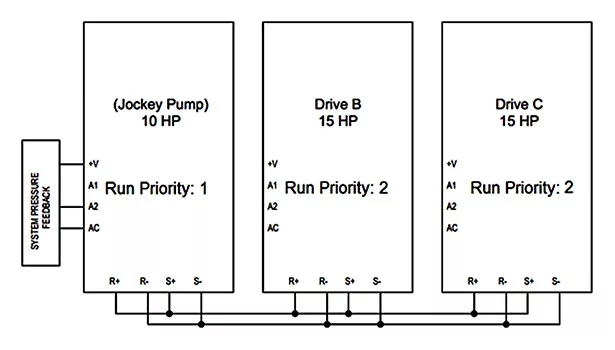
Digging deeper into available functions of network multiplexing leads us to a discussion of run priority. A run priority sets the drives priority level on a network. By setting up a run priority, we can make the network stage a smaller pump (many times called a jockey pump) to provide pressure maintenance in off-peak times, while larger booster pumps only stage when demand is higher. In an application like this, the jockey pump may no longer be needed when the larger booster pumps are running. After a period of time, when the demand is reduced, the system will go to sleep. During this time, the control of the system passes back to the jockey pump (Figure 3).
Understanding the many features of network multiplexing opens the door for you to apply it to your application. Network multiplexing provides benefit to the mechanics of pumps, saves energy, and offers piece of mind with redundancy.
Looking for a reprint of this article?
From high-res PDFs to custom plaques, order your copy today!