Cool Air Commodity UFAD Systems In High-Density Trading Floors
Here, the pressures on the occupants are exceeded only by the weight of the cooling loads. However, underfloor air proves to be a good fit for an unusual setting. Take stock of the requirements, then look for designs that can pay dividends.
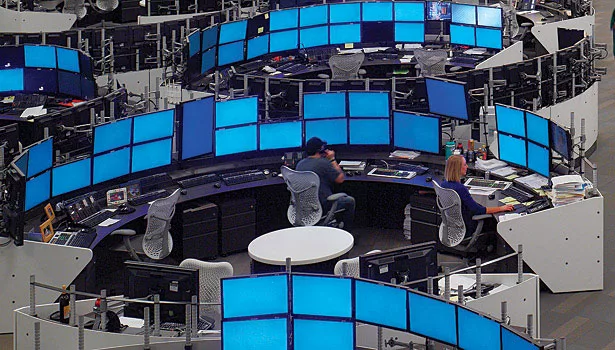
In this digital age, open outcry trading floors have all but been replaced with electronic trading platforms. Traders and support staff (developers, compliance, analysts, etc.) now utilize sophisticated IT equipment to maximize efficiency, speed, accuracy, and frequency of trading operation, including multiple high-end computers designed specifically for the trading environment. Workstations customized for trading operations are available with up to six core processors, speeds in excess of 4.0 GHz, and the capability of supporting 12 monitors. Five computers and 10 monitors per trading floor occupant are common (Figure 2). Developers and analysts are known to deploy dedicated servers at their desks, in addition to workstations, for testing algorithms and simulating trading strategies.
Because the occupant density and equipment heat gain associated with today’s high tech trading floor is much higher than that of a typical office space, it requires an equally sophisticated air conditioning system.
Per ASHRAE Fundamentals Handbook, densely populated and highly automated office spaces have an average heat gain of 2W/sf and workstation density of 85 sf/workstation. In comparison, the heat gain of some of the high-density trading floors exceeds 30 W/sf, with workstation densities at 50 sf/workstation! From an air conditioning standpoint, the primary objective is to maintain a comfortable thermal environment for occupants and equipment. This requires a careful balance of ASHRAE Standard 55 and ASHRAE TC 9.9 recommendations.
A typical base building air conditioning unit might include an overhead airflow distribution system, composed of primary air distribution ductwork and terminal units. But for the high heat gain trading floor, the base building air conditioning system is not adequate. The conventional approach for trading floors has been to incorporate a supplemental air conditioning system, comprising ceiling-mounted chilled water fan coil units (FCUs) or water-cooled, self-contained air conditioning units to operate in tandem with the base building system. The FCUs and AC units also distribute airflow via overhead ductwork. While this conventional design offers very limited redundancy as failure of a supplemental cooling unit can lead to significant reduction of airflow to the associated zone, it works satisfactorily for low-density trading floors with heat gain typically less than 7.5 W/sf.
However, the heat gain, and hence cooling load, of the high-density trading floor is orders of magnitude higher than a typical office space and therefore requires even more cooling support, in turn requiring an even more aggressive solution.
The Challenge
The heat gain from PCs in a high-density trading environment constitutes approximately 60% to 75% of the total cooling load. Because PCs are typically located within desk cavities, it is difficult to deliver adequate airflow at proper temperature to cool them. With a typical overhead airflow distribution system, the temperature of air being introduced into the desk cavities is “room neutral,” or 75°F to 77°F. If the desk cavities are air-tight and do not allow for adequate air movement, the PCs can overheat leading to thermal shutdown and premature failure in extreme cases. On the other hand, if the desk construction is too porous, then hot discharge air from PCs can leak out of the desk cavity and into the knee well. This can be a cause of discomfort to the occupants.
In addition, the variation in load among occupants can be significant. Analysts, traders, developers, compliance officers, and other support staff deploy varied equipment based on their business strategies. Therefore, the total cooling load is not relatively constant throughout the day, as it peaks when trading activity is surging and drastically reduces upon market closing. Another challenge is that most trading firms have employees, albeit a very small percentage, dealing with foreign markets in different time zones. That creates an after-hours cooling load that must still be satisfied.
Finding the perfect balance between all of these factors is extremely difficult and requires creative engineering.
The Requirements
Workspace flexibility and scalability are critical project requirements for high-density trading floors. At initial project build-out, occupancy and equipment loads are a fraction of the anticipated future build-out. Over time, people and equipment in the high-density trading environment will most likely need to be relocated, an occurrence that is far more frequent than in a conventional office setting. Because critical trading operations cannot be affected by refresh projects, the systems must be sized for anticipated future occupancy during initial design.
The Solution
|
Desk-Mounted Fans
|

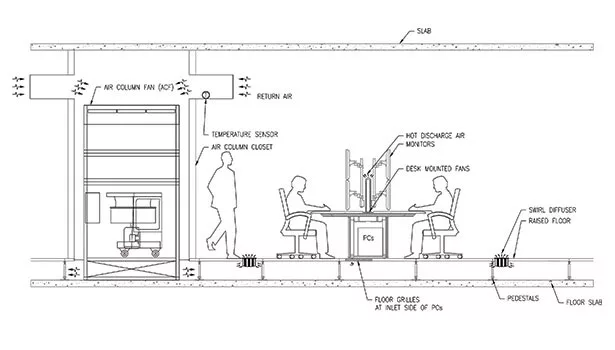
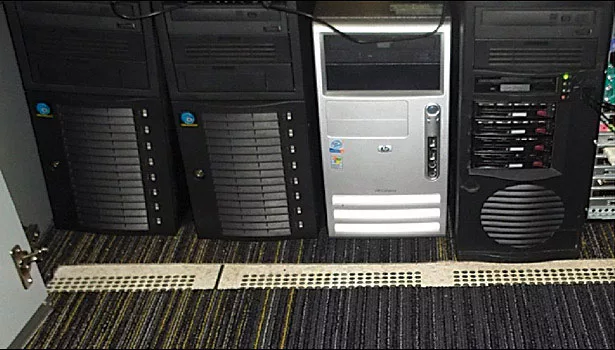
An underfloor air distribution (UFAD) system is exceptionally suited for high-density trading floors (Figure 1). With this system, each trader has the ability to adjust his or her own personal thermal comfort via dedicated swirl diffusers. In addition, floor grilles can be provided directly in front of the PCs within desk cavities (Figure 3). This ensures that adequate quantity of supply air at optimum temperature is provided at the inlet of PCs. The PC load, which is a significant percentage of the total cooling load, can be handled directly at the source.
The benefits of UFAD systems are well known. Offering excellent flexibility and scalability, the entire raised floor can be installed by day one. Swirl diffusers and PC grilles can be added in the future as needed. In addition, they can be easily relocated during refresh projects.
A UFAD system also offers excellent redundancy since multiple Air Column Fans (ACFs) discharge into a common raised floor plenum. If a particular ACF were to fail, the other units can ramp up in capacity to handle the cooling load.
Usually, the building’s primary air system cannot handle the total cooling load of the high-density trading floor. However, chilled water is available in many instances for supplemental cooling. A potential solution is to deploy few ACFs that blend building primary airflow (aka ventilation airflow) with recirculation airflow. The remaining ACFs can be equipped with chilled water coils that operate with 100% recirculation airflow. Another potential solution is for all ACFs to be equipped with chilled water coils (100% recirculation airflow). The code required ventilation airflow can be provided by overhead distribution. Such a solution essentially separates the process cooling airflow from the ventilation airflow. This solution is especially suited and almost necessary for places such as Chicago, where the building codes are very stringent if the raised access floor (RAF) is utilized for ventilation.
Needless to say, a UFAD system is not suitable for all buildings. One of its challenges is the available floor-to-floor height. However, with proper design and optimum placement of ACFs, an 8-in to 10-in-high RAF is possible, typically adequate for 1,200 W/workstation to 1,600 W/workstation. Also keep in mind that a UFAD reduces the size of, and in some cases eliminates, primary air ductwork above the ceiling, so floor-to-ceiling height can be recouped to some extent. For small-scale projects, a hybrid system can be implemented. In a hybrid system, only the trading floor utilizes a UFAD system, while the rest of the areas utilizes the conventional overhead airflow distribution system. Another drawback is that the ACFs can take up significant floor space. For smaller-scale projects, where space is at a premium, ceiling mounted FCUs may be the best solution in lieu of floor-mounted ACFs. The FCUs are ducted into the RAF by providing duct risers within shafts.
The Implementation
Regardless of the system being considered, one of the important first steps is to approximate the heat dissipation from the proposed trading equipment (monitors, PCs, desk mounted servers, etc.). Power consumption indicated on the equipment nameplate tends to be extremely conservative and will result in a grossly oversized system if utilized. An easy approach is to measure amp draw of the proposed trading equipment while representative occupants are utilizing it for their day-to-day activities. The amp draw can be measured and trended by utilizing clamp-on meters. The amp draw and voltage can be used to approximate the power and heat gain.
If a UFAD system is being considered, computational fluid dynamics (CFD) modeling is very critical and helps to verify concept. CFD modeling allows for optimum placement of ACFs and helps to study failure scenarios. It is recommended that major underfloor obstructions such as conduits and cable trays be incorporated into the CFD model for design accuracy.
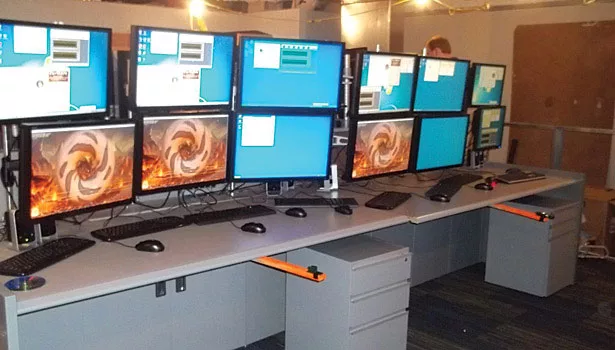
A prototype or mockup should be considered if space, budget, and schedule permits. The mockup allows for verifying the results of CFD modeling and helps the end users get acquainted and comfortable with the design. The mockup is essentially a scaled down version of the proposed implementation (Figure 4). A raised floor is set up at a small vacant space (approximately 500 to 1,500 sq ft), and a desk with trading equipment is installed on the raised floor. Swirl diffusers and floor grilles are installed, similar to the proposed detail. In lieu of an ACF, a series flow fan powered terminal unit (FPB) fed by the building’s primary air system is utilized to supply airflow into the raised floor. Wireless sensors are installed at critical locations to measure and trend temperature. The PCs are built with simulation software that mimics actual processor usage (and hence heat dissipation) throughout the testing exercise. The mockup results can also be used to improve upon the trading desk construction and compare desks from different manufacturers.
Conclusion
Utilizing UFAD containment by way of workstations and redundant cooling units creates an environment where people and computers can be simultaneously satisfied. To successfully implement these strategies, the work must be done ahead of time with accurate power consumption readings and in-depth coordination with workstation vendors. As traditional open outcry trading is replaced more and more by electronic trading, engineers will be challenged to provide reliable, scalable, and effective air conditioning for these critical hybrid workplaces.
Looking for a reprint of this article?
From high-res PDFs to custom plaques, order your copy today!