Tomorrow’s Environment
Third-Party Troubleshooting Review - Part 2
Mapping out the system and walking to conclusions will go a long way in solving mechanical errors.
Continuing on with Part 2 of the discussion on troubleshooting problematic HVAC systems and buildings (read part 1 here), I want to get a little more detailed with how to grasp the big picture when starting out with problemsolving an installation.
Those of you who read this column on a regular basis will know that I always mandate that a design engineer start with a flow diagram of the HVAC system he is preparing to design or retrocommission. The same should be mandatory when troubleshooting an HVAC project. Always start with a simple, freehand sketch (unless you are more computer literate than I). This will give you a good overview of how the system is supposed to be configured, based on available record drawings and/or automatic control drawings.
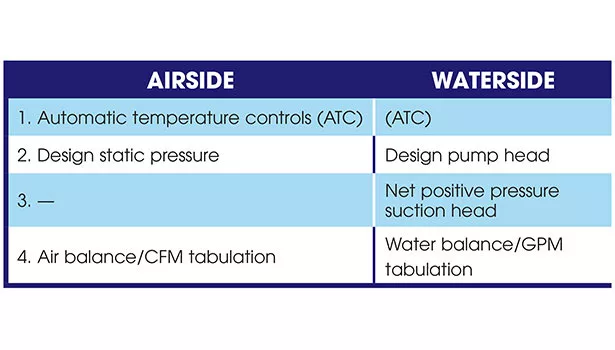
With sketch in hand, the troubleshooting engineer can begin to collect data, an integral quality control process, so that sufficient information is collected in advance of assessing potential solutions. Using the system flow diagram to be the platform for several data collection needs, the following is a list of potential information the engineer is looking to gather.
I believe that a really knowledgeable troubleshooting engineer should have training in problemsolving following similar quality control processes, so that the engineer avoids what many want to do, which is “to jump to the solution” based on her past experience with HVAC systems. There is a phrase pertaining to assuming, and the engineer should not assume anything when problemsolving. Step one is to always collect data, followed by step two, complete data assessment. One needs to be methodical in the process so that design-to-actual is clearly identified before proceeding with coming up with potential solutions. At a glance, what may appear to be the answer quite frequently is not the solution. From the time an HVAC system starts to experience a problem(s), it is not unusual that others will tweak the system via automatic control adjustments, readjusting a volume damper or balancing valve, or some other means to find a quick fix.
It is also not unusual that a quick fix turns out to be exactly that. Problem solved! But as outdoor temperatures change or interior space usage changes, a new problem will have been created from the quick fix.
I have found that really good and very analytical/anal engineers will look at a problem leaving out the practitioner’s experience that shows the solution is just an accounting problem that indicates the numbers just don’t add up. A practitioner will want to dig deeper into the problem to determine, by reviewing the existing conditions, that they may find components installed in the HVAC system that were not part of the original HVAC design. With this in mind, a face-value solution probably won’t be the long-term answer to the problem.
System flow diagrams can help avoid jumping to the answer because each of these diagrams can show the design intent, as well as a design intent that may not have been the correct ATC for the application or an error in estimating what the actual status pressure or head pressure should have been. An example of this was an original central air system design based on insufficient total static pressure. The design engineer calculated the total system static pressure that only included static pressure drop of 0.25 in based on clean filters and not based on manufacturer’s recommended replacement pressure drop (in this case, 1 in).
The more common troubleshooting problems are ATC of an HVAC system that has been “tweaked” from the time it was initially started up as well-intended technicians rush to complete a project or to get on to the next system he is responsible to start up. Other common troubleshooting system problems simply come with time and operation that slowly move away from the original settings due to control point accuracy or air/water flows changing with time.
Troubleshooting can be a recession-proof business opportunity. When the economy and construction spending drop off, HVAC systems really don’t care. If these systems find themselves going out of “spec” (not meeting the basis of design) or they want to consume more energy/cost than the building owner can afford, then the solution is to find a better way of operating to improve space comfort and/or reduce operating cost. And who do they call? The troubleshooting engineer.
Looking for a reprint of this article?
From high-res PDFs to custom plaques, order your copy today!