CASE IN POINT
Centre for Sustainability takes innovative HVAC, IAQ approach
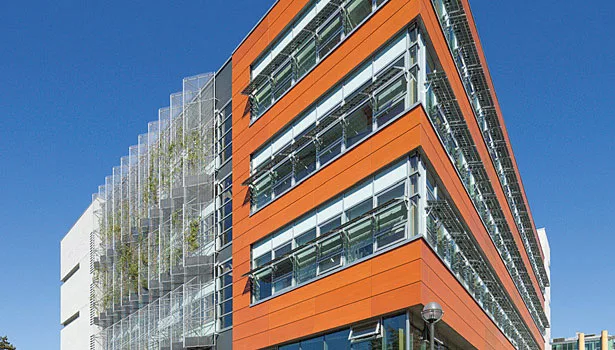
The Centre for Interactive Research on Sustainability (CIRS) definitely lives up to its name. The building on Vancouver’s University of British Columbia (UBC) campus boasts geothermal technology and heat scavenging from neighborhood buildings.
Also, CIRS now showcases an HVAC system designed with the help of Vancouver-based engineering firm Stantec. Officials at CIRS believe the design is a model for technology, building/occupant interactive research, and energy conservation for decades to come. The four-story, 65,000-sq-ft net-positive CIRS has achieved LEED Platinum certification, and applied for Living Building Challenge recognition.
Principal Jimmy Ng, P.E., led a Stantec HVAC design team that worked synergistically with the CIRS research team spearheaded by professor and CIRS project leader John Robinson PhD., and architectural firm Perkins+Will.
Stantec’s IAQ design uses both natural and displacement ventilation through underfloor air distribution. In the CIRS project, the UFAD acts as an 18-in-high ventilation plenum to distribute air strategically through floor diffusers. Consequently, air is discharged from the floor upward as opposed to overhead with conventional air mixing ducts. The idea is to save 20% in fan horsepower in a more efficient way to deliver air to the occupied zone. CIRS’ supply air is discharged to each floor’s UFAD and is controlled with the BAS by Honeywell.
Fabric Duct Inside of UFAD
Pressurized UFAD systems contribute to the achievement of several LEED credits, however, they sometimes suffer thermal degradation at the perimeter. This challenge leads to longer and inefficient mechanical equipment runtimes, according to Ng. Therefore one ventilation innovation Ng specified is UnderFloorSox (UFSox) by DuctSox Corp.
Installed by project mechanical contractor, Eagle Ridge Mechanical in Port Coquitlam, B.C., UFSox is fabric ductwork designed specifically and UL-approved for installation inside UFAD systems to distribute air closer to all floor diffusers and the perimeter. Ng worked with manufacturer’s representative Progressive Air Products to size the under floor textile duct for minimal static pressure drops.
UFAD systems certainly lend a ventilation advantage in sustainable building approaches, but they need fine tuning, according to Ng. Air leakage in UFAD and its interior electrical junction boxes can add up to 20% to 30% efficiency losses when not sealed properly with code-compliant fire stop materials.
Therefore, general contractor Heatherbrae Builders in Richmond, B.C., pressure tested the UFAD for any leakage after construction. Furthermore, supply air inside UFAD systems, in many instances, would be better distributed via fabric ducts to assure it’s dispersed where it is most needed, according to Ng.
Installing metal duct with registers and dampers inside UFAD is an alternative; however, fabric duct’s inherent linear diffusion characteristics distributes air more evenly, plus its flexibility easily circumvents utility piping obstacles and can be quickly rerouted during floor reconfigurations.
One of two centralized air handlers in the basement’s mechanical room provide conditioned air to each floor’s UFAD metal plenum that supplies each fabric duct. Each plenum has dampers that the BAS can automatically shut off by zone during unoccupied periods or when the building mostly relies on natural ventilation. CIRS also has manual or automatically operated high and low level windows, which occupants or the BAS can open for free cooling and natural ventilation when temperature and humidity conditions allow. The UFAD areas also rely on a high performance envelope and high R-value building design that uses materials specified by Perkins+Will and engineering firm Morrison Hershfield. The design limits solar gain while using the building’s sustainable geothermal, heat scavenging, and solar panels to maintain a 65°F UFAD discharge temperature.
The second air handler supplies CIRS’ 425-seat Modern Green Development Auditorium. The theater also uses air displacement, but with an underfloor metal air distribution system manufactured specifically for theaters by Krantz Kompenten. Unlike the building’s offices and labs that lack active cooling, the auditorium uses mechanical cooling through heat pumps that reject heat into the geothermal field, when heat is not being extracted from it.
In addition to the ventilation strategy, CIRS uses both photovoltaic electric and hot water solar panels. The panels are used to convert sunlight into electricity and to harvest heat for pre-heating water in the building. Both panel technologies are also integral in shading the four-story atrium skylight, the south and southwest facades, and part of the south roof from direct sunlight.
The geothermal field supplies one 118-kW and two 196-kW heat pumps manufactured by Water Furnace International. The building itself produces no emissions, therefore a 200-kW electric boiler for backup and peak demand was specified versus gas-fired models.
The building also has exhaust heat scavenging from a neighboring laboratory building to supply the CIRS heat pumps used in both space and water heating. Excess heat from CIRS’ net positive profile is fed into the same lab building to reduce that building’s reliance on fossil fuel energy and thus the campus greenhouse gas emissions. The geothermal field supplies backup heat to CIRS in the winter and rejects CIRS’ heat into the ground during the summer.
While Alberto Cayuela, P.E., CIRS’ director of operations and business development, reports good indoor air comfort reviews of the building’s HVAC systems, the true test will come after a “post occupancy” evaluation reveals recorded data of energy savings and confirms the anticipated net-positive status.
Regardless, CIRS will continue to be a living building and the design team will continue to optimize its performance, according to Ng.
Looking for a reprint of this article?
From high-res PDFs to custom plaques, order your copy today!