Variable Refrigerant Flow vs. Building Codes
When newer technologies or techniques meet older codes written for an earlier version of engineering reality, the losers are the users and occupants.
When newer technologies or techniques meet older codes written for an earlier version of engineering reality, the losers are the users and occupants. VRF use is growing — find out how that growth is being hampered by various codes addressing energy, piping, refrigerants, and electrical design.
Variable refrigerant flow (VRF) HVAC is quickly taking over market share of the industry for commercial buildings. VRF is among the highest efficient HVAC systems. VRF allows an engineer to provide customers with a very energy efficient HVAC system with exceptional comfort and flexibility. Several building codes, however, prevent this highly efficient technology from being installed because of the first cost premium that offers no benefit. The building codes discussed in this article include NEC Article 220.84, the Energy Code section on economizers, IECC 503.3.1, and the mechanical code, Chapter 11.
Imagine eliminating this technology as a viable option for your building because a building code imposes irrelevant restrictions as traditional technologies are favored. The purpose of building codes is to protect public health, safety, and general welfare. Building codes have been around for decades, with the first dating from 1772 B.C. The code from this era basically states that if a builder builds a house and it kills the owner, that builder shall be put to death. Researching the history of building codes is a fascinating read. But, the question is, are the building codes keeping up with technology?
NEC 220.84
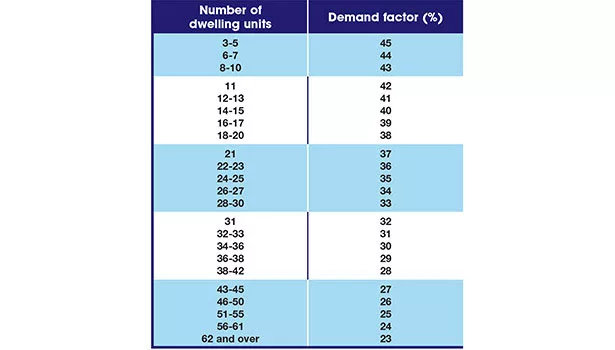
How often have we heard building owners express, “Why is the electrical first cost higher for a system that uses less energy?” When developing the electric schematic for a residential building, NEC Table 220.84 allows for diversity in feeder and service sizing. This diversity provision makes sense. It has been demonstrated that sizing the power distribution based upon worst case operation is a serious waste of money. After all, what is the likelihood that every apartment is simultaneously using every stove top burner, is maxing out the receptacle load, is washing and drying clothes, and is using hot water at a rate that requires the water heater to operate at full capacity, etc.? Not high. Therefore, as can be seen in the Table 220.84, the electrical engineers can de-rate feeder and service sizes based on a known and well-established diversity in load. Not using this de-rate table increases first cost on the order of tens of thousands to hundreds of thousands of dollars for no added value.
This code section does have some exceptions that allow for use of the de-rate table even if the apartments are equipped with gas ranges or gas water heaters. However, this code does not have a provision for apartments that are not on a dedicated HVAC system served by each apartment’s panel. The lack of this provision requires the electrical service and feeders to be oversized for no benefit. This added cost for larger electrical and feeder sizes that offer no value has caused many developers to forgo VRF as an option, and even revert to electric baseboard. This oversizing not only adds cost to the building owner but leads electric utility load growth forecasters to anticipate the need to build another electric generation facility, even though the predicted increase in energy consumption is not required. And the development of electric generation facilities has a negative impact on the environment.
Since VRF uses a “central plant,” each apartment does not have a panel that serves the electric space heat. However, the exceptions do allow for multi-family units with gas cooking to simulate an electric cooking appliance of 8 kW in the base calculation. Therefore, the logical question is, can the NEC assume an electric heat load in watts per cubic foot? (Cubic feet accounts for high ceiling spaces.)
Two buildings in Portland, OR, were built in the same year. Each comprise five floors of apartments over one floor of retail. One paid the premium for VRF, the other chose electric baseboard. Dataloggers are to be installed to obtain a good load profile of the electrical consumption in the building, on the house side, as well as the apartment side. It is our expectation that the results of this study will support a code change to accommodate VRF.
IECC 503.3.1
The energy code has a requirement for air side economizers. Economizers use outside air to cool when the outside air temperature can cool the space instead of using mechanical direct expansion cooling. Economizers add first cost but are certainly worth installing in many climates when the installed equipment meets the code mandatory minimum efficiency requirements. Economizers can save energy.
However, every state with an energy code also has a provision in Chapter 1 that states that it is not the intent of the energy code to limit new technologies. IECC 101.3 states, “This code is intended to provide flexibility to permit the use of innovative approaches and techniques to achieve the effective use of energy.” This means that there are prescriptive requirements, but upon demonstration that your design uses less energy than the prescriptive design, your design also shall be deemed to meet the code.
The IECC still allows mechanical equipment meeting the energy code from two decades ago to be installed today. For example, in 1994 gas heaters had to have a steady state efficiency of 80%. The current energy code requires gas heaters to have a steady state efficiency of 80%, even though 90+ has been available for about 15 years. The (S)EER rating from two decades ago was 8.9, and today it is 11.0. VRF has an IEER in the high teens and low 20s. (The definitions for Seasonal (SEER) and Integrated (IEER) can be understood from http://www.pnnl.gov/main/publications/external/technical_reports/PNNL-21435.pdf.)
The efficiencies are established by the AHRI, who recently established performance values for VRF, Standard 1230, dated May 2012. AHRI also determines equipment efficiency as a way to compare product lines.
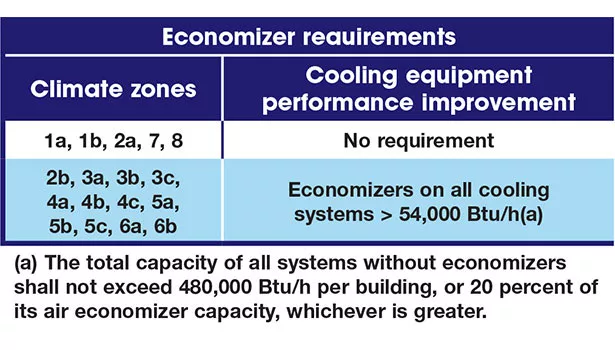
Based on code minimum prescriptive equipment efficiency, air side economizers are not required in all applications. Most of the country is exempt where equipment is less than 5 tons, and some areas do not have an economizer requirement at all. This can be seen in IECC Table 503.3.1(1) duplicated in Table 2 below. This table also caps the maximum cooling capacity in a building without economizers at 480 MBH. These limiters are fine for traditional HVAC systems but do not account for systems with internal/external heat recovery and inverter driven compressors (which, like VRF, offer exceptional performance all year).
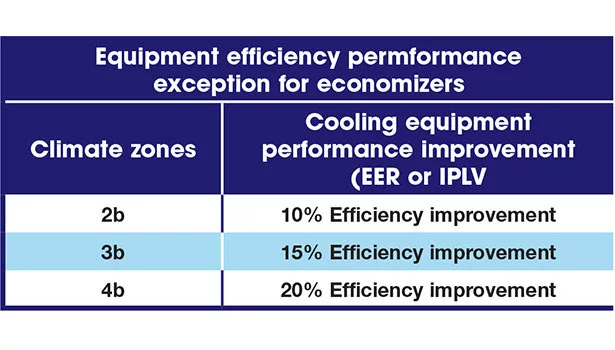
IECC Table 503.3.1(2) duplicated in Table 3 goes one step further and recognizes the value of higher efficiency mechanical equipment but stops at 20%, a recognition of traditional equipment performance improvements. An efficiency that is 20% better than code minimum would exhibit an IEER of about 15. VRF has AHRI tested performance in the high teens to mid-20s. Therefore, this table should be updated to reflect the value of VRF.
The above paragraphs address the simple VRF systems. However, the VRF with simultaneous heating and cooling (internal/external heat recovery) offer savings beyond that associated with equipment efficiency. This internal/external heat recovery also offers “free” savings during the hours when economizers are useful. The hours when an economizer is useful represent the same period when a technology with internal/external heat recovery is useful. Some progressive state codes exempt economizers on systems with internal/external heat recovery.
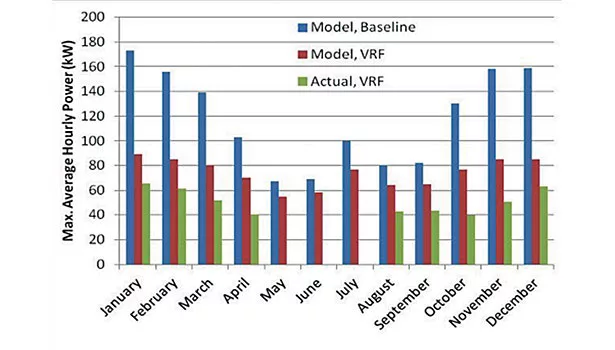
Of course, each building is unique. Computational models have shown that the energy saved with air side economizers is about the same as the energy saved with a technology that offers internal/external heat recovery. Furthermore, energy modeling programmers appear to be conservative in their algorithms for VRF. We’ve compared modeling results with actual building performance on new and retrofit buildings and found that actual performance has been better than the results obtained from modeling. This can be seen graphically in Figure 1 from the Electric Power Resource Institute (EPRI) for an actual office building. Programmers for energy modeling software appear to be attributing the value of VRF conservatively.
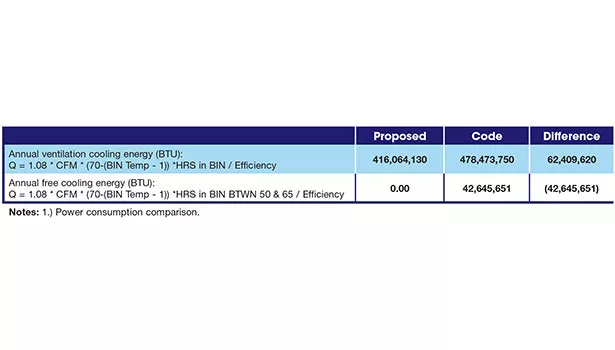
The energy code allows for a Whole Building Analysis (WBA). This analysis allows for energy use comparisons across disciplines. The added cost for the WBA analysis can cause a building owner to forgo the VRF option. However, simple spreadsheet degree day calculators can be used to demonstrate that a VRF system saves more energy throughout the year that can be saved with an economizer. For example, if we just consider the ventilation air and envelope losses in the analysis, and we compare code minimum efficient equipment with VRF, it is not difficult to show that VRF without economizers saves energy, even without consideration for internal/external heat recovery.
This calculation is extremely conservative, as it does not consider the high-efficiency equipment impact on envelope losses or heat gains. Through coupling the above calculation with the fact that VRF has internal/external heat recovery, we save even more energy. Further, if we add heat recovery and demand control ventilation on a DOAS, we can save even more energy than code minimum.
IMC Table 1103.1
Table 1103.1 defines the allowable amount of refrigerant in an enclosed space. The refrigerant used for VRF is R410A, an A1 refrigerant classification. The allowable limit is 25#/1,000 cf for non-institutional occupancies, and 12.5#/1,000 cf for institutional occupancies. As a rule of thumb, we would expect to see about 3 pounds of refrigerant per ton.
If an air conditioning system in a typical 1,600-sq-ft home with 8-ft ceilings served with a 3-ton split heat pump developed a leak, the threshold of 25#/1,000 cf would not be anywhere near close to being exceeded.
Allowed refrigerant:

The “allowed” is greater than that “provided,” 320 > 9, therefore the design is safe.
However, with VRF, a single condensing unit serves a whole neighborhood of apartments. The amount of refrigerant in the system is much greater. And, if a leak developed in one of the apartments, and the refrigerant in the circuit serving the whole neighborhood leaked into one home, the threshold may be exceeded. Therefore, the design would need to look at the smallest “zone” and the amount of refrigerant in the system serving that zone to see if mitigating measures are needed. A “zone” is all the rooms served by a single indoor unit fan coil. A ducted indoor unit serving three rooms would mean the volume of all three rooms would be used in the calculation.
If it is determined that a zone is too small for the system, mitigating measures include changing the zoning, or adding the smallest zone to an adjacent zone to make the zone larger. Alternatively, designers may provide an exhaust or transfer fan sized at 1 cfm/sq ft to run either continuously, or upon notification of condensing unit failure. There are many other options for mitigation.
In looking at the Material Safety Data Sheet (MSDS) for R410A, we find that this refrigerant is not flammable or toxic, and has a specific gravity greater than 1 at 70ºF. It does, however, have the ability to asphyxiate. Engineers as a rule are conservative people. And, knowing that VRF equipment has inherent safety measures, engineers are very amendable to offer mitigating measures. Some of the safety measures on equipment include the fact that outdoor units will shut down upon loss of a percentage of pressure (between 25% and 50%) depending on the manufacturer, and, the valves to all the zones can be programmed to close upon shutdown. Therefore, the calculation using 100% of the refrigerant in the system is a conservative one.
IMC 1107.2
This last part of this paragraph has led some to interpret the routing of refrigerant piping across a corridor to be prohibited. For flammable or toxic refrigerants, this is a very good practice. For R410A routed above the corridor ceiling, eliminating VRF because of the unwarranted imposition to pipe routing/encasement, eliminates the opportunity to install a very energy efficient HVAC system for no added value. The volume of the corridor should be allowed to be considered. Or, the code can be changed to prohibit joints in the corridors.
Conclusion
This article addresses only some of the codes that have not considered VRF specifically. The codes consider the worst-case application and therefore address designs in the most conservative manner. The result has been to omit VRF from consideration for reasons that are not realistic or valid.
As new and emerging technologies mature and become ready for implementation, they can often face many barriers. Because these high-performance technologies didn’t exist when the codes were written doesn’t mean that they should be penalized. If developers select an energy-efficient technology they will pay a premium for the same infrastructure of the status quo, which penalizes them for improving building performance. As technology evolves, so should the codes — this will help pave the way and reduce the barriers for innovations and make our buildings and energy systems more efficient.
Looking for a reprint of this article?
From high-res PDFs to custom plaques, order your copy today!