CASE IN POINT
Contingency plan keeps school in session during HVAC outage

|
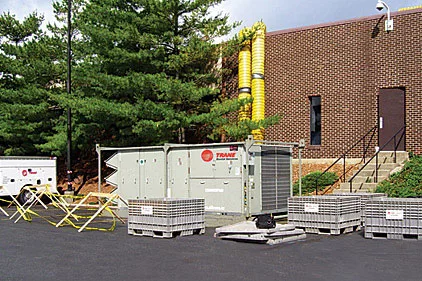
| When a Virginia school experienced an HVAC outage during the summer months, a temporary air-cooled chiller succeeded in maintaining adequate cooling and IAQ until a replacement could be made. |
Afternoon temperatures in Virginia can reach uncomfortable highs on late summer days. So when it’s time for kids to return back to school, the HVAC system needs to be working.
In 2013, an elementary school in Richmond, VA, found itself in a predicament when its 12-year-old water-cooled chiller stopped functioning on the first day of classes. School officials wanted classes to remain in session but struggled to keep students, faculty, and staff comfortable, and maintain indoor air quality without a functioning heating, ventilation, and air conditioning system.
School officials contacted their HVAC account manager for assistance and were referred to John Wingfield, a district rental specialist from Rental Services at Trane, to help find a quick solution. Wingfield determined that a temporary HVAC system was the best way to keep the school up and running until a permanent solution could be ordered, shipped, and installed.
Since the school had a contingency plan, officials were able to make decisions quickly and get a temporary HVAC system on site the next morning. Thanks to the new 155-ton air-cooled chiller, the temperature and IAQ in the building returned to normal by lunch time. The temporary air-cooled chiller remained in the school for about three months until a permanent water-cooled chiller could be installed.
School officials and building owners alike are mindful of tenant comfort, IAQ issues, and revenue and productivity losses resulting from unscheduled outages. This Richmond elementary school was fortunate — students, faculty and staff were safe, classes continued, and it was able to resume normal operations within a matter of hours.
Unexpected outages are inconvenient and can substantially hurt efficiency and increase operating costs, so planning and prevention are key. Wingfield offered a few pieces of advice to help other educational facilities and building owners prepare for and minimize the risk of similar situations.
“A 12-year-old chiller is a relatively young piece of equipment to quit working,” said Wingfield. “Like an automobile, HVAC systems run more reliably and efficiently with regular maintenance.”
Routine maintenance should include checking oil levels and drainage pans, lubricating moving parts, changing filters, and inspecting wiring and connections in accordance with factory-recommended guidelines. If time and budget resources are limited, it’s important to prioritize the most critical needs.
In the unfortunate event that a catastrophic chiller failure does occur, building preparedness can help minimize downtime.
“We recommend that education, government, and health care buildings — any critical applications — have a contingency plan in case the primary system quits working,” said Wingfield. “The building must be able to handle the increased electrical and water demands of a back-up HVAC system in order to maintain operations and IAQ.”
He also said that building owners should work with their HVAC account manager to form a contingency plan for their application. During the contingency planning stage, it is important to evaluate the building’s water, piping, and electrical systems. Installing chilled water taps at ground level and electrical breakers to increase amperage to the building are good places to start.
“If a building does not have adequate supply-return chiller water piping or a back-up power supply, the HVAC system may be down until a plumber or electrician is available to run new lines, valves, or wiring,” said Wingfield. “Having water and electrical infrastructure in place expedites the installation of a temporary chiller and can help reduce downtime from several days to several hours.”
Looking for a reprint of this article?
From high-res PDFs to custom plaques, order your copy today!


