A Big Step With A Little Footprint
With a natatorium, a gym, and other community functions, it’s only appropriate that the Ping Tom Memorial Fieldhouse design exercised a variety of HVAC muscles
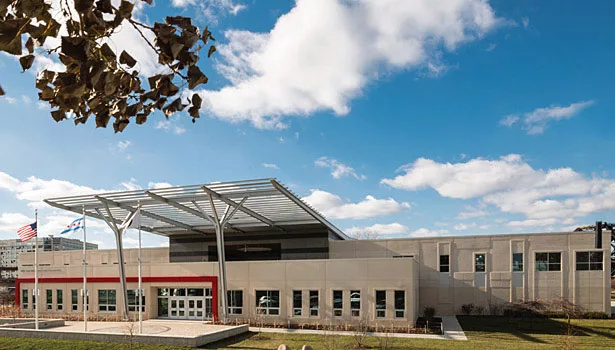

Chicago’s new 30,000-sq-ft Ping Tom Memorial Park Fieldhouse may be small in stature compared to its neighboring downtown skyscrapers, but it’s made a larger-than-life impression on the local Chinatown residents who, until it opened a few months ago, had been living without a single park or recreation facility for two full generations.
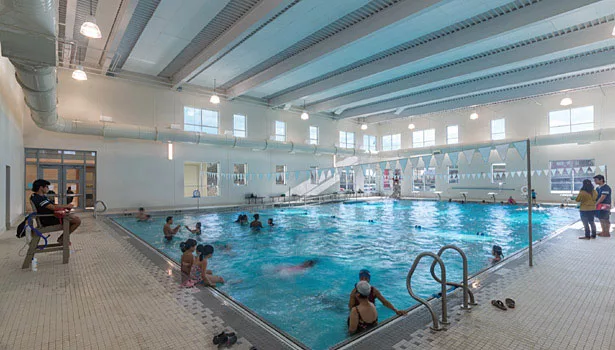
Designed by Chicago-based architects, design builders Wight & Company and MEP engineering firm, Environmental Systems Design (ESD), the Ping Tom Memorial Park Fieldhouse was built with future generations in mind. The design, its LEED Gold-status pending, features high efficiency lighting, distributed WiFi, HVAC systems connected to a geothermal well field, and state-of-the-art amenities including a gymnasium, clubroom, full-size competition pool, zero depth pool, and fitness rooms.
“The Public Building Commission of Chicago and Wight Construction worked closely with its partners including ESD to meet the PBC’s goals for sustainability, and the successful outcomes can be seen in projects like the Ping Tom Park Memorial Park Fieldhouse,” said Erin Lavin Cabonargi, executive director of the Public Building Commission (PBC). “In this project, the teams were able to ensure that the project design was executed in keeping with the sustainable building standards, once again demonstrating that use of sustainable materials can yield great results.”
Sustainable Systems
The initial design for the Ping Tom Memorial Park Fieldhouse came from a prototype developed by the PBC years before the project formally began in 2012. ESD took this prototype from concept to full MEP systems design, maintaining the owner’s sustainability goals while adjusting proposed designs to better fit the modified building. Key systems include a vertical borehole geothermal system with high-efficiency modular heat pumps, high-efficiency condensing boilers coupled with low temperature hot water distribution, a refrigerant heat recovery system in the pool air handler, air-to-air heat recovery serving the large locker rooms, and a rainwater harvesting system.
Geothermal Energy
The Ping Tom Memorial Park Fieldhouse both heats and cools its interior spaces year round through heat pumps coupled with sixteen,650-ft-deep vertical U-tube wells. Located on site, the closed loop geothermal system is designed to extract and reject heat to and from the ground. The hydronic system has 25% propylene glycol to allow for year-round operation and diminish freezing potential.
In its first year of operation the geothermal distribution system has typically operated around 55°F, the same temperature as the undisturbed ground temperature. However, the system’s design temperature can range anywhere from 45°F to 95°F, depending on the building’s load profile and stored thermal energy. The Ping Tom wells were designed near the Chicago River that maximizes heat dissipation because of the active water table.
Conductivity tests were performed after the first well was drilled which showed an average thermal conductivity and diffusivity of the grouted wells to be 2.23Btu/hr-ft-°F and 1.82-sq-ft/day respectively. In addition, a 25-year study was performed to confirm the well field sizing using the aforementioned ground characteristics together with the simulated heating and cooling loads. The study indicated balanced cyclical loading of the field and confirmed the proposed well field sizing. The 16 geothermal wells are installed in a four-well by four grid pattern on 20-ft radial centers. The buried geothermal piping is made with high-density polyethylene (HDPE) and is piped in a reverse return arrangement that allowed self-balancing of the underground system. Wells are connected in two circuits that are manifold just inside the building allowing for enhanced accessibility.
Geothermal water distribution is connected to modular heat pumps located in each room or zone throughout the fieldhouse. The heat pumps are independently controlled which allows for energy to be shared and distributed from zone to zone. Chosen for its high energy efficiency ratio (EER) and coefficient of performance (COP), this system helps minimize Ping Tom’s daily operational costs, as the installed heat pumps have EERs as high as 20 and a heating COP of over 4.
Other HVAC Elements
Ventilation is provided to the building through air valves connected to the return of each heat pump. A central VAV heat pump dedicated outdoor air unit (DOAU) distributes fresh, room-neutral air throughout the building. The DOAU has an air-to-air plate and frame heat exchanger to exchange locker room and toilet room exhaust with incoming fresh air. Zone air valves are controlled by space CO2 sensors to modulate ventilation airflow based on occupancy. Because there is a minimum ventilation requirement for the toilet and locker room areas, a corridor VAV terminal unit modulates to maintain building pressurization, prevent over ventilation, and mitigate odor migration from the natatorium, or pool area, that is served by a dedicated air cooled unit.
While the heating system for the building is primarily fed off the geothermal loop and heat pumps, three high-efficiency condensing boilers provide heat to the pool, the dedicated outdoor air unit, natatorium air handler, and inject heat into the geothermal loop should temperatures get below 40°F. The heating system is arranged as a primary-secondary loop with dedicated boiler pumps and two building secondary pumps. A two-way pressure independent control valve is used to inject heat into the geothermal loop as needed. Using condensing boilers with injection to the geothermal field allowed designers to size the well field for a smaller cooling load in lieu of the dominant heating load in Chicago. In addition, the lower temperature of the geothermal loop allows the condensing boilers to operate at peak efficiency. The hot water system is designed with 150°F supply water and 120°F return water temperatures.
The fieldhouse gym doubles as an emergency heating/cooling shelter for the area. In order to maintain the necessary reliability, the gym is conditioned with two, 8-ton heat pumps and ventilated from the dedicated outdoor air unit that has twin plug supply fans. The BAS was designed to lock out the dedicated outdoor air unit compressors when operating on the emergency generator, which allowed designers to reduce its size. Conditioning of the ventilation air is provided by hydronic heating coils in the dedicated outdoor air unit, while the gym’s heat pumps were sized to dehumidify and condition the outdoor air and gym space load during emergency operation.
The natatorium requires specific temperature and humidity levels at all times, and a dedicated self-contained, air-cooled, pool rooftop unit was specified. The unit contains two heat exchangers used for pool water heating: the primary heat exchanger is for refrigerant heat recovery while the secondary heat exchanger uses hot water. By rejecting heat to the pool water, the air handler operates more efficiently and the pool water is heated without the use of hot water. The air handler also features a full airside economizer and relief air energy recovery through a runaround refrigerant coil.
Water Efficiency
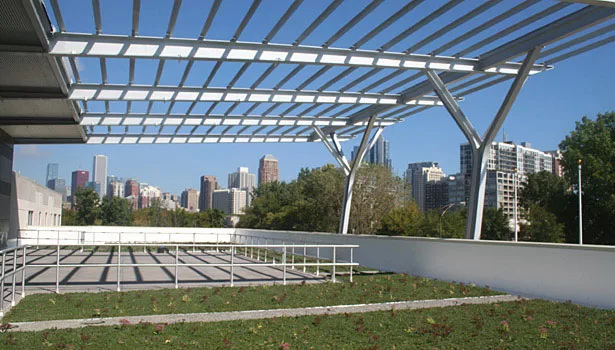
The Ping Tom Memorial Park Fieldhouse hosts a 3,500-sq-ft green roof and roof deck. The high roofs above the pool and gym are used to harvest rainwater. Rainwater is collected in a 5,000-gallon underground cistern. Water is pumped from the storage tank to a treatment system located in the building. LEED water efficiency calculations for this system anticipate over 60% in water use reduction. Rainwater is used in this facility for flushing toilets and urinals. Low flow fixtures provide further water savings at the fieldhouse, with 1.5-gpm showers, 0.5-gpm sinks, 0.5-gpf urinals and dual flush toilets (1.6 gpf up and 1.1 gpf down).
Electrical and Controls
A natural gas generator serves the Ping Tom Memorial Park Fieldhouse emergency lighting and life safety loads of the facility including the heating and air conditioning for the gym/local emergency shelter. Primary mechanical equipment is powered from the 208v/3p distribution system while lighting and smaller components are 120v/1p. A DDC control system monitors and controls the building systems to create efficiency. The control system trends status and the energy consumption of major mechanical components including pumps, fans, and heat pumps that can be used to further systems optimization. Demand control ventilation and occupancy sensors reduce energy usage in spaces that are not fully occupied. The DDC system is connected to a central monitoring station used by the Chicago Park District to monitor their portfolio of buildings.
LEED Certification
The project targeted LEED Gold certification that is currently under review. During the design phase, ESD performed energy modeling for the Ping Tom Fieldhouse which estimates a 30% total energy savings over ASHRAE 90.1, 2007 baseline, by implementing all of the above mentioned sustainable design elements, enough for eight LEED points. In addition, the water savings of over 60% were sufficient for four LEED points, the maximum available, under LEED Water Efficiency Credit 3, Water Use Reduction.
Conclusion
Looking around the 12-acre Ping Tom site with its playground, boathouse, community gathering areas, and Chinese landscape design elements, the local community knows that the building represents more than just a chance for them to access fitness and gather together, but is symbolic of a larger victory and a new beginning for the next generation of Chinatown residents.
“With the development of the new Ping Tom Memorial Park Fieldhouse, the Public Building Commission of Chicago was able to implement a unique design concept with features significant to the Chinatown community, including environmentally sustainable features that promote water and energy efficiency and contract provisions that promote economic sustainability through requirements for minority and women owned business,” said Lavin Cabonargi. “We know that this fieldhouse will be an important and enduring part of the community for years to come.”
Looking for a reprint of this article?
From high-res PDFs to custom plaques, order your copy today!