Hospital Retrofits For Energy Efficiency
How many health care facilities are limping along in terms of mechanical performance but could be running better than ever with one committed round of treatment?

By design, acute health care facilities are energy intensive. They provide critical patient care 24/7, and have many areas with strict requirements for temperature, humidity, pressurization, and proper air changes. Hospitals are made more complex by a series of regulations and inspections from local, state, and national organizations such as the Joint Commission.
These exacting requirements do not, however, preclude hospitals from being energy efficient. In fact, health care facilities are under increasing pressure to contain costs and to achieve an improved level of energy efficiency. The challenge to retrofitting a hospital for efficient operations is to clearly understand the key operating parameters, document the systems that are in place, develop a design for improved efficiency, and to work with a construction team to implement these changes. Of course, all of this has to occur within a facility that is continuously occupied.
The first step to improve efficiency is to conduct a detailed energy study. We generally do an ASHRAE Level 3 (or “Investment Grade”) audit. The study begins with an in-depth interview with the owner’s operations team to identify current issues and plans, followed by a detailed inspection of each system, study of the current BAS (if there is one), and extensive data logging.
We will typically collect copies of three years of energy bills, and complete sets of mechanical, electrical, and controls drawings. Our site inspection includes measuring current conditions including equipment nameplates, light levels, CO2 concentration, temperatures, and humidity levels. We will document system issues with notes and photographs. Data logging is done through the owner’s BAS along with the use of standalone data loggers that are able to record variables including current, temperature, humidity, and light levels. For hospitals, we work closely with the owner’s team to identify the occupancy for each area of the facility and the corresponding systems that serve them. Follow-up fieldwork includes recovering the data loggers after a period of a few weeks to a month along with any additional required inspections.
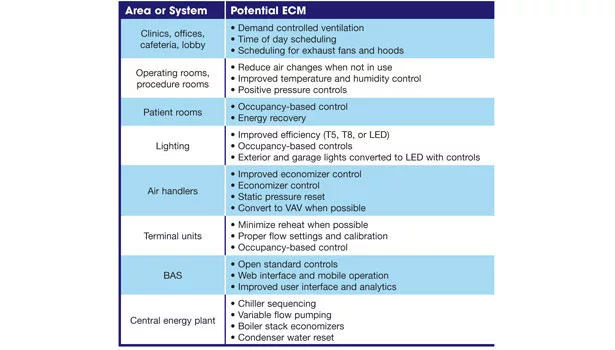
Following the fieldwork, we begin work on several tasks including energy benchmarking, developing an Energy Star score, and an energy model using EQUEST software from the U.S. Department of Energy. Energy modeling is a powerful tool that simulates the building energy use and allows you to try various solutions and get an estimate of anticipated energy impact. Developing the model requires inputting details on the building architecture and systems. The models are then calibrated using historical weather and energy usage data. While the model is in development, we examine each system and develop a series of potential energy conservation measures (ECMs).
For each ECM, we develop a schematic design that includes the required components, recommended sequence, and key metrics. For example, an ECM could include placing an air handler into a time of day schedule that corresponds to the occupied hours for that particular area. Careful evaluation of BAS and logger trend data as well as design and as built documents allows us to develop recommended ECMs. We also develop a detailed budget for each ECM. All of this information finally comes together in a detailed report and presentation that includes recommendations, evaluations, schematic design, and financial analysis. The goal of these reports is to assist the owner in making a decision to invest in efficiency. The report is accompanied with a detailed presentation and often several iterations of the project scope and budget as the owner works to secure approval for the project. Obtaining funding is always a challenge, and solutions such as utility incentives, tax credits, grants, etc., are all important.
With approval in hand
Once a project is approved, it moves into full design, which generally includes more fieldwork, the development of detailed plans and specifications, followed by contractor proposals and finally, contractor selection. Design development for an existing building is difficult. Special care is needed to develop a new design that is efficient, without violating any of the existing code or operating requirements. This requires special attention to issues such as ventilation rates, air changes, emergency shutdown, smoke control, and evacuation. Documenting existing conditions is critical, and consulting with the local authority having jurisdiction (AHJ) on key issues is advised.
The selection of the contractor for a retrofit project is critical. The ideal contractor has extensive controls experience and experienced project managers with an understanding of the special requirements of a health care environment. Some of these special work requirements may include the need to work at nights and on weekends, as well as coordination required for cleaning and infection control in work areas. The construction phase is often extended due to challenges with accessing systems and areas of the building. Having a program to advise building occupants about the ongoing changes is highly advised. Regular project meetings are required to keep the project on track and to deal with the myriad issues that will come up.
The final step in the process is a complete commissioning. We find that it is often challenging for the contractor to complete a system, but even harder to get it running in the optimal method as designed. Working with the contractor through the commissioning process can result in a project that does operate at the desired level of efficiency. Ideally, the facility engineers are involved with the project as it evolves and are learning the new systems. Formal training comes late in the process as the systems are turned over to operations. The new BAS should become a critical tool for the facility engineers to track energy usage, deal with issues, and continue to optimize operational efficiency.
Following the completion of the project, ideally, follow up includes a formal process for measurement and verification (M&V). The M&V process establishes an energy baseline, identifies weather and occupancy sensitivity, and then compares usage against the historical baseline with the proper adjustments. M&V is not an exact process, but it provides a valuable tool to see if a project is actually achieving its target goals.
Case Study
To illustrate the entire process from study through commissioning, it is valuable to look at an actual project. This case study concerns a 117-bed suburban hospital located in the Southeast. The facility was constructed in the mid 1990s and had large built-up VAV air handlers, centrifugal chillers, and steam boilers. The controls were a mixture of pneumatic and DDC with a central BAS. Like many hospitals, the facility has gone through a series of renovations and additions, resulting in numerous changes to the original systems. The owners of the hospital realized that this particular facility was using more energy than others in their system, but they weren’t sure why. They had previously completed a detailed energy study and had talked with an Energy Service Company (ESCO) but had not elected to proceed with any changes.
What we learned upon studying the facility was that it was operating less efficiently than would have been expected. Energy usage was consistently around 300 Kbtu per sq ft per year and was 20 – 30% above the Commercial Building Energy Consumption Survey (CBECS) average for similar facilities in the area. The site inspection revealed some fairly obvious issues, including continuously operating zones, less than optimal chiller sequencing, and the use of inlet guide vanes on the fans instead of VFDs.
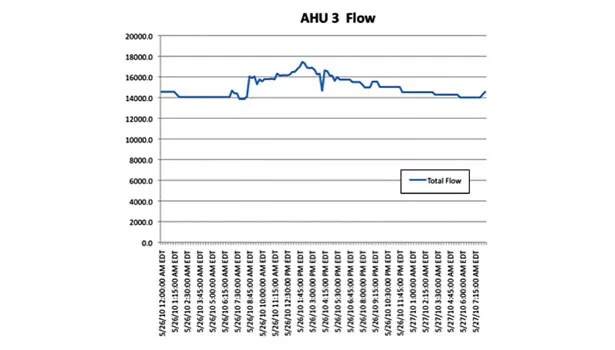
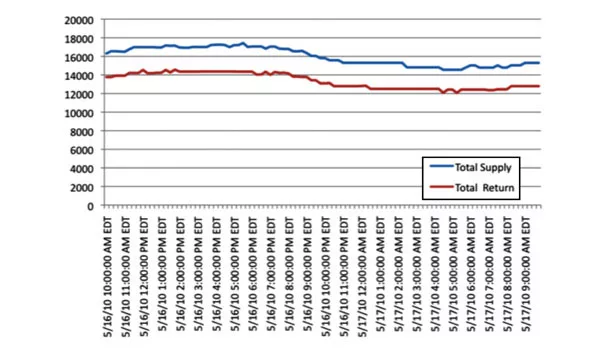
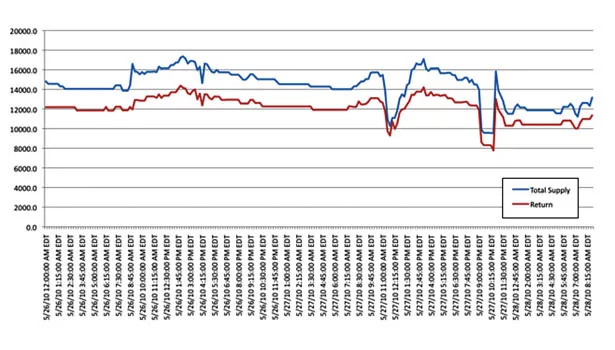
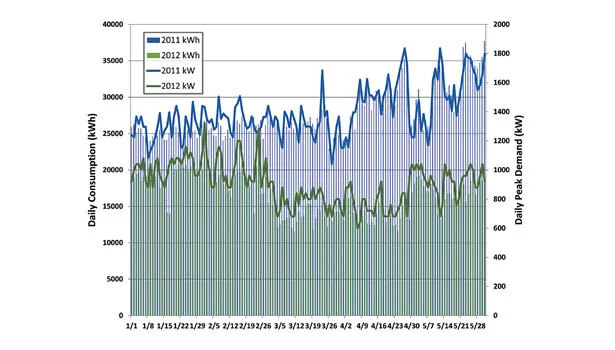
Analysis of the facility’s smart meter data revealed that little was shut off on nights and weekends, even though large portions of the building only operated during weekdays. Data logging showed that the building was generally holding the desired temperature and humidity levels. What didn’t make much sense, however, was that the airflow never appeared to vary, even at night or during mild weather. Our expectation was that the VAV boxes should be modulating to minimum flow as the cooling load in the building decreased.
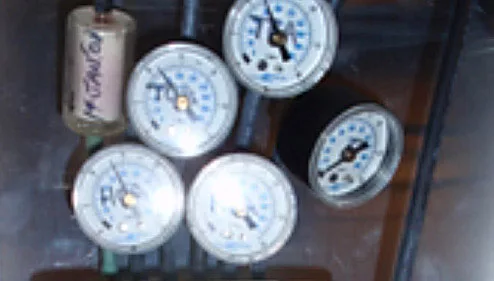
Through the study, we finally determined that the pneumatic controls compressor had failed years earlier resulting in oil contamination throughout the system. Filters had been deployed to clean up the damage and controllers were replaced when they failed. It appeared that many of the pneumatic volume regulators on VAV boxes had been replaced, but the new units were not properly calibrated for minimum and maximum box flow.
To test our theory, we went through the boxes served by one air handler and properly calibrated each one; by simulating a temperature changes in each zone, we were able to see that the air handler did properly modulate flow as anticipated. The lack of proper flow control would normally have resulted in space comfort problems, but on this project, all of the boxes had hot water reheat coils. The boxes had essentially reverted to constant volume with reheat with the thermostats controlling the reheat valve operation. The result was good comfort, but poor efficiency.
We recommended a program that included the following:
- General - Evaluate flow settings for all zones to meet current code. Provide for unoccupied modes for zones that do not have continuous occupancy. Eliminate (or minimize) simultaneous heating and cooling. Improve sequencing and control.
- VAV Boxes - Replace pneumatic controls with DDC. All boxes to be rebalanced with new minimum and maximum flow setpoints. Add separate minimum flow settings for heating and cooling. Selected zones are placed into schedules to shut off boxes during unoccupied periods.
- Air Handlers - New DDC controls to replace the existing pneumatics. New sequences for scheduling, fan control, static pressure reset, and enthalpy economizer. Fans retrofitted to cogged belts and variable frequency drives.
- Chiller Plant - New controls and sequences for sequencing, tower control (including condenser water reset), and secondary pump control. New sequence for the waterside economizer heat exchanger.
- Energy Reclaim Unit - Convert to single-zone VAV operation. Do not run desiccant wheel during mild weather.
- Operating Rooms - Use an unoccupied cycle that reduced airflow from the regular level of 20 to 25 ach down to eight to 10 air changes when unoccupied.
In order to calculate the potential energy savings from these changes, we developed an energy model using EQUEST. The model provided the owner with an estimate of potential savings from each of the ECMs. For each of the measures, we developed a budget for design, installation, and commissioning.
The total cost of the project was significantly above what the owner had available to spend. We looked at splitting the project into multiple phases to spread out the expense over several years. In the end, though, we were able to assist the owner with applying for and winning a state energy grant, which along with utility incentives, provided a project that the owner was willing and able to fund.
The design process required more fieldwork, evaluation of the loading for each zone, examination of the many changes made during renovations, and development of a complete set of plans and specifications. The contractor selection process started with a request for qualification (RFQ) and interviews. Selected contractors were invited to review the design documents and provide proposals with a technical approach and pricing. Finally, a contractor was selected who was able to provide a new Honeywell WEBS BAS that was BACnet based and would connect with the owner’s existing Tridium Niagara Server. Design and deployment took well over a year with a lot of challenges in working around a fully occupied hospital. Eventually, the project was fully commissioned and turned over to operations.
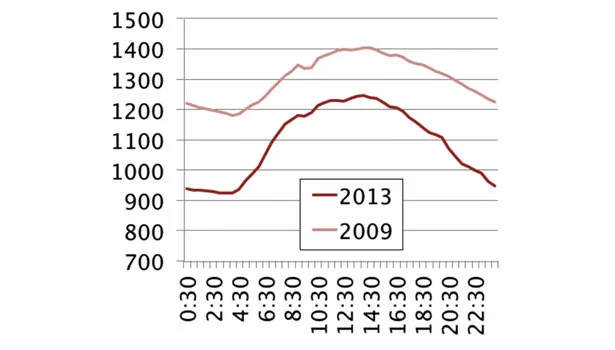
The result has been a facility with dramatically improved controls and the ability to have facility operations view and react to problems. The project did go through formal measurement and validation, and the resulting savings was well over 20%. Systems are now shutting off when areas are not occupied, and the comfort and critical areas continue to meet the exacting health care requirements.
There were many lessons learned resulting from this project. The first was the importance of taking a detailed systems approach to understand what is in place today, the designers’ original intent, and current operations. Evaluating a complex facility such as a hospital requires a lot of “detective work” and it includes tracking down drawings, taking measurements, and finding out what is there and why. You then need to be creative and realistic about what can and cannot be replaced or upgraded. One of the most important lessons is never to simply replace what is there today, but to look for opportunities to improve and optimize as part of the retrofit.
Working through the details and having a strong contracting team are absolutely crucial, but probably the most critical element is strong support from the owner. Making changes to any operating building is a challenge and should not be attempted lightly, but such challenges are even more extreme in a health care environment. Getting owners involved at every level of their organization was probably the most important part of this project. Without this support, achieving this type of successful retrofit would not be possible.
Looking for a reprint of this article?
From high-res PDFs to custom plaques, order your copy today!