More Than Just Fun And Games
This project team left nothing to chance when it came to designing a five-story mixed-space facility for a Chicago gaming company.
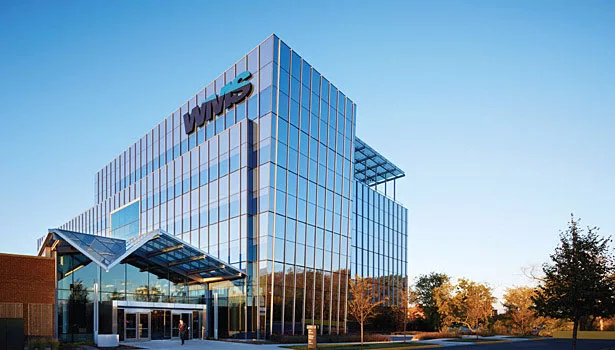
FIGURE 1. WMS Industries achieved over 28% energy savings and a LEED certification by employing a number of technologies, including two 150-ton packaged DX rooftop units featuring evaporative condensers.
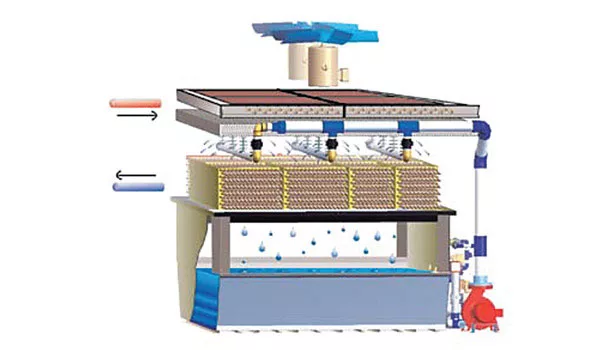
FIGURE 2. The evaporative condensers integrated into the largest of the DX air handling units allow the eight scroll compressors to operate at efficiencies 20% to 40% higher than units employing traditional dry condensers.
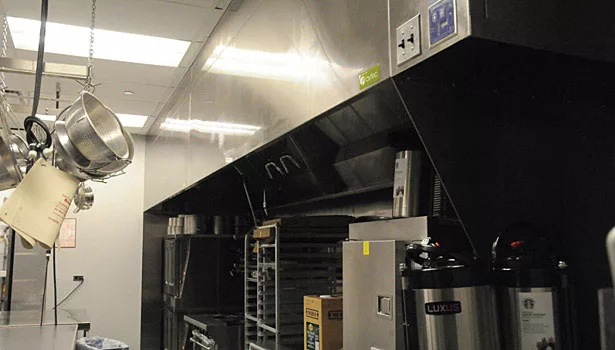
FIGURE 3. WMS installed kitchen exhaust fans that reduce energy use by operating at variable speeds. (Photo courtesy of ESD.)
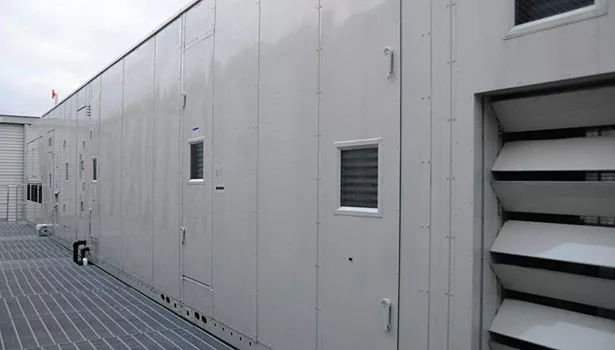
FIGURE 4. Packaged DX rooftop units provide ventilation and conditioning for multiple floors and spaces at WMS Industries. Motorized dampers on the AHU are capable of controlling the percentage of outside air being brought into the building, ranging from the code required minimum up to 100%. (Photo courtesy of ESD.)
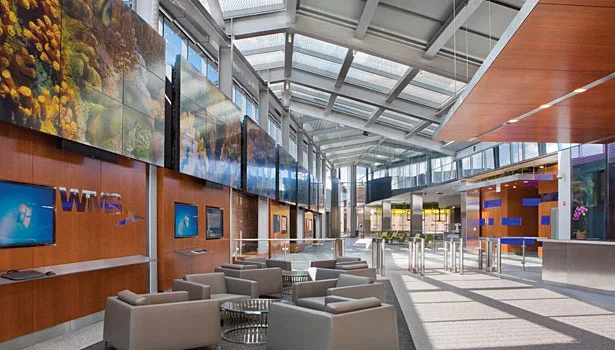
FIGURE 5. Enthalpy controls evaluate conditions and guide the amount of outside air provided to the WMS lobby, ranging from code min-imum to 100%. Regardless of the mix, the AHUs employ MERV 13 filters.
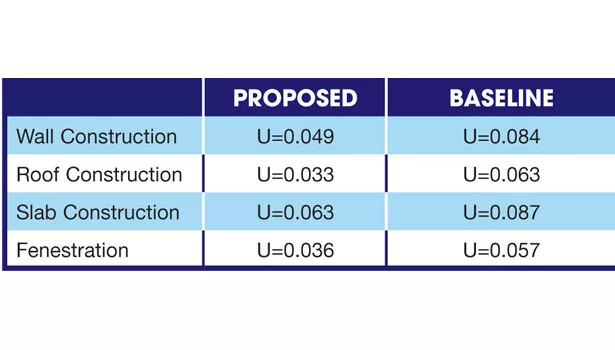
TABLE 1. Proposed thermal performance versus baseline performance.
In 2009, WMS Industries, Inc. launched a company-wide green initiative. In addition to implementing everyday conservational strategies throughout their facilities, they made a public pledge to seek LEED certification for all newly constructed facilities.
The 120,000-sq-ft Chicago-based Technology Development Center for the designer, manufacturer, and distributor of electronic gaming devices for the casino world was the first to be built under the new program, achieving LEED Platinum.
“We have made a strong commitment to reducing our global footprint through energy efficiency at WMS corporate offices and in every market where the company operates. Consistent with the company’s overall continuous improvement methodologies, we carefully analyze energy and resource consumption,” said Todd Clark, director of global facilities at WMS Industries. “The LEED Platinum certification of the Chicago Technology Center follows that of the gold-level LEED certification for our office and warehouse in Reno, NV. We are in this for the long term because we all have a choice about how we use our natural resources, and the only right choice is to conserve.”
The five-story, mixed-use office building features a full-service kitchen, dining room, lounge, fitness center, basketball court, auditorium, staff training room, and a terrace suite complete with a wet bar and outdoor seating area. Oh, and there are also three floors of office space.
The challenge was for Chicago-based ESD to design an HVAC system that could meet the diverse requirements of the building, but also the demands of a highly technical facility, while doing it in an economical, energy-efficient way.
ACHIEVING IT ALL
The ambitious goal of the mechanical systems design at WMS was to reduce energy usage by 28% as measured by cost, over ASHRAE 90.1 (2004) and meet LEED Platinum requirements. And that’s exactly what happened — actual predicted energy savings came in at 28.5%. With the unique HVAC load of the varied spaces, this would mean employing a combination of both commonly used and innovative energy saving measures.
Two 150-ton packaged DX rooftop units provide ventilation and conditioning for the first floor’s fitness center, dining area, basketball court, and lobby as well for as the office space on the first through fourth floors. Motorized dampers on the AHU control the percentage of outside air being brought into the building ranging from the code required minimum up to 100%, so long as outdoor conditions are favorable, as determined by comparative enthalpy controls. Each AHU is equipped with MERV 13 filters. The first floor auditorium, pre-function auditorium area, and the penthouse are served by additional AHUs, each equipped with 100% airside economizer and MERV 8 filtration.
| OTHER GREEN INITIATIVES |
|
Beyond an efficient HVAC system, other sustainable initiatives employed at WMS include a BAS, energy efficient lighting and occupancy sensors, high-performance insulation, low-flow/motion detected bathroom fixtures, and a rain harvesting system, reducing the building’s carbon footprint and utility use in just about every way possible.
“Water consumption in the new Chicago Technology Center is about 30% less than our other buildings because our water closest and urinals now make use of our rain harvesting system,” said Todd Clark, director of global facilities at WMS. “Surprisingly, the building also houses our café and fitness center, where water consumption is heavy.”
|
VFDs were supplied for each of the rooftop AHUs and were also implemented in the air column fans and larger exhaust fans requiring large horsepower motors. Electronically communicated motors (ECMs) were specified on all fractional power motors, such as those found in fan-powered terminal units and small exhaust fans that serve the auditorium and penthouse.
KITCHEN
The kitchen features one of the most unique systems implemented in the mechanical design, alongside the aforementioned evaporative condensing AHUs: its own variable speed kitchen exhaust system (see diagram).
Two exhaust fans (5hp and 7.5hp) are used to exhaust air from several hoods in both the back-of-house kitchen and servery areas. While code requires a kitchen exhaust to capture and remove smoke and grease created during certain types of cooking, there are often many operational kitchen hours at WMS when smoke and grease are not generated even though equipment under the hood is in use. For this reason, ESD specified a variable kitchen exhaust system, allowing the exhaust fans to operate at partial speed in the absence of smoke and grease.
Using temperature and optical sensors on the kitchen hoods, when the variable exhaust system detects smoke or grease, it signals the exhaust fan to operate at 100% design capacity. When the fans don’t detect smoke or grease, however, they operate at partial speed, increasing proportionally as exhaust temperature increases.
This variable system is projected to reduce fan energy by 90% annually compared to a constant volume system in which the kitchen exhaust system runs at full design capacity whenever the equipment under the hood is in use. When the speed of the fan can be reduced, it’s better than a proportional payback. Power varies directly with the cube of the fan speed. Therefore, when speed is reduced by half, only one-eighth the maximum power is required.
While the energy savings realized by operating the fans at reduced speed is significant, it would likely not justify the additional cost of the system alone. Additional savings are realized in the reduced makeup air requirement. A dedicated makeup air unit replaces the air removed by the hoods with 100% outside air.
Conditioning this air is energy intensive. The variable kitchen exhaust system ensures that no more outside air is heated or cooled than is necessary to maintain effective removal of smoke at the kitchen hoods by “communicating” with the makeup air unit.
ESD developed a control sequence to tie the variable kitchen exhaust system and the makeup air unit together through the BAS. Controls independently monitor the exhaust fans and then communicate the readings to the makeup air unit, so it knows what speed to run at in order to meet the demand of the kitchen spaces. We estimate that the energy use related to conditioning the outside air will be 50% less than that required by constant volume hoods.
UFAD
The second- through fourth-floor office spaces feature an UFAD system, employed to maximize the ventilation effectiveness of the HVAC system in these spaces. Air delivered at the floor through a series of swirl diffusers minimizes mixing and promotes the continuous removal of contaminants away from building occupants, moving air up to the ceiling where it is removed from the space.
The 12-in raised floor has at least one diffuser at each workstation or space, depending on the amount of air that’s needed to cool the space. Allowing for individual control of air delivery, the system not only enhances occupant comfort but is also more efficient, delivering air per occupant demands and reducing overall fan energy.
While the UFAD is ideal for the WMS office floors, it wasn’t employed in other areas like the first floor mixed-use space, or the areas along the perimeter of the building where it was either more efficient or cost-effective to design a standard overhead delivery system.
CO2 MONITORING
Carbon dioxide monitoring is provided at both the AHU returns as well as in densely occupied spaces to both create better indoor air quality for occupants and achieve LEED credits.
While CO2 rarely accumulates to harmful levels given today’s modern ventilation requirements, the CO2 monitors were employed at WMS Gaming to track air turnover and ensure that more harmful contaminants, like VOCs and chemicals found in everyday items such as printer toner or cleaning agents, are removed from the building.
Tied to the BAS, the CO2 monitor gauges the overall ventilation effectiveness of the HVAC system in the building’s densely occupied spaces (e.g., the large conference rooms, auditorium, and fitness center), alerting the BAS as more outside air is needed in a particular space. If CO2 levels in the return air entering an AHU exceed 800 ppm, the system is set to proportionally increase outside air quantity to an adjustable maximum CFM greater than the design minimum. In densely occupied spaces, local terminal units will provide increased volume of primary air when CO2 levels exceed 1,000 ppm. A supervisory alarm is then generated at the BAS whenever CO2 levels exceed 900 ppm in any space.
BUILDING MATERIALS
Collaborating with other building team members, ESD worked to reduce energy consumption and minimize the building’s overall environmental impact not only by heating and conditioning air more effectively, but also by minimizing the need to heat or condition air in the first place, implementing a high-performance envelope.
By selecting building materials with outstanding thermal performance, the building team was able to exceed baseline requirements, further promoting the building’s efficiency (Table 1).
CONCLUSION
Beyond design, ESD developed a measurement and verification plan for the WMS Gaming HQ to achieve additional LEED points. Gas and water use are metered at the utility entrance, while equipment logs and careful analysis of overall building operations will help determine mechanical equipment contributions to this energy use. Electrically, energy measurement will be measured and quantified directly, while mechanical equipment is powered from dedicated metered panels.
Trend data will be logged and saved over the course of the first few years so ESD can assist in calibrating the actual and baseline energy models to closely match performance.
Completed in the summer of 2012, the company’s new Chicago Technology Development Center is not only a sustainable leader for WMS but a winning example of environmental stewardship for all.
Looking for a reprint of this article?
From high-res PDFs to custom plaques, order your copy today!