Myths, Mix-ups, and Misconceptions
Do you know what you think you know about US/EU cleanroom classifications, HEPA efficiency, and air change rules of thumb? And what does that leak really mean for performance?
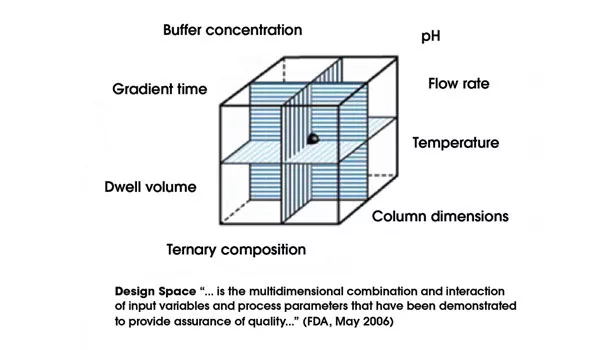
FIGURE 1. Design space description.
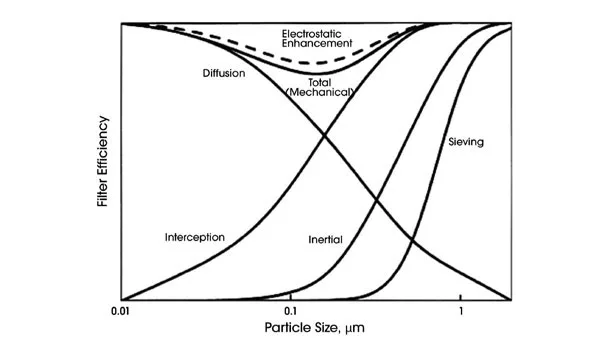
FIGURE 2. Filtration mechanisms. (Courtesy of NAFA.)
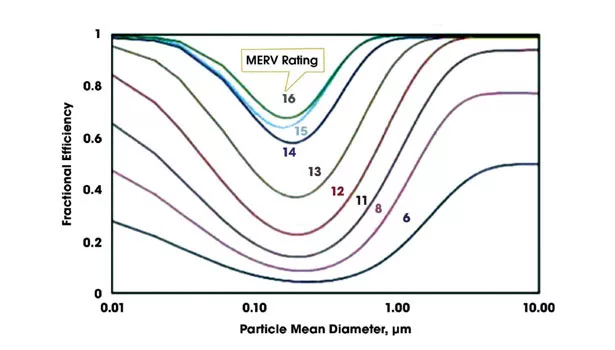
FIGURE 3. Filter efficiency by particle size. (Courtesy of NAFA.)
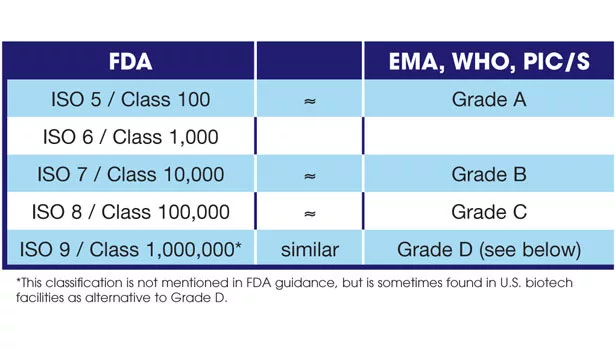
TABLE 1. Comparison of classes.
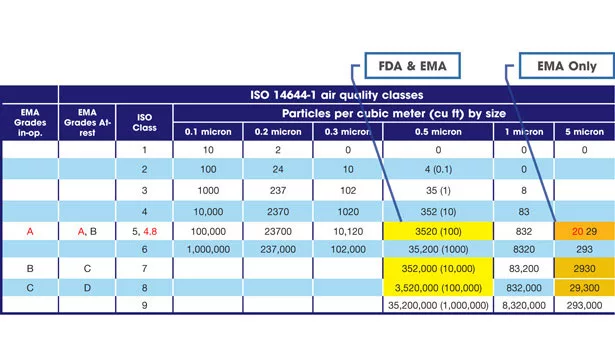
TABLE 2. Particle counts in-operation.

TABLE 3. Effect of a pinhole leak.

TABLE 4. Effect of HEPA leaks - limit determination.
According to Webster’s, a rule of thumb is “a general principle regarded as roughly correct but not intended to be scientifically accu-rate.” I actually prefer the definition offered by Wikipedia: “A principle with broad application that is not intended to be strictly accurate or reliable for every situation.” If these “rules of thumb” are not intended to be “scientifically accurate” or “reliable for every situation,” then how can we continue to use them in the design of some of our most critical environments — those used for the manufacture of lifesaving products?
The pharmaceutical industry is changing, or rather, continues to change. In my 2009 article, “First Steps in Sustainable HVAC De-sign for Bio/Pharma Facilities,” I discussed the rise of the risk management approach to compliance. Along with our new focus on understanding risk, there is a keen sensitivity to understanding the scientific basis for design. In the modern era, regulators aren’t looking for simple compliance; they look for an understanding of the “design space” — that is, the range and interaction of variables in the pharmaceutical process that produce acceptable quality. (see Figure 1) Examples abound in process engineering.
This direction can be clearly seen in the EMA’s new process validation guidance, ISPE’s new process validation guidance, and FDA’s “Quality by Design” brief, which defined this concept (design space).
What HVAC engineers need to do is to identify where our approach has not been scientific and then develop science-based practices in place of our old rules of thumb for environmental control and HVAC.
In this article, we will deal with five (5) areas of misunderstanding that are ripe for a more scientific approach.
- Cleanroom classification (US and EU)
- HEPA filter efficiency against small particles
- Establishing cleanroom airflow and air change rates
- HEPA use for low-classification cleanrooms
- The importance of HEPA leaks
MYTH #1 - CLEANROOM CLASSIFICATIONS
Over the course of 30 years, I’ve managed to collect a list of favorite myths and blunders, but few have been more widespread or as vexing as the general misunderstanding of the correlation between FDA environmental requirements and those of the EU, WHO, and PIC/S.
The systems most closely correlate as follows:
While all systems are now based upon ISO 14644-1,2 they overlap, but don’t look at all the same parameters in the same way.
The FDA approach is to look at 0.5 micron particles in operations only. (see Table 2)
This stands in Contrast to the EMA approach which looks at 0.5 and 5.0 micron particles, both in operation and at rest.
The subtle differences between the systems may have lead to the common misapplication of designations within operating facilities. Particularly the EU “At rest” requirement, and the fact that this requirement is commonly listed first, may have caused the incorrect correlation between systems.
MYTH #2 – HEPA’S DON’T WORK BELOW 0.3 MICRONS
The argument goes like this: “HEPA filters are rated to stop 99.97% (or 99.99%) of particles 0.3µ and larger; therefore, they are less effective (or not effective) at stopping smaller particles …”
Nothing could be farther from the truth. HEPA filters are certified at or near their most penetrating particle size — that is, the size of particle that most successfully penetrates the filter at design air velocities. In fact, HEPA and ULPA filters are more efficient at stopping particles both above and below the tested size. HEPA filters have a Most Penetrating Particle Size (MPPS) somewhere between 0.1 and 0.3 microns. Above and below this range the filter is more efficient than its rating. That is, until we reach molecular size at about 10 Angstroms.
This characteristic curve is due to the additive impact of the four different filtering mechanisms at work in fibrous air filters. (see Figure 2)
Sieving – What its name implies: large particles simply can’t pass between the fibers of the filter and are “sieved” out.
Inertia – Smaller particles can pass between the fibers of the filter, but sometimes they run into them and stick.
Interception – Still smaller particles can easily pass between the fibers of the filter, and they are less likely to run into a fiber. But they are very light, and passing too close to a fiber can cause them to get caught.
Diffusion – The smallest particles can easily pass between the fibers of the filter, but (exhibiting Brownian motion) they travel a tortuous path which assures that they run into or pass too close to a fiber.
This last mechanism, diffusion, is responsible for HEPA and ULPA filters’ ability to stop very small particles.
MYTH #3 – CORRECT AIR CHANGE RATES ASSURE PERFORMANCE OR COMPLIANCE
Let’s start with a simple statement: There is no regulatory requirement for a minimum air change rate.
The FDA Sterile Drug Products Produced by Aseptic Processing - Current Good Manufacturing Practice Guidance, states the following in Section IV.C.
“Air change rate is another important cleanroom design parameter. For Class 100,000 (ISO 8) supporting rooms,airflow sufficient to achieve at least 20 air changes per hour is typically acceptable. Significantly higher air change rates are normally needed for Class 10,000 and Class 100 areas.”
This is the only guidance on this topic.
The EudraLex -The Rules Governing Medicinal Products in the European Union, Volume 4, EU Guidelines to Good Manufacturing Practice, Medicinal Products for Human and Veterinary Use, Annex 1- Manufacture of Sterile Medicinal Products, does not specify air change rates, but Paragraph 14 states thusly.
“The particle limits given in the table for the “at rest” state should be achieved after a short “clean up” period of 15-20 minutes (guidance value) in an unmanned state after completion of operations.”
This is a guide to assist in establishing a reasonable air change rate to achieve the room classification after an upset, within a rea-sonable time.
HVAC design theory suggests that the factors influencing the steady state contamination level and clean-up rates include (but are not limited to):
- Particle generation rate
- Size and nature of particulates generated
- Air mixing efficiency in the room (i.e., airflow patterns)
- Heat generation in the room
- Supply and return/exhaust air locations relative to particulate sources
- Room configuration (obstructions, etc.)
- Supply air filtration
- Airflow available to dilute the particulate
It seems intuitively obvious that, given two identical rooms, one with a process that emits 10,000 particles a second and another with a process that emits 1,000,000 particles a second, the latter room will require more air to achieve the desired cleanliness classification. Air changes rates alone would not account for this.
Similarly, it would be absurd to expect a room with 50% HEPA coverage where the 50% is all at one end of the room to have good particle counts at the other end of the room, so clearly room distribution needs to be accounted for.
Historically, rules of thumb for pharmaceutical clean rooms have specified airchange rates starting at 20 AC/hr for ISO 8 and 9 (Grade C and D) rooms, increasing to 40, 60, and sometimes even 100 for ISO 7 (Grade B) spaces. Real world environmental monitoring, however, shows that rooms operating at these airchange rates often achieve dynamic contamination levels orders of magnitude cleaner than specified.
In fact, published design target air change rates for different classifications of space are being dropped from most standards publications (the USP being one notable exception – but there it appears in the informative, not the normative section of the standard).
Given modern tools, there is no excuse for using air change rates as the sole determinate of cleanroom airflow. A thorough under-standing of the interaction of the parameters mentioned above, using tools like CFD, can give a much more reliable result.
MYTH #4 – ALL CLEANROOMS NEED HEPA OR ULPA FILTERS
The guidance for sterile area design (the most stringent cleanrooms in the life sciences arena) has been to employ HEPA filters in critical classified areas. This practice has spilled over into unclassified rooms and into classifications well below those envisioned in sterile manufacturing facility guidance.
In practical application, many life science cleanrooms can meet contamination control expectations through the application of high-efficiency non-HEPA filters. This is especially true in applications at ISO 8 and below, depending on the quality of the outside and/or return air.
The four filtration mechanisms we discussed earlier don’t only describe the functioning of HEPA and ULPA filters, most air filters demonstrate the same characteristic curve with a low point at their MPPS. As shown in the curves in figure 3, MERV 15 or 16 filters are nearly as efficient as a HEPA at particle sizes above 1.0 and below 0.01 microns.
The performance of high-efficiency non-HEPA filters have a place in life science applications and can provide good control for non-sterile manufacturing spaces without excessive pressure drop or the expense of regular integrity testing.
MYTH #5 – A HEPA LEAK AT FILTER INTEGRITY TESTING CAN COMPROMISE A CLEANROOM
The definition of a “significant” leak has been carried in a series of regulatory documents from FS209 in 1963 to the present. According to George Cadwell (one of the pioneers of the industrial application of HEPA filters), the definition of a sig nificant leak as 0.01% penetration (penetration = 1 efficiency) was serendipitous, without a real basis in science. This standard corresponded to one “tick mark” on the photometers used to test filters in the early 1960s.
Not only is the definition of what constitutes a leak very conservative, but the filter integrity test method takes a series of small readings (at about a 1-cfm rate) across a filter face. All of the areas that are not leaking serve to dilute any particles that penetrate the leak.
If we examine the method and the scale of the definition in context, we see that a pinhole leak as defined and tested according to the method above is not capable of making a significant change to even a critical-controlled environment.
Example
Filter - 12” x 12” HEPA protecting an ISO 5 (Grade A) space
Challenge – Outdoor air @ 3.0E +06 0.5µ particles / m3
Evaluate the impact of a pinhole leak (0.01% penetration per FDA 2004 sterile guide and FS 209) on airborne particle concentration.
With a pinhole leak, the particle count is still about 1/100th of the limit for ISO 5. (see table 3)
What is the theoretical limit of protection HEPA filter? Table 4 models the penetration of leaks that are 1000 times greater than a pin-hole.
With 10 large (10%) leaks, the particle count still meets ISO 5! With the application of some basic science, this myth is well and truly busted.
CONCLUSION
Challenging our preconceived notions and practices can yield better practices, enhanced compliance, and control of critical environ-ments. What’s more, a scientific approach to HVAC can focus our limited resources on areas of real need. This benefits the business and the patient by freeing up resources that might otherwise be wasted on energy bills.
Looking for a reprint of this article?
From high-res PDFs to custom plaques, order your copy today!