Case In Point
Natatorium dehumidification goes swimmingly, aided by geothermal and heat recovery
 |
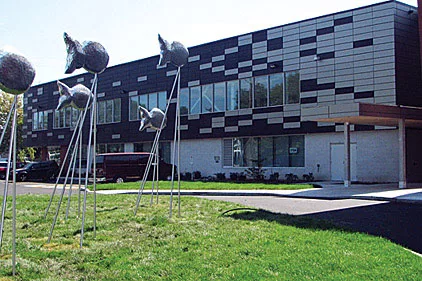
| This aquatic and community center in Côte Saint Luc, Quebec, employed a number of energy-saving technologies. Condensing boilers and VFDs on the geothermal pumps all provide capable backup or occasional service as needed. |
According to developers, the facility’s HVAC strategy surpasses many national energy efficiency code requirements and equates to several Leadership in Energy and Environmental Design credits. The 45,000-sq-ft facility employs a 500-ft-deep geothermal field, an exhaust air heat recovery system for preheating outside air, and dehumidifier compressor heat recovery for free pool water heating. It is also one of Canada’s first natatoriums to use a cutting-edge reduced refrigerant HVAC dehumidifier strategy.
The technology is a residual of design ideas from a LEED-certification goal the city withdrew early in the planning process. While the green technology typically carries a higher upfront price tag, the city will achieve a four-year payback, save millions of dollars in energy costs over the lifespan of the facility, and minimize the local environment’s exposure to refrigerants.
“The city realized there could be unprecedented savings in operational costs by using the original LEED-inspired designs,” said Stéphane Maccabée, P.E., project manager for Kolostat®, a design installation and service mechanical contractor.
Maccabée led a Kolostat design/build team along with Michel St. Pierre, P.T, LEED AP, estimator/designer, and Daniel Robert, P.E., vice president of engineering.
The HVAC technology contributing the most sustainable impact on the project is the energy recovery dehumidifiers from the new Protocol NP-Series by Seresco.
Named for the 1997 Kyoto Protocol environmental treaty, the NP-Series uses up to 80% less refrigerant than comparably-sized conventional mechanical natatorium dehumidifiers. They also deliver an annual operating cost reduction of 5% to 7%. Instead of an all-refrigerant design, the dehumidifiers use heat exchangers and environmentally friendly glycol for heat rejection to the water-source loop.
Using glycol, with a cost of approximately 5% of today’s environmentally friendly refrigerant prices, also eliminates the liabilities of often rising refrigerant and maintenance costs associated with systems holding large refrigerant charges.
Pool water heating is supplied by a coaxial-type heat exchanger using recovered waste heat from the two Seresco dehumidifiers’ refrigeration circuits, which are required for dehumidifying the space to a comfortable 55% relative humidity. If pool water heating is satisfied, the remaining heat is rejected to the geothermal water source loop or into supply air for reheat. On subzero days when pool water heating isn’t 100% satisfied by heat recovery, the 96% efficient backup condensing boilers by Camus Hydronics Unlimited are activated.
Throughout the summer months, heat rejected to the water source loop is stored in the six-well, 500-ft-deep geothermal field for use later in the heating season.
The water source loop, which averages temperatures over 80°F in the summer and provides almost all the heating for domestic hot water and locker room showers, also uses two rooftop evaporative cooling towers by Baltimore Aircoil to reject any excess heat not required within the complex.
The geothermal loop’s operational and redundant 20-hp pumps by Taco use Danfoss VLT drives to operate at only the needed flows. For example, when heat pumps or the dehumidifiers are not requiring cooling or heating, the VFDs ramp down the pumps’ water flow for further energy savings.
The Kolostat design uses an option provided by the dehumidifier manufacturer for exhaust air energy recovery. This recovered energy is then used for pre-treating the code-required outdoor air. Most codes adopt ASHRAE Standard 62 to ensure adequate outdoor air for the facility and IAQ for the patrons. Cold outdoor air is expensive to condition most of the year, therefore the payback on the option is typically less than a year. The energy recovered from the warm energy-rich 85°F pool exhaust air is used to preheat colder incoming outdoor air to as high as 40 degrees warmer than the ambient via a unit-mounted heat exchanger.
All systems are monitored and controlled by a BACnet-based building automation system from Automated Logic that was supplied, installed, and programmed by Kolostat.
Single compressor/dual-stage heat pumps by ClimateMaster also efficiently provide conditioned air, based on occupancy.
TWO POOLS, ONE ROOM, MANY WINDOWS
The main HVAC challenge was designing a two-pool community natatorium where seniors, families, and competitive swimmers could congregate but also experience comfortable individual water and air temperatures in the same room.
The 6,800-sq-ft, 25-meter competition pool, and 3,133-sq-ft recreation pool have their own dedicated 30-ton dehumidifiers that provide set point water temperatures of 80°F and 86°F, respectively. Both the 25,000-cfm and 13,000-cfm dehumidifiers are programmed to supply 85°F air temperatures. While ASHRAE natatorium standards recommend a two-degree air and water temperature differential to minimize pool surface evaporation, the design concept can be problematic when both pools are in the same space.
The ventilation system consists of several royal blue fabric ductwork systems manufactured by NAD Klima. The competition and recreation pools have their own respective dedicated perimeter systems even though they share the same space. Duct sizes vary between 36 and 24 inches in diameter. The competition and family pool areas have 400 and 160 linear ft of perimeter ductwork that is 25 ft and 18 ft high, respectively.
Kolostat worked closely with the architects to ensure synergy between the architecture and mechanical systems. For example, a 150-ft long, 20-ft high wall of windows was challenging because glass is difficult to keep dry and condensation-free in Montreal’s ASHRAE winter design condition of -11°F with extremes reaching -30°F. Kolostat, which has designed many pool facilities, requested exterior window mullions so as not to block air flow critical for keeping the windows condensate-free. Fabric ductwork positioned closely to the windows has strategically placed linear diffusers that bath the glass and deck surfaces with warm dry air.
“We have designed many natatoriums that all have had underfloor air distribution, so we were initially concerned when the construction design team opted for overhead air distribution,” said Robert. However, the client has reported no problems with condensation or fogging on the windows after one full winter season.
Besides energy efficiency, Kolostat also delivered on the city’s request for quiet indoor and outdoor operation because of the facility’s tranquil residential neighborhood setting. Only the evaporative coolers are outdoors on the roof. All heat pumps are indoors and the large 30-ton dehumidifiers were rigged into an indoor mechanical room after the building structure was completed.
As part of the contract, Kolostat will guarantee the performance of the equipment it specified as well as monitor and maintain it over a five-year period. The “pay now” strategy city officials built into the facility ranks it as one of the most energy-efficient natatoriums in Quebec and will reap long-term benefits over the building’s expected 70-year lifecycle, according to Robert.
Looking for a reprint of this article?
From high-res PDFs to custom plaques, order your copy today!