Tomorrow's Environment
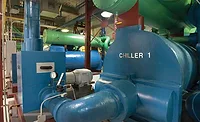
Designing A Central Chiller Plant Equipment Room
It turns out that heat stroke, difficult access to equipment, and concussion are all detriments to good maintenance.

Here are a few interesting things to keep in mind when designing an equipment room. First, these spaces usually take up 7% of the gross floor space when located within the building or on the roof. For a 100,000-sq-ft building, and at a cost of $200 to $400/sq ft, this facility’s infrastructure represents a first cost investment of $1.4 million to $2.8 million to purchase and locate the mechanical and electrical assets within centralized equipment room(s). Based on this simple math, shouldn’t the operation and maintenance department have an efficient work space, as well as a safe work environment? So let’s start designing the chiller plant-equipment room with a few criteria in mind.
Traffic control: A chiller room will have a very good chance of being maintained if the design engineer follows some simple rules for flow of traffic. I have always strived, in spite of some architects, to layout the equipment with a 4-ft wide by 6-ft, 6-in high corri-dor/passageway extending from one end of the room to the other end and back again (e.g., passage along the four-sided perimeter of the room) with short “no outlet” (can’t say “dead end” these days) passages strategically located between major pieces of equipment. There are several reasons for this approach:
- Ease of access to the equipment requiring routine maintenance, checking of gages and thermometers, and routine visual inspection. This design can be a daily benefit to the operator and allow her to be able to do her job with little difficulty.
- Access for delivering materials directly to the equipment without having to take the material off its delivery cart and not making the handling and servicing any more difficult than is has to be.
- Access to remove and replace parts (e.g., compressor motor) because equipment has a useful service life and nothing is forever.
Ventilation: A chiller room needs adequate air ventilation for general IAQ and possibly air conditioning depending on the building location. The designer should do engineering calculations for heat gain within the room. Excessively warm space can have a negative impact on maintenance, as well as on the equipment itself. Some designers will rely on 100% OA in lieu of mechanical cooling, but on a humid 90°F day, putting that heat into the chiller room will only make the room more unbearable versus limited outdoor air and some mechanical cooling. And don’t forget to take into account the room temperature during the heating season, particularly if the refrigeration equipment operates 24/7/365.
Emergency ventilation: Depending on the type of refrigeration equipment that is in the room, emergency ventilation will be re-quired by code, as well as practical safety provisions for the occupants. Leak detection is needed along with exhaust ductwork that extends down to the floor. Also, an emergency floor plan showing means of egress out of the chiller plant should be posted strategically so that anyone who just happens to be in the room when a leak occurs can safely exit. Don’t assume everyone in the room knows their way around the equipment and where the closest door is to get out of the room.
Hazardous floor conditions: When designing a chiller room, consideration must be given to tripping hazards. Therefore, the de-signer should show the “traffic control” passageway on the architectural floor plan of this room and then coordinate floor drain locations and, where needed, drain piping should be laid out to extend along the floor while avoiding tripping hazard(s). Consider painting the passageway a color that makes the traffic flow intent very obvious, and then add yellow and black tape of paint to highlight any tripping hazard.
Hazardous headroom condition: Just like tripping hazards can appear when the equipment room is not designed correctly, “head bangers” are another hazard for the O&M staff. When designing this room, make sure there are drawing sections taken through the room showing the equipment, pipe, duct, light fixtures, and associated hanger rods. When drafting, I would always show a 6-ft person in the drawing section to illustrate needed headroom. A little trick of the trade was to make this person fat so that the curvature of the figure stood out among all those straight line pipes and ducts.
Water hazards: If a chiller room is above the ground floor, quite often there will be openings to below, and you don’t want to have any water leaks flowing from the equipment room floor down to the floor below. Now you may say code doesn’t allow these openings to exist and that there should be fire-retardant packing to seal the floor. Yet somehow not all openings get sealed so I would provide the structural engineer with a floor plan that would show 4-in-wide by 4-in-high water-tight curbing in addition to the needed housekeeping pads and concrete inertia pad requirements.
More to follow next month.
You can reach McKew at hmckew@bss-consultant.com for business development planning advice and D-B/IPD facilitator services. For more online publications, visit www.buildingsmartsoftware.com.
Looking for a reprint of this article?
From high-res PDFs to custom plaques, order your copy today!