Cover Story
Building On A Swedish Tradition
The American Swedish Institute looked homeward to plan for its future, using geothermal technology to achieve high-performance energy solutions in an urban setting.

FIGURE 1: The challenge of implementing a geothermal system in an urban setting is the lack of available land areaâfor the vertical heat exchangers, which require placement a minimum of 20 ft apart. (Photo credit: Paul Crosby Photography.)
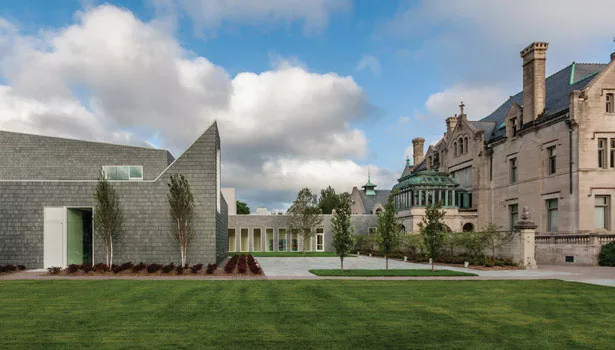
FIGURE 2: The American Swedish Institute design began with a traditional Swedish gard — courtyard or farmyard — that serves as a central outdoor "living room". Some of the geothermal wellfield is positioned under this courtyard, which features birch trees, native grasses, and blue-stone pavers. (Photo credit: Paul Crosby Photography.)

FIGURE 3: This geothermal piping schematic for the American Swedish Instituteâs Nelson Cultural Center addition shows how the well system interfaces with the buildingâs interior heating and cooling systems. (Credit: HGAâArchitects and Engineers.)
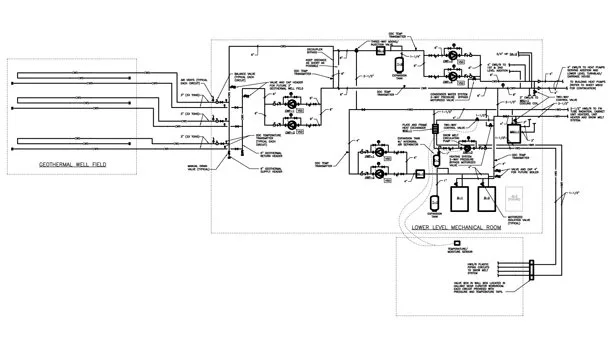
FIGURE 4: The geothermal wellfield design layout on the site of the American Swedish Institute, Nelson Cultural Center addition. (Credit: HGA Architects and Engineers.)

Reflecting a long-established Swedish commitment to environmental stewardship, the Nelson Cultural Center addition at the American Swedish Institute (ASI) in Minneapolis integrates several technically advanced sustainable features, including a high-efficiency geothermal heating and cooling system that reduces energy consumption by nearly 30 percent (based on an ASHRAE 90.1 baseline) while supporting the Institute’s diverse community programming.
Designed by HGA Architects and Engineers to accommodate ASI’s growing programs, the addition blends innovative engineering technology with dramatic architecture. The new addition dramatically flows off of the institute’s original residence, the French Chateauesque Turnblad mansion built in 1908.
The 34,000-sq-ft, two-level addition includes a reception lobby, museum shop, café, gallery space, event space, and landscaped courtyard. A series of modular architectural forms sheathed in dark slate tiles and punctuated with large windows unfolds horizontally on the site. Natural wood, glass, stone, textiles and handcrafted-detailing enhance the interior. A new corridor and vertical circulation tower connect the addition to the mansion.
The site plan translates traditional Scandinavian landscapes to a Midwestern setting. The courtyard between the addition and mansion provides an inviting outdoor gathering space, while disguising a series of closed loop, ground source geothermal wells. Native grasses, birch trees, and blue-stone pavers are aesthetically pleasing, low-maintenance, and appropriate to both Minnesota and Swedish landscapes. A sloping green roof and terrace reduce energy costs and rain run-off.
MEETING SUSTAINABLE GOALS
Early in the conceptual design process, ASI challenged HGA to identify a sustainable mechanical system for the addition and portions of the Turnblad mansion.
To begin the design process, HGA researched a variety of different mechanical systems used in Sweden and discovered that geothermal heating/cooling systems are commonly used in homes and commercial buildings. In fact, Sweden is an international leader in employing sustainable technology, from geothermal systems to chilled-beam technology, as well as in traditional building practices that include green roofs and earth-berm construction.
Geothermal technology was the natural choice for the Nelson Cultural Center. The mechanical system uses the earth’s constant 50ºF to 60ºF temperatures to heat and cool buildings.
HGA’s geothermal technology portfolio has grown steadily in recent years, having completed geothermal systems for projects such as The Adolescent Treatment Center in Winnebago, MN (Geothermal Success in the Midwest, Engineered Systems, December 2010); the Milwaukee Community Sailing Center overlooking Lake Michigan in downtown Milwaukee (also in Engineered Systems, December 1, 2010); and the Bishop Henry Whipple Federal Building in Minneapolis.
Each project presented unique engineering challenges for HGA, especially in terms of location. The Adolescent Treatment Center is located in a rural area, so there was plenty of open land to drill the well holes necessary for geothermal coils. ASI, on the other hand, is located on a tight urban site bordering a residential neighborhood, so drilling expansive well fields was limited and required careful strategizing.
Deciding on a geothermal system was also a first step to meeting the ASI’s requirement for achieving LEED® Gold certification, which the building was awarded in February 2013. To achieve this certification, the ASI addition also integrated a ground-source outdoor air-conditioning system, demand-control ventilation systems, high efficiency domestic water heating, high-efficiency lighting systems, green roofs, fully automatic direct-digital building control systems, abundant interior daylight, and other building-wide sustainable features.
HIGH-EFFICIENCY BENEFITS USING GROUND SOURCE ENERGY
The geothermal system delivers high efficiency by using the earth as a source of heat for the building in winter, and as a reservoir for absorbing rejected heat from the building in summer, thus reducing energy usage and costs over a conventional cooling/heating system.
The ground loop consists of 99 vertical heat exchangers at 250 ft deep, spaced throughout the tight urban site. The system provides the building with enough condenser water heat transfer circulation to support up to approximately 150 tons of building heating/cooling loads. The challenge of implementing a geothermal system on an urban setting is the lack of available land area for the VHE’s, which require placement a minimum of 20 ft apart.
Codes restricting the placement of VHE’s under buildings further restricted and complicated the location of the VHE’s. In the case of ASI, HGA had to stay away from recently installed parking surfaces that shelter underground rainwater storage tanks, limiting VHE placement to grassy areas only.
HGA’s engineering team worked with its in-house design and landscape architects to define usable areas for the VHE’s. Ultimately, the fields were placed throughout the site wherever open ground was available, especially under the newly landscaped courtyard. Placing the majority of the wells under the courtyard satisfied engineering requirements and benefitted the surrounding neighborhood by unifying an entire city block and creating a cohesive urban space that can be shared and enjoyed by members of both the institute and the community.
ZONE TEMPERATURE CONTROL
The closed-loop geothermal ground source piping system is extremely efficient, as it supplies condenser water to the building mechanical heating/cooling heat pump systems. Water from the VHE’s are collected at a manifold in the basement of the building. Pumps circulate the collected water to the building’s heating/cooling equipment. Incremental zone-type water-to-air heat pumps serve as the source for individual zone control of the building’s heating and cooling.
Ground water from the VHE’s supplies these units — heating or cooling as required. Heat from the earth is transferred to the con-denser water in the VHE’s and from there to the heat pump compressorized system, where it is rejected into the air stream in winter. The heat pump reversing valve allows heat from the space to be rejected to the ground loop condenser water, where it is rejected into the earth throughout the cooling season.
The ground source heat pump system operates approximately 30 percent or more efficiently than an AHRAE 90.1 baseline conventional heating/cooling system.
CONDITIONED AIR FOR OCCUPANT COMFORT
The other major energy-consuming mechanical task in any building is the conditioning of outdoor air. The Nelson Cultural Center hosts many high-occupancy events that require outdoor air. The geothermal ground source system was sized to allow use of its condenser water to serve the dedicated outdoor air-handling unit. Outdoor air is conditioned to a predetermined discharge air temperature between 60ºF to 65ºF. The conditioned outdoor air is ducted to the intakes of all of the building zone heat pumps to maintain a fresh supply of outdoor air for occupants. Use of the geothermal system to supplement this unit for heating and cooling considerably reduces the amount of energy consumed and subsequently reduces energy costs.
Carbon dioxide sensors provide an effective, energy-efficient method of controlling the amount of outdoor air in a space during periods of lower occupancy. HGA implemented CO2 sensors throughout occupied zones for each heat pump supplied with outdoor air. A VAV box provided at each location varies the amount of outdoor air that is distributed to the occupied space based on carbon dioxide levels within the room. When the level in a fully occupied room or zone exceeds the set point (typically 1000 ppm), the VAV box opens, allowing the maximum amount of outdoor air to flow into the zone.
The amount of outdoor air supplied to a given zone varies depending upon the number of occupants and the amount of carbon dioxide they release into the space. The benefit for ASI is the reduction in outdoor air requiring heating or cooling, significantly reducing energy usage and costs.
DDC OVERSIGHT
Complementing the high-performance HVAC systems is a fully automatic, state-of-the-art DDC system. This system provides continuous monitoring and control of the building’s systems, including the lighting control systems.
Continuous monitoring and control of the building’s mechanical systems is essential to maintaining highly efficient performance throughout the life of a building. Trending of daily, monthly, and yearly energy performance allows the building facilities staff to identify both large and small changes. Depending upon the type of changes occurring, the user can determine whether a simple adjustment can be made at the control system or if further investigation is required. Daily use of this comprehensive control system will help facilities management staff identify problems long before a system completely fails, as was often the case in the past with this system.
ENERGY REDUCTION COMPONENTS
Other energy-reduction building components utilized include low-flow plumbing fixtures to reduce water demand, and a “condensing” domestic hot water heater. This high-efficiency water heater generates hot water for the building’s plumbing fixtures and kitchen equipment by using heat captured from the gas-fired heat exchanger, resulting in up to 96 percent operating efficiencies, which is a significant improvement over the typical 80 to 82 percent standard water heating equipment efficiencies.
MUSEUM AND COLLECTION STORAGE REQUIREMENTS
In addition to meeting the energy demands of the new addition, HGA upgraded the mechanical systems of the historic Turnblad mansion, which houses the library, archives, and material collections consisting of everything from books and recordings to Swedish glass and paintings.
Proper storage and display of the various objects require special room temperature and humidity conditions to minimize damage due to changes in indoor environmental conditions. To accommodate the special requirements, each space has a dedicated HVAC unit with humidification and separate controls to maintain constant room temperature and humidity levels.
BENEFITS OF GEOTHERMAL
Today the American Swedish Institute serves more than 5,000 member households through diverse programming, exhibits, education, and community outreach. For the ASI, the geothermal system and other sustainable systems enable the institute to fulfill its community mission by creating a facility that will carry it into the next 50 years with sound economic and environmental stewardship.
Geothermal technology is one of the most efficient heating/cooling systems available, resulting in lower annual energy costs and lower maintenance costs. Compared to the typical 40-year life cycle for most heating and cooling systems, ground source piping systems are sustainable for a longer period of time (75+yrs) and require little maintenance and no replacement costs.
Overall, the system is expected to save ASI more than $30,000 in annual energy bills, reduce energy consumption by 30 percent (based on AHRAE 90.1 baseline over conventional heating/cooling systems), and reduce greenhouse gas emissions by approximately 278-metric tons of CO2 per year.
As the national energy dialogue increasingly focuses on renewable resources and new technology, geothermal heating and cooling systems will gain more attention in the building industry for its long-term payback in energy and cost savings that exceed upfront development costs.
Craig Lemma is an associate vice president and mechanical project manager with HGA Architects and Engineers, where he specializes in sustainable infrastructure systems for commercial, public/governmental facilities and cultural buildings. He has worked on the development of several geothermal systems, including the American Swedish Institute addition and the B.H. Whipple Federal Office Building renovation, both in Minneapolis. Craig graduated from North Hennepin Technical College.
Scott Lichty, PE, LEED AP, is a mechanical engineer with HGA Architects and Engineers, where he specializes in HVAC, hydronics and geothermal systems for commercial buildings. He has particular expertise in energy modeling, energy analysis and LEED documentation. His geothermal work includes the American Swedish Institute addition. Scott graduated from the University of Minnesota and the National American University.
Looking for a reprint of this article?
From high-res PDFs to custom plaques, order your copy today!