The Challenges Of Federal Government Procurement
With a collaborative design approach and the choice to forego networking protocols, this nuclear facility’s controls upgrade points toward an atypical alternate for success.
The procurement process used by the U.S. government (or its contractor) can follow one of several different paths. Usually, an equipment specification is written that contains performance criteria and other requirements. A solicitation is then released and potential sellers competitively bid for the work. Eventually, a contract is issued to the lowest bidder. The seller is then held accountable for meeting the requirements contained in the specification.
However, the design details are left to the seller. The buyer monitors the progress of the seller’s design using a cumbersome process of official communiques, which are called submittals. These submittals contain valuable design information that was previously identified in the specification as being important, and it provides the specification writer (usually a designer or engineer) an opportunity to review the seller’s design. The submittals pass through official channels, eventually reaching the engineer. After review, the engineer has the authority to approve, make comments, or halt the process if problems are identified. Unfortunately, during government procurements, the engineer and seller are forbidden from making direct contact with each other. Instead, they must communicate through official channels throughout the life of the project.
Accordingly, the cost associated with clarifying or resolving small and seemingly insignificant details can end up costing many thousands of dollars. Unfortunately, the procurement process can often leave the engineer who composes a specification in a quandary. On one hand, the specification should be clear and very specific about the requirements, leaving no ambiguity that will later need to be clarified. On the other hand, the physical size of the specification should not be allowed to grow into a novel-sized document where important details will be missed or be subject to misinterpretation by the seller.
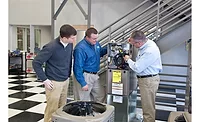
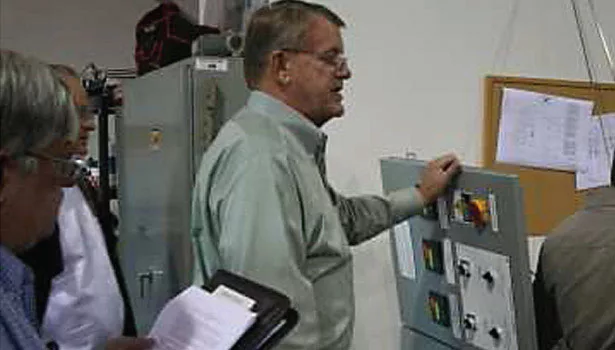
Adding to this difficulty is the final approval process, whereby the buyer must inspect, test, and approve the equipment being procured. This process is called acceptance testing, and the original specification is the document used to determine whether the supplied equipment is acceptable. In fact, it is not uncommon to see the engineer carefully reviewing each line of a specification for compliance during acceptance testing (Figure1).
Nevertheless, the government is bound by the terms and conditions it contains. If the equipment meets the terms defined in the specification, it is usually approved — even if other short-comings are identified. In short, a specification is a legally binding contract. It provides the only basis the seller can use to determine price, and it binds the scope of work as well as the acceptance criteria the buyer can use to ensure quality.
Consequently, any changes that need to be made outside the framework of the original specification are very costly. Thus, the responsibility for ensuring quality rests primarily with the engineer who authored specification. In fact, procurements where delays, cost overruns, and other difficulties have occurred can usually be traced back to a poorly written specification.
A BETTER WAY
One possible solution is to conduct design meetings with potential bidders prior to releasing a solicitation. Obviously, no favoritism or promise of work can be provided by the government. However, the value of collaboration between the government and potential bidders on a proposed design is invaluable. In the end, a contract is usually issued to the lowest bidder deemed to have an acceptable product and quality program, so being able to clarify the design requirements in advance is worthwhile. Consequently, when the solicitation is released, the design details it contains are less likely to be misunderstood. The buyer obtains badly needed equipment that meets their specification requirements, and the seller makes money. There are no surprises. Accordingly, the real winner is the American taxpayer.
This collaborative effort works extremely well with smaller, less costly procurements such as control systems — particularly when commercial off-the-shelf (COTS) equipment will be incorporated into an environment not originally envisioned by the original equipment manufacturer.
CONTROL SYSTEM UPGRADES AT THE Y-12 PLANT
A good example which highlights the effectiveness of this process occurred recently at the DOE’s Y-12 site, located in Oak Ridge, TN. Y-12 has a long history, which began during the Manhattan Project of World War II. At that time, Y-12 was responsible for enriching uranium, and this uranium eventually fueled one of the atomic bombs credited with ending WWII.
Currently, Y-12 is undergoing downsizing and badly needed upgrades. These upgrades will help to ensure the national security needs of the U.S. will continue to be met. One of these upgrades involves replacing antiquated air-handling equipment — most of which contain pneumatic control systems that are no longer functional.
Much of this equipment operates with no setback/setup routines or other modern, energy-saving measures. In fact, some units are so badly deteriorated that manual bypass valves are being used to maintain temperature setpoints, because the pneumatic control systems have failed. Ironically, much of the facility equipment cannot support the DOE’s own mandates for energy savings.
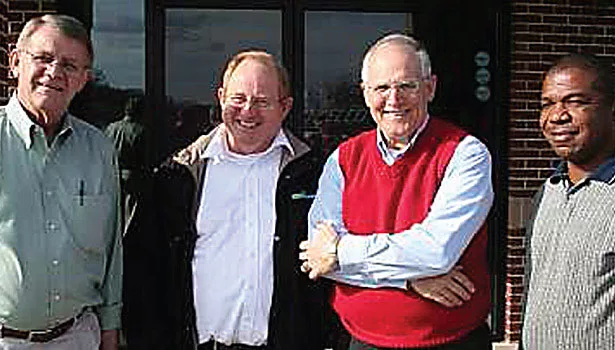
In order to help solve these challenges, a joint design effort was begun between a local vendor and Y-12. The vendor was Brozelco, who specializes in the design and fabrication of specialty mechanical and electrical equipment. A collaborative effort between Brozelco and Y-12 engineers (Figure 2) ensued, which resulted in a very low cost, but highly functional engineered solution. In the end, there were no costly changeorders or other delays associated with the procurement. Thus, the decision to collaborate with an experienced control system provider resulted in a tremendous savings.
The upgrades provided by Brozelco made creative use of low-cost, but highly reliable temperature controllers manufactured by Watlow®. While some may criticize the decision not to implement advanced programmable automation controllers (PAC) or networking protocols, such as BACnet® or LonWorks®, it may be worth noting the design fully met the specification requirements at a fraction of the cost associated with a PAC system. As a result, a decision was made to minimize costs associated with the procurement and forgo PACs altogether.
THE BROZELCO SOLUTION
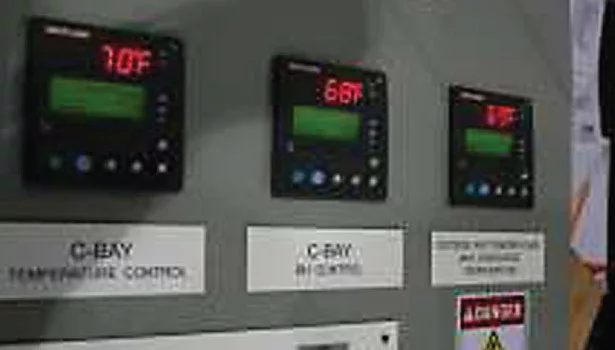
The control system (Figure 3) features cascading Watlow® GPC controllers, which are used to maintain temperature and relative humidity. Setback/setup and equipment schedules, based on time-of-day (TOD), day-of-week (DOW), or even calendar day can be accomplished by means of an Allen Bradley programmable logic controller (PLC). The PLC is configured to provide remote setpoints to the controllers based on setback/setup schedules. These schedules can be changed remotely, using the PLCs internal web server. The system can even be placed in a manual bypass mode, whereby the brine and steam reheat control valves can be manually actuated from the control panel using potentiometers. Remote monitoring of temperature and humidity is accomplished using the plant’s existing utility monitoring system (UMS), which is manufactured by Honeywell®. The Honeywell UMS is tied to the system through a Modbus TCP/IP converter module.
According to Bruce Warnick, the HVAC engineering design manager for Y-12, one of the major cost savings of this approach was the elimination of proprietary controllers, which tend to have a limited shelf life. Moreover, his decision to use COTS products, like Watlow and Allen Bradley, also meant freedom from expensive maintenance contracts. In the DOE world, long-term sustainability is of paramount concern. In these facilities, it is not uncommon to see antiquated equipment still in service. Consequently, the assurance of knowing that replacement parts and open-domain documentation will be available for many years is an important consideration.
In this case, the proven long-term availability and product support provided by Watlow® and Allen Bradley® was highly desirable. However, the integration of these two unrelated COTS products into a viable control system was the direct result of a successful collaboration between buyer and seller. In the end, Y-12’s move toward collaborative design resulted in a standardized platform for older air-handling equipment, saving the American taxpayers thousands of dollars per upgrade. ES
Looking for a reprint of this article?
From high-res PDFs to custom plaques, order your copy today!