Humidification: Options, Amines, and the Impacts of ASHRAE Standards 62.1 And 170
Tight environmental requirements create a need for humidification systems in many facilities in the health care sector and beyond. There are six common humidification systems used in the HVAC industry. Each of these systems has advantages and disadvantages that a designer and owner must consider when selecting the system. In addition, ASHRAE Standard 62.1 and ASHRAE Standard 170 have specific requirements that affect the design of a building’s humidification system.
HEATING BOILER STEAM DIRECTLY INJECTED
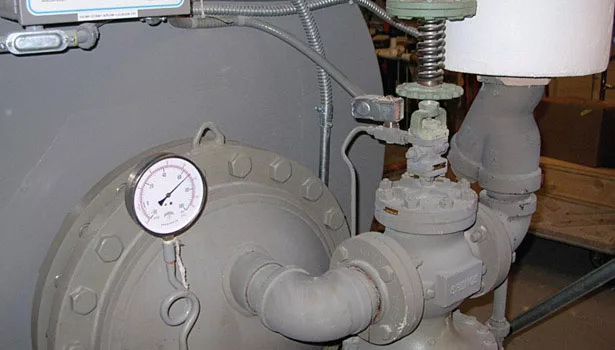
This system uses steam from the heating boiler to inject steam directly into the airstream. These systems are typically used in health care, industrial, and campus facilities where steam is available from a central steam boiler plant. The advantages and disadvantages of this system are described below:
Advantages:
- Low first cost for the humidifier, since the steam boiler cost is absorbed as part of the heating system or is part of the overall campus system.
- Minimal additional maintenance requirements, since the steam boilers are already being maintained as part of the heating system. Maintenance of the steam boilers is centralized to the boiler plant rather than having multiple remote electric/gas humidifiers distributed throughout the facility at each AHU.
Disadvantages:
- Steam heating systems have an overall higher energy usage compared to heating water systems with separate remote humidifiers. The remote humidifier could be any of the other options discussed in this document.
- Chemical treatment should be monitored carefully. Amines are typically introduced into the feedwater, and thus to the ventilation air. A discussion on amines in the steam system is included later in this article.
HEATING BOILER STEAM USED TO POWER CLEAN STEAM GENERATORS
This system uses steam from the heating boiler to generate clean steam at multiple remote clean steam generators, which then inject steam into the airstream. These systems are typically used in health care buildings where steam is available from a central steam boiler plant.
Advantages:
- There is no concern about adding amines or other chemicals into the airstream
Disadvantages:
- High first cost for the clean steam generators.
- High maintenance requirements for the clean steam generators that require cleaning of scale and that are often located throughout the building at each AHU. Softening, RO, or DI can reduce, but not eliminate, this maintenance.
- Steam heating systems have an overall higher energy usage compared to heating water systems with separate remote humidifiers. The remote humidifier could be any of the other options discussed in this document.
CENTRAL CLEAN STEAM BOILER
This system has a dedicated clean steam central boiler system that directly injects clean steam into the airstream. The steam system does not include any chemical treatment, so all piping and steam remains “clean.” The piping is sometimes stainless steel to prevent corrosion (and staining of surgical instruments in hospitals) with standard piping systems. In health care applications, the clean steam boiler will typically also serve sterilizers within the facility.
Advantages:
- There is no concern about adding amines or other chemicals into the airstream.
- In health care applications, the humidification system can be combined with the sterilizer boiler system.
Disadvantages:
- High first cost since an additional boiler is required and any piping throughout the facility may be stainless steel.
- Medium maintenance requirements. While there is an additional boiler to maintain, it is centralized within the boiler plant to make maintenance easier.
LOCAL GAS-FIRED HUMIDIFIERS
This system utilizes natural gas-fired humidifiers located next to the AHU or duct distribution manifolds.
Advantages:
- Moderate first cost compared to other clean steam options.
- Low energy cost compared to other steam options. The steam is typically low pressure, and piping distribution is fairly minimal, reducing piping heat losses.
- There is no concern about adding amines or other chemicals into the airstream.
Disadvantages:
- High maintenance cost since each AHU requires a dedicated humidifier.
- Routing of the exhaust flues from each humidifier can be difficult and expensive, depending on building layout.
- Limited sizing options to meet small humidification loads.
LOCAL ELECTRIC HUMIDIFIERS
This system uses small electric humidifiers located next to each AHU or duct distributor.
Advantages:
- Low first cost compared to other clean steam options.
- There is no concern about adding amines or other chemicals into the airstream.
Disadvantages:
- Highest energy cost.
- High maintenance cost since each AHU requires a dedicated humidifier and canisters require periodic replacement or cleaning.
- Limited sizing options to meet large humidification loads.
ADIABATIC HUMIDIFIERS
This system utilizes highly atomized water to increase the moisture content of the airstream. This is typically accomplished using a compressed air/water mixture or highly pressurized water system.
Advantages:
- Lowest energy cost to operate.
- System provides additional cooling in dry warm climates, therefore increasing the energy efficiency of the HVAC system.
- There is no concern about adding amines or other chemicals into the airstream.
Disadvantages:
- Not permitted by ASHRAE Standard 170 for health care applications.
- A reverse osmosis system is often recommended or required to clean water and prevent clogging of atomizers.
- Longer absorption distances compared to other humidification systems.
- May require additional maintenance due to wetted areas
- There is potential for microbial growth in wet areas.
THE AMINE ISSUE
Boiler piping systems are subject to corrosion due to the presence of carbon dioxide in the condensate pipes coupled with availability of oxygen and high temperature. CO2 is produced when carbonate and bicarbonate alkalinities in boiler feedwater thermally decompose in the boiler. This carbon dioxide is carried with the steam and dissolves in the condensate to form carbonic acid, which accelerates corrosion in condensate piping, receivers, and steam traps. If the carbonic acid is not addressed, corrosion will severely damage the entire condensate system, and corrosion byproducts can be carried back to the boiler causing additional damage.
To minimize condensate system corrosion most central plant boiler systems utilize condensate corrosion inhibiting chemicals called neutralizing amines. Neutralizing amines are volatile alkaline compounds that are added to the boiler feedwater. These amines flash off with the steam and when the steam condenses, the amines neutralize the resulting carbonic acid to minimize corrosion in the condensate system.
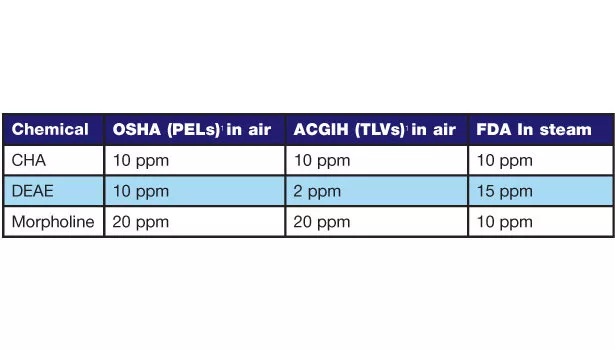
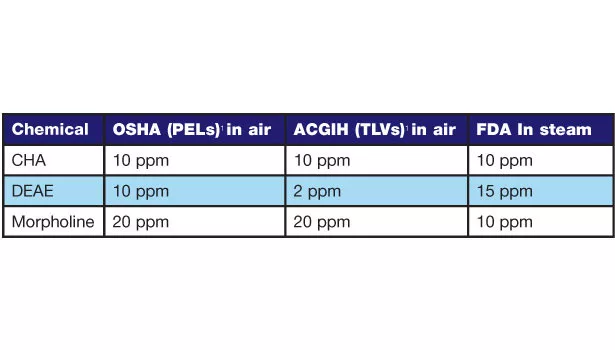
The three most common neutralizing amines are cyclohexylamine (CHA), morpholine, and diethylaminoethanol (DEAE). These chemicals have been associated with upper respiratory, eye, and skin irritations. Due to this concern, the Occupational Safety and Health Administration (OSHA), and the American Conference of Governmental and Industrial Hygienist (ACGIH) have established regulatory and advisory limits for these chemicals. These limits are intended to protect worker safety. These limits are not necessarily appropriate for non-working building occupants since they are based on the 8-hr day as described below.
OSHA has jurisdiction over worker health and safety and publishes permissible exposure limits (PELs) of airborne chemicals that protect workers against the health effects of excessive exposure to hazardous substances. PELs are based on a time weighted average exposure over an 8-hr day and 40-hr week and are enforceable by law.1 PELs are listed in Table 1 and can also be viewed at http://www.osha.gov.
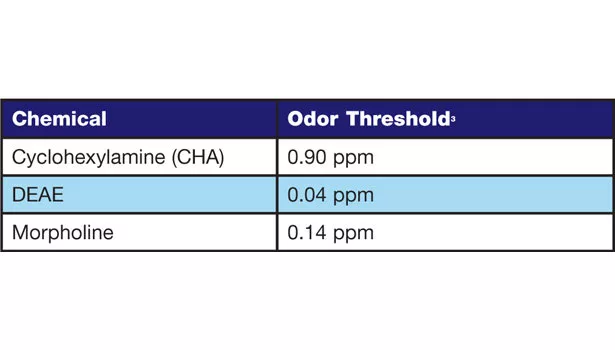
ACGIH publishes threshold limit values (TLVs), which are guidelines to assist industrial hygienists in making decisions regarding safe levels of exposure to various hazards found in the workspace. TLVs represent the opinion of the scientific community that exposure at or below each TLV does not create an unreasonable risk of disease or injury. Since the ACGIH is only an advisory group, its recommendations are not enforceable, but their opinions could be used in legal proceedings. TLV recommendations are lower than PEL requirements for certain amines as shown in Table 2.
The Food and Drug Administration (FDA) has established maximum levels of amines allowed in steam that comes in direct contact with food, other than milk and milk products. Chemical treatment companies often use these values as guidelines for the maximum concentrations they will allow each chemical to reach if the boiler steam is used for direct injection humidification.
ASHRAE Standard 170 states
Steam chemical additives used for humidifiers serving health care facilities shall comply with FDA requirements. (U.S. Dept. of Health and Human Services. Food and Drug Administration in Federal Register. 173.310. April 1999.)
ASHRAE 170, FGI, and therefore most states require humidification of many health care spaces to a minimum of 20% or 30% rh. It is also common for equipment manufacturers of diagnostic health care equipment to require the rooms to be above 40% rh. Illinois requires operating rooms to be above 40% rh.
If chemicals are added to the boiler steam as allowed per ASHRAE Standard 170, Ventilation of Health Care Facilities, the maximum levels in the humidified air can be theoretically calculated. Standard 170 states, “Steam chemical additives used for humidifiers serving health care facilities shall comply with FDA requirements.” The FDA regulates boiler steam that contacts food rather than air, but the normal assumption is that those should be the limiting values for humidification steam. Our calculations of the maximum resultant airborne concentrations are shown below for humidification of 100% OA that enters with 0% rh (which is a worst case and not a likely outdoor rh).
Room air = 73°F db at 40% rh. Humidity ratio = .007 lbs moisture per pound dry air. 29/99 represents the ratio of the molecular weight of air to cyclohexylamine.
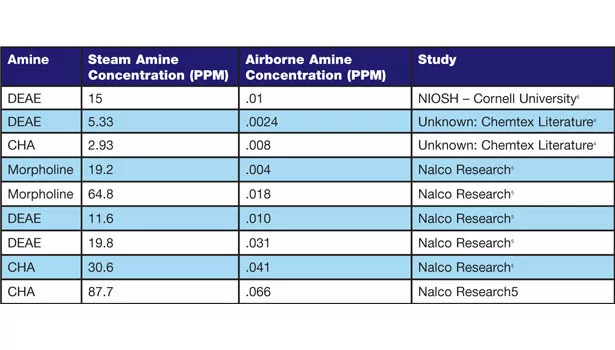
The calculation above agrees reasonably well with field studies in which amine levels were measured in boiler steam used for humidification and in the room air. Some of the data are listed in Table 3 for reference.
Based on this theoretical calculation and the field studies, we believe that if the amine levels in steam remain below the FDA recommendations for steam in contact with food, the chemical concentration levels in the humidified air are well below exposure recommendations by OSHA and ACGIH. All of these values are also below the published odor thresholds in Table 2.
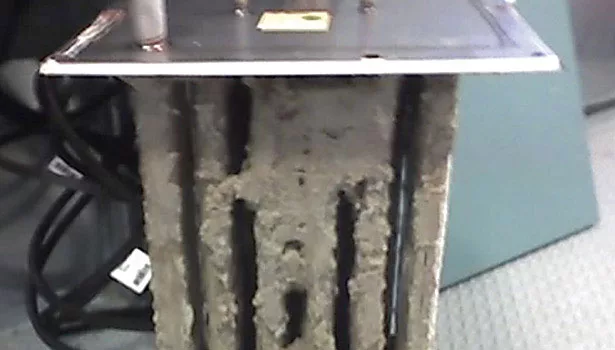
NIOSH completed a study in 1983 at the Johnson Museum of Cornell University. NIOSH investigated complaints of skin and eye irritation by employees. It was determined that the university used a direct-injection steam humidifier and used DEAE for condensate corrosion prevention. After completing air-quality testing NIOSH determined the concentration of DEAE in the air was at most 0.01 ppm. While this level was significantly lower than any recommended maximum concentrations published by OSHA or ACGIH, they did find DEAE on exposed surfaces. NIOSH concluded that DEAE condensed out of the air and building occupants touched the surfaces, thereby causing the skin irritations and complaints. Thus there is some risk of exposure of amine chemicals to building occupants if the building is not cleaned properly.
ASHRAE Standard 62.1-2010 includes the following wording that has been problematic for designers and reviewers:
5.12 Humidifiers and Water-Spray Systems.Steam and direct evaporation humidifiers, air washers, and other water-spray systems shall be designed in accordance with this section.
5.12.1 Water Quality.Water shall originate directly from a potable source or from a source with equal or better water quality.
The issue has been that it is unclear what “originate” and “equal or better water quality” mean.
The authors submitted a continuous maintenance proposal that started the path to revised wording. The committee has issued two versions of wording for public review; the second of which the authors believe is an excellent improvement to the standard and removes the awkward situation where Standard 62.1 may be stricter than Standard 170 for health care. The wording to the latest public review addendum was:
5.12 Humidifiers and Water-Spray Systems.Steam and direct evaporation humidifiers, air washers, direct evaporative coolers, and other water-spray systems shall be designed in accordance with this section.
5.12.1 Water Quality.Water purity shall meet or exceed potable water standards at the point where it enters the ventilation system, space, or the water vapor generator. Water vapor generated shall contain no chemical additives, other than those chemicals already in a potable water system.
Exception:
1) Water-spray systems that utilize chemical additives which meet NSF/ANSI Standard 60, Drinking Water Treatment Chemicals.
2) Boiler water additives that meet the requirements of 21CFR173.310 Secondary Direct Food Additives
Permitted In Food for Human Consumption and include automated dosing devices.
8.4.1.3 Humidifiers.Humidifiers shall be cleaned and maintained to limit fouling and microbial growth. Any automatic chemical dosing equipment shall be calibrated and maintained in accordance with the O&M manual to maintain additive concentrations to comply with Section 5.12.1. These systems shall be inspected at a minimum of once every three months of operation and/or treated as specified in accordance with the O&M manual.
There were a few public review comments, all supportive, that suggested further improvements to the wording. It is likely that a third public review will occur after the ASHRAE Winter Meeting.
One item that concerns the authors is how the concentrations per 21CFR173.310 (the FDA requirements referenced in Standard 170) should be monitored. In discussions with chemical treatment suppliers, we learned that most facilities monitor their condensate pH levels and do not directly measure the amine concentrations in their steam or feedwater. This seems acceptable to the authors, if a baseline is first established showing that the desired pH setpoint is achieved when the steam or feedwater amine concentration is below the FDA limits. We welcome suggestions from the chemical treatment industry for good wording to clarify a minimum requirement for monitoring and control of amines so that facility operators know what is expected of them.
HUMIDIFICATION ENERGY
The following are a few methods that facilities can use to reduce humidification energy consumption (thereby reducing airborne amine concentrations).
- Enthalpy recovery: ASHRAE 90.1-2010 and IECC-2012 require energy recovery on many more HVAC systems than prior editions. Latent recovery systems will reduce annual humidification loads substantially. However, they may not affect humidifier sizing, which is often based on peak loads that occur in partial economizer mode around 30° OAT.
- Insulated humidifier bayonets: An addendum to ASHRAE 90.1-2010 requires “Humidification system dispersion tube hot surfaces in the airstream of ducts or air handling units shall be insulated with a product with an insulating value of at least R-0.5.” This is because, especially with short dispersion humidifier grids, a large surface area of uninsulated metal filled with steam can produce substantial unwanted “reheat” downstream of the economizer (OA) connection. This results in condensing more steam from the bayonets. It also causes the economizer dampers to open more to return to setpoint, which then requires more humidification. The authors have seen up to 5° of heat gain across humidifier bayonets.
- Avoid preheat coils that heat in economizer mode: An addendum to ASHRAE 90.1-2010 requires that “Preheat coils shall have controls that stop their heat output whenever mechanical cooling, including economizer, is occurring.” The authors have seen over 15° of heat gain from integral face and bypass coils in the full bypass mode. Most product warranties do not permit modulating the steam after the dampers close. We hope the manufacturers who have this warrantee limitation will address this issue as 90.1-2013 nears publication.
- Condenser reheat: Condenser reheat systems use heat recovery chillers to make chilled water and reject the heat for reheating and domestic water heating. We typically see paybacks less than four years for new systems. A secondary benefit is that cooling with the cooling coil reduces the amount of outside air introduced by the economizer and therefore the amount of humidification required.
We hope this information helps owners and designers to make informed humidification decisions. ES
References
1. OSHA. http://www.osha.gov/.
2. American Conference of Governmental and Occupational Hygienists. http://www.acgih.org/tlv/.
3. Rabinovich, Shulamit. “Hospital Steam Humidification Systems and the Chemicals they Use.” HPAC Engineering. May, 2004.
4. Chemtex Corporation. “Are Neutralizing Amines Safe in Steam Humidification Systems? Volume 18, Fall 2004. http://www.chemtexcorp.com/docarchive/news/Water%20Treatment%20News%2018-NeutralizingAmines%20in%20SteamHumidification.pdf.
5. Grattan, D., M. Koutek, S. Russum. “Amine Levels in Steam Humidified Room Air.” Engineered Systems. 1989. https://www.armstronginternational.com/files/products/humidifiers/pdf/techreports/aminelevels.pdf.
6. Cornell University. HETA 83-020-1351. http://www.cdc.gov/niosh/hhe/reports/pdfs/1983-0020-1351.pdf.
Looking for a reprint of this article?
From high-res PDFs to custom plaques, order your copy today!