search
Ask ACHR NEWS AI
cart
facebook twitter instagram linkedin youtube
  • Sign In
  • Subscribe
  • Sign Out
  • My Account
  • NEWS
  • TECHNOLOGY
    • Heating & Boilers
    • Cooling & Chillers
    • Pumps & Flow Controls
  • SECTORS
    • Commercial
    • Health Care
    • Data Center
    • Educational Facilities
  • DESIGN | CONSTRUCTION
  • OTHER TOPICS
    • High-Performance Buildings & Automation
    • Ventilation and IAQ
    • Commissioning
    • HVAC Retrofits
  • TODAY’S BOILER
    • Today’s Boiler Archives
    • Today’s Boiler Digital Edition
  • MORE
    • Case Studies
    • Podcasts
    • Videos
    • Directory
    • Webinars
    • ES NEWS Store
    • White Papers
  • SIGN UP
  • Back to The NEWS
Engineered Systems NEWSCommissioning

Is Systems Integration Getting Worse?
By Rebecca T. Ellis, P.E.
heating and cooling
heating and cooling
heating and cooling
heating and cooling
heating and cooling
heating and cooling
August 28, 2012
In very simplistic terms, building systems controls have evolved as follows:

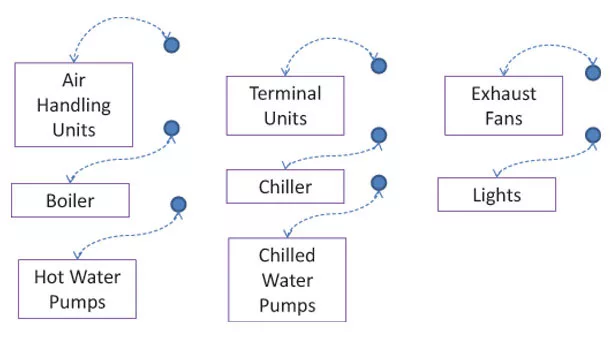
Pre-1980: Simple and inefficient. Every piece of equipment (furnace, fan, pump, boiler, light, etc.) had its own standalone controller. These controllers were usually very simple switches and thermostats and they operated in ignorance of what other equipment was doing (Figure 1).

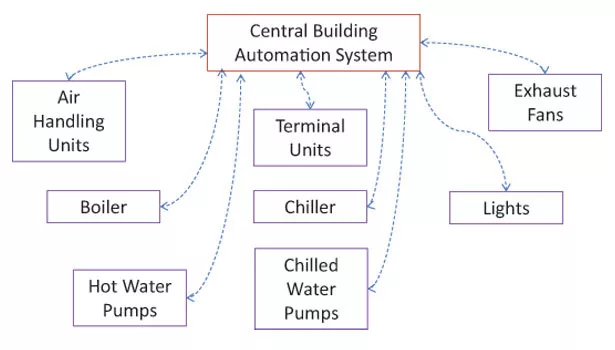
1980s through 2000s: Complex and efficient. Central BAS monitored all data and calculated all control signals. As such, the BAS computer contained all of the input and output signals and algorithms for every piece of equipment/system (Figure 2).

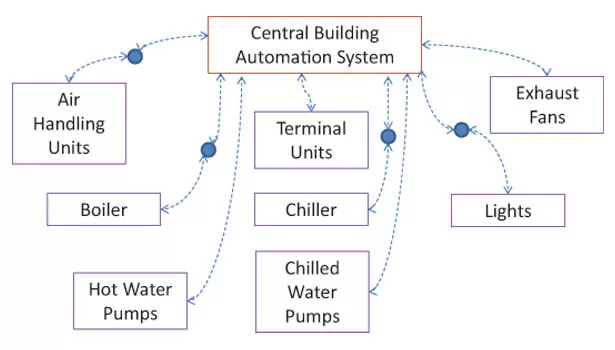
Today: Complex and less efficient. Some equipment is arriving from the factory as self-contained systems with all sensors, control devices, DDC panels, and software in place. Onboard equipment controllers share input and output points and setpoints with the BAS but typically do not allow the BAS to dictate output signals used to control equipment devices such as dampers, VFDs, compressors, burners, etc. Other equipment continues to rely on the BAS for all of its inputs and outputs (Figure 3).


COMMUNICATION BREAKDOWN

Today’s systems are, on the surface, more cost-effective for a new construction project. The standardization and quality control inherent to onboard equipment controllers drives down the total first cost of equipment, installation, and startup. However, we are at a very challenging place in the evolution of building systems control because many of today’s onboard controllers are not designed to communicate with each other and they limit the level of integration the BAS can accomplish.

One example of this is building pressure control. A single  rooftop unit (RTU) on-board controller will modulate its return air fan speed to maintain a setpoint building pressure. That’s fine if there is only one RTU serving a building. When there are multiple RTUs, building pressure cannot easily/successfully be accomplished by individual rooftop units, which do not communicate with each other.

Even if the RTUs are all controlling to the same building pressure sensor and setpoint (which is possible with most RTU-to-BAS interfaces), the individual control loops on the RTU will invariably result in different output signals to their respective return fans. As soon as the return fans start operating at different speeds, they will potentially start fighting each other, and you can end up with one or two return fans at 100% speed and the other fans at minimum speed. This plays havoc with ventilation and temperature control at all of the RTUs.

In “complex and efficient” all-BAS systems, this was not a problem because the BAS could send exactly the same output signal to all return fans for building pressure control. This is just one example of how the shift to a “complex and less-efficient” approach has resulted in a step backwards with respect to systems integration. Building controls will undoubtedly continue to evolve but this is a current reality that project teams must address. ES

Share This Story

Looking for a reprint of this article?
From high-res PDFs to custom plaques, order your copy today!


Rebecca is president of Questions & Solutions Engineering, Inc. She can be reached at rteesmag@qseng.com

Recommended Content

JOIN TODAY
To unlock your recommendations.

Already have an account? Sign In

  • HVAC-enrollment

    The Trades Are Back: HVACR Programs See Nearly 30% Enrollment Spike

    A new wave of future technicians is entering the pipeline.  
    News
    By: Matt Jachman
  • 2025 Top 40 Under 40

    2025 Top 40 Under 40 HVACR Professionals List

    The 11th annual Top 40 Under 40 list highlights those...
    HVAC Residential Market
    By: Hannah Belloli-Oster
  • LG Ductless Mini-Split Systems

    The 9 Types of Heat Pumps

    As the U.S. moves toward electrification, heat pumps are...
    HVAC Residential Market
    By: Joanna R. Turpin

More Videos

Today's Boiler

Spring 2026 Issue

Today's Boiler - Spring 2026 Cover

Read More from Today's Boiler

Case in Point Logo

Smarter Hydronic Design for Data Centers - Free Webinar - January 22, 2026

Related Articles

  • network

    Master Systems Integration: The Future of Efficiency

    See More
  • BuildingAutomation

    Systems Integration

    See More
  • June 10, 2013: Building Systems Integration Benefits Variety of Facilities

    See More

Related Products

See More Products
  • new cover.jpg

    Profit is An Attitude: The Strategies You Need to Optimize Profits

  • Uncomplicating The Heat Pump: Refrigeration & Air Flow Systems DVD

  • ShowISBNImage.jpg

    Electricity, Electronics, and Control Systems for HVAC, 4/e

See More Products

Related Directories

  • Integrity Sales & Marketing

    We are a manufacturer's rep agency representing quality manufacturers of water heaters, energy management and hydronic heat.
×

Sign Up. Stay Informed.

The #1 trusted source for the HVACR industry since 1926

SUBSCRIBE
  • RESOURCES
    • Advertise
    • Contact Us
    • Advisory Board
    • Classifieds
    • Submit a Letter
    • Directories
    • Store
  • ACCOUNT CENTER
    • Create an Account
    • Start a Subscription
    • Manage My Account
    • Sign Up for Newsletters
    • Visit Customer Service
    • Update Preferences
  • SERVICES
    • Marketing Services
    • Reprints
    • Market Research
    • List Rental
    • Survey/Respondent Access
  • STAY CONNECTED
    • LinkedIn
    • Facebook
    • Instagram
    • YouTube
    • X (Twitter)
  • PRIVACY
    • PRIVACY POLICY
    • TERMS & CONDITIONS
    • DO NOT SELL MY PERSONAL INFORMATION
    • PRIVACY REQUEST
    • ACCESSIBILITY

Copyright ©2026. All Rights Reserved BNP Media, Inc. and BNP Media II, LLC.

Design, CMS, Hosting & Web Development :: ePublishing